CEOInterviews.AI
Start App
Try: AI strategy tariffs earnings guidance layoffs interest rates growth

Harlan Robins

Co-founder and Strategic Consultant; formerly Chief Scientific Officer, Adaptive Biotechnologies

Search every verified Harlan Robins interview, podcast appearance, and on-the-record quote — each transcript cross-checked by AI and human review to confirm speaker identity. Harlan Robins, co-founder of Adaptive Biotechnologies and current president and co-founder of Harell Data, discussed his work and views on immune repertoire sequencing and AI-driven biology in two podcast appearances in October 2026. On the Repertoire Room podcast, he described the immune repertoire as a potential "ledger of every disease" a person has experienced, reflecting his view that T cell receptor sequencing could provide comprehensive disease information. He also reflected on his career, including his PhD in string theory and his role in developing TCR sequencing from a lab technique into a clinical test at Adaptive. In a separate appearance on the Progress, Potential, and Possibilities podcast, Robins outlined Harell Data's mission to enable AI models to train on proprietary biological data without exposing it. He explained that the company partners with data owners to host datasets in a secure cloud platform, allowing machine learning experts to train models while preventing data downloads or visualization. He also commented on the broader AI landscape, noting that generative AI advances have relied on publicly available data, and discussed challenges in personalized cancer vaccines, which he said have shown inconsistent patient responses over the past 25 years.

Recent appearances

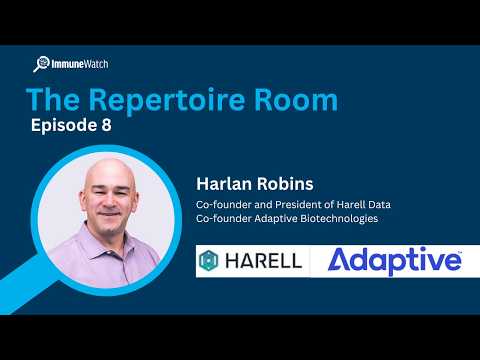
  • Immune repertoire should be a ledger of every disease | Repertoire Room ep. 8 with Harlan Robins

    What happens to all the proprietary data that could train the next generation of AI models in medicine? Harlan Robbins co-founded Adaptive Biotechnologies and helped turn T cell receptor sequencing from a lab experiment into a clinical test. He is now building Harell Data Corp. In this episode of the Repertoire Room, host Sander Wuyts (ImmuneWatch) talks with Harlan about the early days of TCR sequencing. Before high-throughput sequencing, T cell receptors were run out on a gel, which only showed how many sequences had a given length. With the first Solexa machines at Fred Hutch, Harlan's te…

    Watch on YouTube ↗

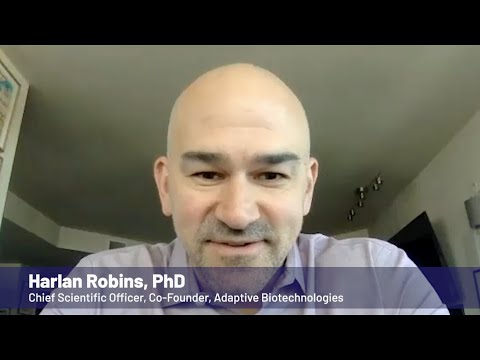
  • Can AI Solve Biology If It Can't Access The Data? | Harlan Robins, Ph.D. - President, Harell Data

    We have some of the most powerful AI systems in history - but what if one of the biggest obstacles to using AI to solve biology isn't the algorithms? What if it's the data? There are enormous amounts of biological data sitting inside pharmaceutical companies, biotech companies and research institutions. The problem is that much of it is proprietary - and the organizations that spent millions generating it have little incentive to simply give it away. What if there's a way for AI to learn from that data without the data having to leave its owner's hands? Dr. Harlan Robins, Ph.D. is a physici…

    Watch on YouTube ↗

  • Ep38: Harlan and Chad Robins (Take 2)

    The co-founders of Adaptive Biotechnologies on immune sequencing.

    Watch on YouTube ↗

  • Founder Stories: Harlan Robins, Human Genomics for Target Identification & Validation

    Harlan Robins is the Chief Scientific Officer and Co-Founder of Adaptive Biotechnologies, a commercial-stage biotech company that aims to translate the genetics of the adaptive immune system into clinical products to diagnose and treat disease. Prior to co-founding Adaptive, Harlan served in various roles at the Fred Hutchinson Cancer Research Center (FHCRC) in the Computational Biology Program, including Assistant Faculty Member, Associate, and Full Member and Head of the program. Harlan holds a BS in Physics from Harvard University and a master’s degree and PhD in Physics from the Universi…

    Watch on YouTube ↗

  • Founder Stories: Harlan Robins, Adpative Biotechnologies & ClonoSEQ

    Harlan Robins is the Chief Scientific Officer and Co-Founder of Adaptive Biotechnologies, a commercial-stage biotech company that aims to translate the genetics of the adaptive immune system into clinical products to diagnose and treat disease. Prior to co-founding Adaptive, Harlan served in various roles at the Fred Hutchinson Cancer Research Center (FHCRC) in the Computational Biology Program, including Assistant Faculty Member, Associate, and Full Member and Head of the program. Harlan holds a BS in Physics from Harvard University and a master’s degree and PhD in Physics from the Universi…

    Watch on YouTube ↗

  • Founder Stories: Harlan Robins, Surprisingly Small Effective Size of the Human TCR Repertoire

    Harlan Robins is the Chief Scientific Officer and Co-Founder of Adaptive Biotechnologies, a commercial-stage biotech company that aims to translate the genetics of the adaptive immune system into clinical products to diagnose and treat disease. Prior to co-founding Adaptive, Harlan served in various roles at the Fred Hutchinson Cancer Research Center (FHCRC) in the Computational Biology Program, including Assistant Faculty Member, Associate, and Full Member and Head of the program. Harlan holds a BS in Physics from Harvard University and a master’s degree and PhD in Physics from the Universi…

    Watch on YouTube ↗

  • Founder Stories: Harlan Robins, Adaptive Biotechnologies intersecting at Immunology & Genomics

    Harlan Robins is the Chief Scientific Officer and Co-Founder of Adaptive Biotechnologies, a commercial-stage biotech company that aims to translate the genetics of the adaptive immune system into clinical products to diagnose and treat disease. Prior to co-founding Adaptive, Harlan served in various roles at the Fred Hutchinson Cancer Research Center (FHCRC) in the Computational Biology Program, including Assistant Faculty Member, Associate, and Full Member and Head of the program. Harlan holds a BS in Physics from Harvard University and a master’s degree and PhD in Physics from the Universi…

    Watch on YouTube ↗

The summary and quote tags on this profile are produced with AI assistance from verified, first-person interview transcripts, then checked by our team to confirm the speaker's identity and the accuracy of every quote. See how we verify →