CEOInterviews.AI
Start App
Try: AI strategy tariffs earnings guidance layoffs interest rates growth

Branko Milanovic

Research Professor, CUNY Graduate Center

Search every verified Branko Milanovic interview, podcast appearance, and on-the-record quote — each transcript cross-checked by AI and human review to confirm speaker identity. Branko Milanovic, Research Professor at the CUNY Graduate Center and former lead economist at the World Bank, appeared on the World Views podcast on September 25, 2026, to discuss his latest book, The Great Global Transformation: The United States, China, and the Remaking of the World Economic Order (2026). During the interview, he discussed the emergence of a new elite, parallels among leaders such as Trump, Putin, and Xi, and the concept of "national market liberalism" in a multipolar world. He argued that the era of neoliberal globalization, dating from the early 1980s, has ended, a view he attributed to figures ranging from Mark Carney to Trump and Ursula von der Leyen. In the conversation, Milanovic also drew an analogy between artificial intelligence and nuclear weapons, suggesting that the development of AI by private companies carries risks similar to outsourcing nuclear weapons production to the private sector. He criticized European elites, particularly those from small countries, for pursuing narrow national interests that can exacerbate global conflicts, citing Israel's influence on U.S. Middle East policy as an example. He also discussed the dynamics of state power relative to oligarchs and the potential for an AI-driven economic bubble.

Recent appearances

  • Branko Milanovic: The Great Global Transformation

    Branko Milanovic joins the show to discuss his latest book, The Great Global Transformation: The United States, China, and the Remaking of the World Economic Order (2026). We discuss the emergence of a new elite; similarities between Trump, Putin, and Xi; and “national market liberalism” in a multipolar world. Branko Milanovic is a Research Professor at the CUNY Graduate Center and former lead economist at the World Bank. He is the author of Global Inequality: A New Approach for the Age of Globalization (2016), Capitalism, Alone: The Future of the System That Rules the World (2019), and Visi…

    Read the verified transcript → Watch on YouTube ↗

  • Branko Milanovic on What Comes After Globalization | Odd Lots

    It's pretty obvious by now that globalization has fallen out of favor. And while many pundits have deemed economic globalism dead, we are still figuring out what to call this new era. Branko Milanović's chosen phrase is "national market liberalism," a term that sums up how a world once defined by the free movement of capital has begun to contract as the most powerful governments have come to favor mercantilism and nationalism. In his new book, The Great Global Transformation: The United States, China, and the Remaking of the World Economic Order, the famed economist explains what comes after g…

    Read the verified transcript → Watch on YouTube ↗

  • The Future of Inequality - Branko Milanović

    In this insightful interview, economist Branko Milanovic discusses the transformative potential of artificial intelligence, its implications for emerging economies, taxation, inequality, and future global trends. Gain expert perspectives on how AI could reshape labor markets, wealth distribution, and economic development over the next century. Chapters 00:00 The Impact of AI on Society 02:46 AI and Emerging Economies 05:35 Job Transformation in the Age of AI 08:10 Governance and Taxation in an AI World 10:34 The Birthplace Lottery and Global Inequality 13:17 Taxation of the Wealthy and…

    Read the verified transcript → Watch on YouTube ↗

  • Branko Milanovic - English version

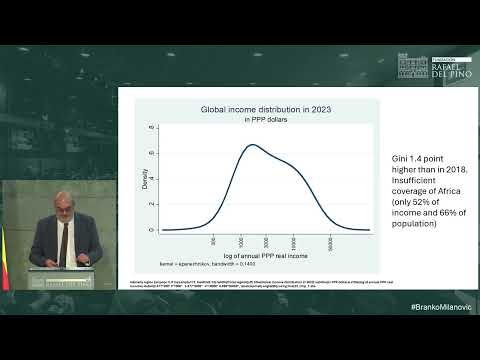
    The Rafael del Pino Foundation organized, on March 4, 2026, the Keynote Lecture “The Great Global Transformation” delivered by Branco Milanovic on the occasion of the presentation of his latest book of the same title. After the lecture, he talked with Miguel Almunia.

    Read the verified transcript → Watch on YouTube ↗

  • Ex-World Bank Insider on the Declining West & New World Order | Aaron Bastani Meets Branko Milanovic

    Sign up for the launch of our new Downstream Newsletter here: https://novaramedia.com/newsletters/t... At Novara, we focus on the trends that are remaking the world and affecting our lives: technological development and automation, multipolarity, the demise of an American-led world order and the rise of China. On Downstream this week is a man whose work draws together all of these themes: former World Bank macroeconomist and leading expert on global inequality, Professor Branko Milanovic. In conversation with Aaron Bastani, Branko answers all of Aaron’s burning questions about modern economi…

    Read the verified transcript → Watch on YouTube ↗

  • Why Economists Should Care About Inequality - ft. Branko Milanovic | Capitalisn’t

    Is income inequality the greatest threat to democracy and capitalism? Economist Branko Milanovic joins Bethany and Luigi live at the Aspen Ideas Festival to explore why economists need to revisit inequality’s prominence in their work. Milanovic challenges the assumption that capitalism and democracy are inseparable, discusses whether China proves capitalism can thrive without liberal democracy, and explores what capitalist societies can do about the inequality they've produced. Timestamps 0:00 Why inequality matters 1:11 Did economists ignore inequality? 2:47 Why rich people hate the word…

    Read the verified transcript → Watch on YouTube ↗

  • Contemporary China: Demystifying Economic and Social Changes

    This event was recorded live on September 17, 2025. From the perspective of the West, China is easily misunderstood. Is it capitalist or communist, an adversary or a vital economic partner, a modernized nation or a retrograde regime? A panel of experts demystifies the vast economic and societal changes that have transformed China in recent decades. They discuss China’s remarkable strides toward eradicating poverty and the simultaneous growing inequality that has produced a new billionaire class; the decline in the birthrate despite the end of the One Child Rule; and how increased access to te…

    Read the verified transcript → Watch on YouTube ↗

  • Branko Milanovic: The End of Globalization, Why Europe Is Doomed

    Renowned economist Branko Milanović joins Prague Finance Institute to discuss the end of neoliberal globalization, the rise of China as both a geopolitical and economic rival, and the global reshuffling of income. He explores how China’s growing middle class is overtaking parts of the Western population and what that means for domestic stability in rich democracies. From shifting forms of capitalism to the "citizenship premium," Milanović offers deep insights into the transformation of the global economic order. The interview was conducted by Jiří Zatloukal, Financial Journalist.

    Read the verified transcript → Watch on YouTube ↗

  • Branko Milanovic: The World Under Capitalism

    Serbian-American economist Branko Milanovic discusses global inequality and our shared future with host Sanjay Ruparelia on April 24, 2025.

    Read the verified transcript → Watch on YouTube ↗

  • The three eras of global inequality with Branko Milanovic

    Science & Cocktails is proud to present an episode with Branko Milanovic, world-renowned economist, Professor at the City University of New York, and author of many books including Global inequality: a new approach for the age of globalisation, who will tell you about why global inequality seems to be decreasing but increasing within countries. What is global inequality between citizens of the world? Why global inequality is falling and inequalities within countries are increasing? How is global inequality linked with migration? Why is the rise of China producing conflict? Branko Milanovic wil…

    Read the verified transcript → Watch on YouTube ↗

  • Will Global Inequality Ever End? Feat. Branko Milanovic, Economist and Author (Ep. 24)

    The podcast conversation of The Great Tech Game with Aniurdh Suri features Branco Milanovic, an expert on income inequality, discussing his work and global inequality trends. Milanovic's book, "Capitalism Alone," argues that capitalism is the only dominant economic system, with variations like liberal capitalism (US) and political capitalism (China). He also explores how socialist revolutions inadvertently paved the way for capitalism in some countries. His other book, "Visions of Inequality," looks at how influential economists have viewed inequality. Milanovic discusses how to measure inequ…

    Read the verified transcript → Watch on YouTube ↗

  • Branko Milanovic on Global Inequality: Past Lessons and Future Prospects

    The statements made and opinions expressed are solely the responsibility of the author(s) and do not necessarily reflect the opinions of the Security in Context network, its partner organizations, or its funders. In this video, Security in Context's Anita Fuentes interviews Branko Milanovic on global inequality and how the subject's past can inform the future. Branko Milanovic is an economist best known for working on income distribution and inequality. He is a research professor at the City University of New York's Graduate Center. Milanovic obtained his Ph.D. in economics (1987) from the U…

    Watch on YouTube ↗

Notable quotes

“What do I mean by national market? Let me explain that relatively easily and quickly. We all do agree from Mark Carney to Trump or to Ursula Vanlen or whoever that the period of neoliberal globalization that we can date to the early 1980s certainly the peak was around 2000 that period has come to an end and that's I think quite obvious and people have written it's not only Trump's tariffs his use of coercion in inter”

“I think that the dynamics there and that's what I criticize European elites and particularly from small countries. I think very often it has happened that small countries of course look at their own interests and they to some extent use larger countries or other countries to internalize or actually to not maybe always consciously take their interest and then go to wars and I actually mention I mean I think it's clear”

“When it comes to global income inequality... the ironic stuff about that is when if you want to reduce global income inequality between individuals, you really have to worry about growth, because the best way to reduce... in particular the only way on the global level is high growth rates of poor countries. And that's why Africa in that point of view... I say to them, the key point now is India's growth and especiall”

“Between 1990 and actually until probably until several years ago, China was a sort of a nascent, but a sort of automatic reducer of global inequality because it's a big country. It was still actively poor, and they grow faster and global inequality goes down. And then I say, but that's no longer the case. Today, China's high growth is slightly inequality increasing at the world level because China then becomes furthe”

“I would be very much against taxing specifically things that have to do with artificial intelligence in the sense that if you make a lots of money out of artificial intelligence, you should be taxed differently than other people. I don't think it makes sense. I think it is actually done directly opposed to technological progress. And I don't think that we should be opposed to technological progress. But, if people be”

“We cannot say anymore, as we used to say, China is an engine of reduction of global inequality. It is no longer because it has become sufficiently rich that its own growth creates more distance between China and the rest of the world than gain because of China catching up with rich countries like Europe and the United States. So I think it's an interesting point there because the essential action when it comes to red”

The summary and quote tags on this profile are produced with AI assistance from verified, first-person interview transcripts, then checked by our team to confirm the speaker's identity and the accuracy of every quote. See how we verify →