CEOInterviews.AI
Start App
Try: AI strategy tariffs earnings guidance layoffs interest rates growth

Reiner Pope

Co-founder & CEO, Matx

Search every verified Reiner Pope interview, podcast appearance, and on-the-record quote — each transcript cross-checked by AI and human review to confirm speaker identity. Reiner Pope, co-founder and CEO of MatX, appeared in three podcast interviews in 2026, where he discussed the company's work on designing chips for large language models. In an April 9 appearance, he described MatX as building "the best chips for LLMs that is allowable by physics," and noted that he and co-founder Mike Gunter left Google one week before ChatGPT was released. He stated that MatX's target customers are frontier labs, citing their large spending and willingness to adopt a new software stack. In an April 29 blackboard lecture, Pope walked through how frontier LLMs are trained and served, covering topics such as memory capacity, pipelining, and techniques like RevNets for reducing memory usage during training. In a May 22 lecture, he explained chip design from basic logic gates up to the architecture of GPUs, TPUs, and FPGAs, and discussed MatX's "splittable systolic array" concept, which he described as large systolic arrays that can also function as small ones. Pope also made several statements about the AI industry during these appearances. He argued that the lock-in to Nvidia's platform is weak, noting that frontier labs including OpenAI, Anthropic, and Meta are multiplatform and use TPUs, Cerebras, AMD, and Broadcom-developed chips. He discussed the relationship between inference tokens, pre-training tokens, and RL tokens, suggesting that for a model like GPT to be trained optimally, the total tokens streamed by users should equal the total used in pre-training. He also commented on early investing, saying it is primarily about people rather than technology, while noting that MatX's business plan of selling a physical product is straightforward in terms of margins.

Recent appearances

  • Chip design from the bottom up – Reiner Pope

    New blackboard lecture with Reiner Pope: how do chips actually work - starting with basic logic gates, and working up to why GPUs, TPUs, FPGAs, and the human brain each look the way they do. Reiner is CEO of MatX, a new chip startup (full disclosure - I’m an angel investor). He was previously at Google, where he worked on software efficiency, compilers, and TPU architecture. 𝐄𝐏𝐈𝐒𝐎𝐃𝐄 𝐋𝐈𝐍𝐊𝐒 Transcript: https://www.dwarkesh.com/p/reiner-pope-2 𝐒𝐏𝐎𝐍𝐒𝐎𝐑𝐒 Crusoe was one of only five GPU clouds that made the gold tier in SemiAnalysis' most recent ClusterMAX report. Gold-tier providers like Crusoe…

    Watch on YouTube ↗

  • How GPT, Claude, and Gemini are actually trained and served – Reiner Pope

    Did a very different format with Reiner Pope – a blackboard lecture where he walks through how frontier LLMs are trained and served. It's shocking how much you can deduce about what the labs are doing from a handful of equations, public API prices, and some chalk. It’s a bit technical, but I encourage you to hang in there - it’s really worth it. There are less than a handful of people who understand the full stack of AI, from chip design to model architecture, as well as Reiner. It was a real delight to learn from him. Reiner is CEO of MatX, a new chip startup (full disclosure - I’m an ange…

    Watch on YouTube ↗

  • Hardware-software codesign, with Clive Chan, Dylan Patel and Reiner Pope

    0:00 Intro 1:22 What is codesign? 2:49 Codesign example: Swish vs ReLU 4:22 Are DeepSeek papers codesign? 6:45 Predicting where ML research will go 8:06 Should researchers hate your chips? 9:34 Can you codesign too much? 13:23 Picking the right grain size for specialization 16:22 How much hardware flexibility for The Age of Research? 20:05 Did reasoning and RL disrupt hardware roadmaps? 23:09 Cerebras/Groq: unexpected wins on reasoning and RL 25:34 Disaggregating MLP and attention 29:06 The right metrics for quantization and codesign papers

    Watch on YouTube ↗

  • Where silicon designed for LLMs is headed, with Reiner Pope and Yash Mulki

    0:00 Intro 8:17 Tightly coupling SRAM and HBM on one chip 14:03 More MoE FLOPS, smaller KV cache load 16:08 Numerics: from 32-bit to 4-bit 19:02 Targeting both training and inference 22:14 Chip timelines 27:15 Logic and memory scarcity 29:42 Compute costs 32:07 Latency: from 20ms to 1ms as the new table stakes 40:50 Programming the chip 43:00 Starting MatX 47:11 Codesign without seeing the models 51:57 Interconnect design 55:44 Performance modeling philosophy 1:07:02 Prefill vs. decode 1:13:47 What's next

    Watch on YouTube ↗

  • Reiner Pope (MatX): Designing AI Chips From First Principles for LLMs

    Reiner Pope is the co-founder and CEO of MatX, the startup building chips designed from first principles for LLMs. Before MatX, Reiner was on the Google Brain team training LLMs, and his co-founder Mike Gunter was on the TPU team. They left Google one week before ChatGPT was released. A counterintuitive throughput insight from the conversation: “Low latency means small batch sizes. That is just Little’s law. Memory occupancy in HBM is proportional to batch size. So you can actually fit longer contexts than you could if the latency were larger. Low latency is not just a usability win, it impr…

    Watch on YouTube ↗

  • Reiner Pope of MatX on accelerating AI with transformer-optimized chips

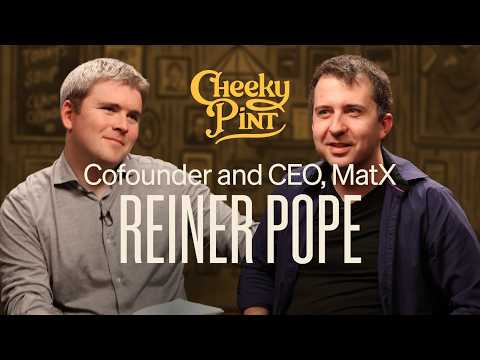
    🍻 Don't miss the next round of Cheeky Pint! Subscribe to our new channel for all future episodes and clips:    / @cheekypint   Reiner Pope is the co-founder and CEO of MatX, designing specialized chips for Large Language Models. A former Google TPU architect, he joins John to discuss why the current generation of AI hardware is hitting a wall. They cover the "uncomfortable trade-off" between latency and throughput for current chips, why MatX is betting on combining HBM and SRAM to solve it, and the massive logistical challenge of manufacturing chips at scale with TSMC. Reiner also shares his…

    Watch on YouTube ↗

  • Google Alum Raises $500M to Compete With Nvidia

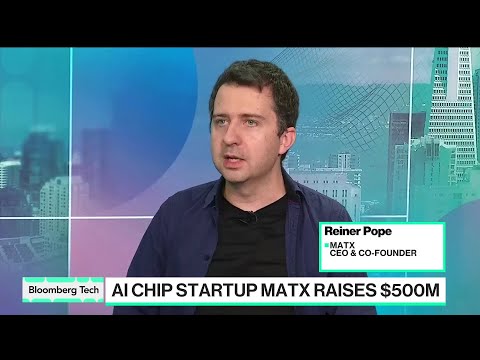
    AI chip startup MatX has raised more than $500 million in a new funding round to produce hardware that competes with Nvidia. CEO Reiner Pope discusses what the funding will be used for and how its AI chips are different from rivals with Caroline Hyde and Ed Ludlow on “Bloomberg Tech.” -------- Like this video? Subscribe to Bloomberg Technology on YouTube:    / @bloombergtech     Watch the latest full episodes of "Bloomberg Technology" with Caroline Hyde and Ed Ludlow here:    • 'Bloomberg Tech' With Ed Ludlow Full Episodes     Get the latest in tech from Silicon Valley and around the w…

    Watch on YouTube ↗

The summary and quote tags on this profile are produced with AI assistance from verified, first-person interview transcripts, then checked by our team to confirm the speaker's identity and the accuracy of every quote. See how we verify →