
Hittites and Italians with Ada Palmer
Wherein Ben and Mike Feinberg welcome Ada Palmer to tell us about a newly uncovered Hittite archive and the death spirals of medieval Italian merchant republics. https://www.dogshirtdaily.com/p/hitti...
Associate Professor of History, University Of Chicago
Search every verified Ada Palmer interview, podcast appearance, and on-the-record quote — each transcript cross-checked by AI and human review to confirm speaker identity. Ada Palmer, Associate Professor of History at the University of Chicago, has recently appeared on several podcasts and given a talk discussing historical parallels between the Renaissance and contemporary issues. In October 2026, she joined the podcast "Beforecast" with Adam Davidson for multiple episodes focused on Machiavelli, where she discussed his introduction of consequentialist ethics and argued that *The Prince* was written for Machiavelli's own government and close associates rather than for public circulation. She also appeared on the "Dogs Shirt Daily" podcast to discuss a newly uncovered Hittite archive and the decline of medieval Italian merchant republics, drawing connections between historical political theology and current American political discourse. In a talk titled "The Ongoing Information Revolution, or Don't Panic," Palmer argued that contemporary anxiety over generative AI echoes the crisis sparked by the printing press in the 1500s, noting that the world "ended" in 1551 according to some contemporaries. She stated that societies lack good models between fully replacing or rejecting new technologies, and cited historical examples to suggest that policy decisions, not technological trends alone, determine outcomes. Palmer also discussed her book *Inventing the Renaissance: The Myth of a Golden Age* on the "Foreign Exchanges" podcast, where she described the difficulty of overcoming entrenched historical narratives about golden ages and dark ages, and emphasized that large systemic changes are multi-generational.

Wherein Ben and Mike Feinberg welcome Ada Palmer to tell us about a newly uncovered Hittite archive and the death spirals of medieval Italian merchant republics. https://www.dogshirtdaily.com/p/hitti...

Historian Ada Palmer and Journalist & Podcaster Adam Davidson discuss the ethics of Machiavelli, how people perceived virtue in the Renaissance, and which of Machiavelli's thoughts still resonate today. Thanks for watching! We have so many topics to discuss on Machiavelli and the Renaissance, all ideas are welcome :) Links: PATREON: / adapalmer Podcast RSS: https://feeds.libsyn.com/622815/rss

Hello Foreign Exchanges fans and welcome to another entry in our podcast series! Today I’m very pleased to welcome to the show Dr. Ada Palmer, Associate Professor of Early Modern European History and the College at the University of Chicago. We’ll be discussing her latest book, Inventing the Renaissance: The Myth of a Golden Age. Join us for a wide-ranging conversation on the Renaissance and some of its more interesting character, but also about the formation of historical narrative and the challenge in overcoming it when new evidence complicates the picture, how our perceptions of time affect…

"The world ended in 1551." Historian Dr. Ada Palmer explains why today's AI panic echoes the printing-press crisis of the 1500s, and what history suggests about getting through it. In this talk, "The Ongoing Information Revolution, or Don't Panic," Palmer (University of Chicago) argues that we lack good models between "AI replaces everything" and "reject it all." She draws on the printing press, manuscripts, e-books, radioactivity, the failed Biblioteca Universalis of 1550–51, early newspapers, and the first magazine to explore how societies adapted to information overload, fake news, and lab…
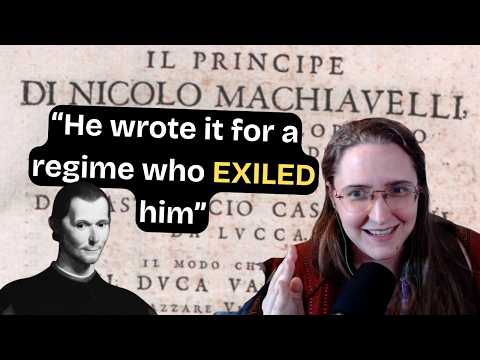
Historian Ada Palmer and Journalist & Podcaster Adam Davidson discuss Machiavelli, the mythical Renaissance figure whose true story is much different than public opinion would have you believe. In this episode the two discuss a letter that Machiavelli wrote in exile about his "little book on Princes", and why it's so important to us today. Thanks for watching! We have so many topics to discuss on Machiavelli and the Renaissance, all ideas are welcome :) Links: PATREON: / adapalmer Podcast RSS: https://feeds.libsyn.com/622815/rss

Censorship is often associated with authoritarian governments. But throughout history, efforts to control ideas have taken many different forms — and they haven't always come from the state. In this episode, Nico sits down with University of Chicago professor Ada Palmer to explore the history of censorship from the Renaissance to the present day. They discuss what motivates censorship, why it evolves alongside new communication technologies, how effective it has been throughout history, and what historical patterns can teach us about today’s free speech debates. Ada Palmer is a professor of…

Had Ada Palmer back on – this time to talk about Machiavelli, perhaps the most misunderstood thinker of all time. Machiavelli cut his teeth as a high-level diplomat for Florence, a position from which he got to closely observe the most important rulers in Europe at the time, including the ones who were on the path to destroying his dearly beloved Florence. In 1513 the Medici retook control of Florence and, wrongly suspecting Machiavelli of participating in a coup attempt, fired, tortured, and exiled him. Machiavelli could have fled his exile and worked for any number of different principalit…

Ada Palmer (Terra Ignota; Inventing the Renaissance) and Jo Walton (Tooth and Claw; Among Others) are two of my favorite writers of contemporary fantasy and science fiction. These two long-time friends have just co-authored an essay collection: TRACE ELEMENTS: CONVERSATIONS ON THE PROJECT OF SCIENCE FICTION AND FANTASY. I found it a fantastic and illuminating read; The chapter detailing the history of scifi publishing is especially informative and a must-read for anybody who cares about the genre!! Anyway, these two excellent authors sat down with me for a lovely conversation about their book…

Full episode: • Why Leonardo was a saboteur, Gutenberg wen... Me on x: https://x.com/dwarkesh_sp Renaissance historian Ada Palmer explains why Italy – the richest region in Europe – never unified, how the Pope had the money and armies to conquer Italy but couldn't consolidate, and why Machiavelli believed regime change always costs more lives than tyranny.
Full episode: • Why Leonardo was a saboteur, Gutenberg wen... Me on x: https://x.com/dwarkesh_sp Renaissance historian Ada Palmer explains why Italy – the richest region in Europe – never unified, how the Pope had the money and armies to conquer Italy but couldn't consolidate, and why Machiavelli believed regime change always costs more lives than tyranny.

Renaissance history is so much wilder and weirder than you would have expected. Very fun chatting with Ada Palmer (historian, novelist, and composer based at the University of Chicago). Some especially fascinating things I learned from the conversation and her excellent book, Inventing the Renaissance: https://a.co/d/03EjyByR 𝐄𝐏𝐈𝐒𝐎𝐃𝐄 𝐋𝐈𝐍𝐊𝐒 Transcript: https://www.dwarkesh.com/p/ada-palmer Apple Podcasts: https://podcasts.apple.com/us/podcast... Spotify: https://open.spotify.com/episode/00AF... 𝐒𝐏𝐎𝐍𝐒𝐎𝐑𝐒 Jane Street is still waiting on someone to solve their backdoor puzzle… They’re accepting…

Ada Palmer, Ph.D., Associate Professor of History at the University of Chicago joins host Thomas J. Roach, Ph.D. to discuss the long lasting impact of science fiction and how the genre has changed our understanding of the unknown and expanded human empathy.
“The two biggest differences, one is scale. This is why people reach to Rome as opposed to to Chinese tiny city republics because we're looking at city republics with a population of 100,000 or 50,000. Where obviously social dynamics operate differently, but where the scale of wealth is staggering. So that's very different from the modern US. And the other thing that's very different from the modern US and also from t”
“When we talk callously about deliberately causing a brief dark age so that it'll make a golden age, imagining somehow that this is happening on the level of electoral politics within years or even within a one lifetime is an absurdity. Big large systemic changes are multi-generational. And our thinking needs to be multi-generational for it to understand what history is. So, I quote that letter that Machiavelli got in”
“Policy and empathy are everything. Will post-pandemic post-GenAI labor be empowered or disempowered? Will wealth gaps grow or diminish? It would be easy and kind of relaxing if the answer was that the trends are always the same. But historical reality demonstrates that policy determines all. After the Black Death, workers gained power in some places, and in others policy stripped workers of power and rights, even of ”
“The ends justify the means when the end is the survival of the people. And so in the same way that our law code says you can do things in self-defense that you can't do when it's not in self-defense, right? If someone breaks into my home and I have a gun, you suddenly have rights that you do not have at other times. And so in Machiavelli's view, the end is the survival of this people so that they are not destroyed by”
“We often talk about censorship as if the natural state of humankind is absolute free speech, and by nature we are living in a state of free speech; unless some aberrations, some laws, some nastiness, appears and creates an apparatus of censorship. And if we remove that apparatus of censorship, then we will return to our natural, pure liberty. That way of thinking about it, which is an 18th century way of thinking abo”
“To be a scientist is to publish your results and share them with a community of other scientists so that they can test them, so that the whole human civilization progresses a little bit. When my friends who are chemists or my friends who are particle physicists discover something, the next goal is to share that discovery with everyone so everyone's knowledge advances. What does Leonardo do? He writes everything he di”
Sign in to search the full transcript archive, filter by topic, and access every quote from Ada Palmer.
The summary and quote tags on this profile are produced with AI assistance from verified, first-person interview transcripts, then checked by our team to confirm the speaker's identity and the accuracy of every quote. See how we verify →
Pro unlocks every transcript in full, plus unlimited search across every executive and company we cover.
50% off appliedPulling data at scale? The Data API gives you 30,000 transcripts a month over REST, MCP and JSON.
Compare all plans