CEOInterviews.AI
Start App
Try: AI strategy tariffs earnings guidance layoffs interest rates growth

Eric Ries

Founder, Long-Term Stock Exchange; Co-founder, Answer.AI; Author, The Lean Startup, Long-term Stock Exchange

Search every verified Eric Ries interview, podcast appearance, and on-the-record quote — each transcript cross-checked by AI and human review to confirm speaker identity. Eric Ries, founder of the Long-Term Stock Exchange and author of *The Lean Startup*, spoke with Saikat Chaudhuri, faculty director of the Stanford Technology Ventures Program, at an Entrepreneurial Thought Leaders seminar on October 1, 2026. During the conversation, Ries discussed the humanistic core of the Lean Startup methodology, arguing that learning is the rate-limiting step in entrepreneurial uncertainty and that it "can never be outsourced." He also referenced Sol Price, the founder of FedMart, to illustrate how a company's ethos of customer fiduciary duty alone is insufficient without structural safeguards against financial pressures, citing Costco as an example of endurance. Ries advised aspiring entrepreneurs to build domain knowledge through repeated trial and error rather than relying solely on prior career experience, which he said can make individuals overly conservative.

Recent appearances

  • Eric Ries (The Lean Startup) - Be the Human Spark [Entire Talk]

    Eric Ries is an entrepreneur, author, and creator of the Lean Startup methodology. He is the founder of the Long-Term Stock Exchange and the author of The Lean Startup, The Startup Way, and Incorruptible. In this conversation with Saikat Chaudhuri, faculty director of the Stanford Technology Ventures Program (STVP) and a professor of Management Science and Engineering, Ries urges aspiring entrepreneurs not to outsource their learning and creativity, while advising them how to benefit customers, avoid corruption, and create mission-driven companies. Entrepreneurial Thought Leaders is produced…

    Read the verified transcript → Watch on YouTube ↗

  • 15 Years After The Lean Startup, Eric Ries Explains Why Great Companies Go Bad

    Brought to you by: Granola is the AI notepad for professionals in back-to-back meetings. New users get 100% off their first month → https://granola.ai?via=KUzb8Nm Eric Ries is the author of The Lean Startup and the creator of the Lean Startup methodology. He's spent two decades working with founders, and he's the founder of Answer.AI and the Long-Term Stock Exchange (LTSE). Fifteen years after The Lean Startup, he's onto a different problem. Not how to find something worth building, but how to keep it. In this conversation, Eric explains why good companies get destroyed in the name of profi…

    Read the verified transcript → Watch on YouTube ↗

  • The Lean Startup and the Long-Term Stock Exchange (with Eric Ries)

    Season 5, Episode 10: The Lean Startup and the Long-Term Stock Exchange (with Eric Ries)  Acquired closes out Season 5 and 2019 with a radical look into both the past and future decades of startup company building, investing and - yes, exiting - in conversation with legendary Lean Startup author Eric Ries. Nine years on from pioneering the now-canonical concepts of product-market fit, minimum viable products, and pivots during the aftermath of the financial crisis, Eric’s new venture at the Long-Term Stock Exchange represents an equally ambitious attempt to rewrite the orthodoxy of how compa…

    Read the verified transcript → Watch on YouTube ↗

  • Why Values on a Wall Aren't Enough: From Lean Startup to Incorruptible with Eric Ries

    Eric Ries, creator of the Lean Startup methodology and founder of the Long-Term Stock Exchange, has spent 15 years helping companies build products — and watching those companies get quietly hollowed out. His new book, Incorruptible, is a response to what he's seen: mission-driven companies that get taken over by the gravitational pull of shareholder primacy, one compromise at a time. In this episode, Eric breaks down the difference between Lean Startup as a set of tactics (which fail when copied blindly) versus the underlying principles — and how that same confusion destroys companies at sca…

    Read the verified transcript → Watch on YouTube ↗

  • Protecting the Soul of Your Company, with Eric Ries, Author of the Lean Startup

    Eric Ries joins Greg Head to explore one of the biggest risks founders face after finding success: losing control of the mission, culture, and soul of the company they built. Eric shares lessons from his new book Incorruptible, drawing from decades of startup advising, corporate innovation work, and building the Long-Term Stock Exchange. This conversation goes far beyond fundraising and SaaS growth tactics — it’s about how founders can protect what actually makes their companies valuable as they scale, hire executives, take investment, or consider acquisition offers. For practical SaaS found…

    Read the verified transcript → Watch on YouTube ↗

  • Ferrari EV, Enhanced Games, Pope's Encyclical, Alcohol & Podcasting

    00:04:31 Ferrari EV 00:45:02 Enhanced Games 00:51:45 Christopher Hale, a Catholic writer and former executive director of Catholics in Alliance for the Common Good, discusses Pope Leo XIV's recent encyclical on artificial intelligence, highlighting the Pope's emphasis on maintaining human dignity and responsibility in technological advancements. He notes the Pope's concern over delegating human decisions to machines, especially in contexts like warfare, and underscores the call for Silicon Valley to consider the ethical implications of AI development. 01:14:52 Alcohol & Podcasting 01:21:25 Sea…

    Read the verified transcript → Watch on YouTube ↗

  • Eric Ries: The Hidden Force Destroying Good Companies | Incorruptible

    Eric Ries wrote The Lean Startup and gave a generation of founders the playbook for building companies fast. In his new book, Incorruptible: Why Good Companies Go Bad and How Great Companies Stay Great, he tackles what he admits he missed the first time around: how to protect what you've built once you've built it. In this conversation, Eric joins Brandon Laws to unpack why most great companies eventually lose their way, what Saul Price and FedMart teach us about the cost of trusting the wrong investors, and why Costco refuses to raise the price of its $1.50 hot dog. He breaks down the concep…

    Read the verified transcript → Watch on YouTube ↗

  • How Anthropic, Costco, and Patagonia all build incorruptible companies | Eric Ries

    Eric Ries is the author of The Lean Startup, a book that reshaped how a generation of founders think about building companies. His new book, Incorruptible, explains how successful companies are destroyed by failing to protect what makes them valuable, and how to change it. In our in-depth conversation, we discuss: 1. Why 80% of venture-backed founders are ousted within three years of going public 2. The governance structures that protect companies like Anthropic, Costco, and Novo Nordisk 3. The simple legal filing that takes two pages and could save your company 4. Financial gravity: why succ…

    Read the verified transcript → Watch on YouTube ↗

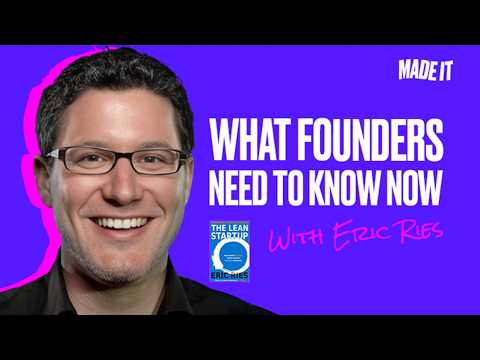
  • Eric Ries: How to test and validate your startup with the lean method

    Try Revolut Business free for 6 months: http://links.madeitpodcast.it/3Il6icD (#ad) In this episode we sit down with Eric Ries, author of The Lean Startup, to explore the method that transformed how founders build companies. From the origins of the Lean Startup methodology to its global impact, Eric explains why the minimum viable product (MVP), validated learning, and the build–measure–learn cycle are essential for every entrepreneur. We talk about what it really means to create an MVP, how to define quality through your customer feedback, and why progress in a startup is measured not by co…

    Read the verified transcript → Watch on YouTube ↗

  • The Future of Innovation: AI & Lean Startup with Eric Ries

    In the dynamic season #1 finale of The Lean AI Podcast, host Ben Hafele is joined by Eric Ries—bestselling author of The Lean Startup and The Startup Way, and creator of the transformative Lean Startup methodology. Join them as they discuss: • Identifying and testing critical assumptions in AI development • The importance of metered funding versus traditional corporate funding • Rethinking traditional vendor relationships in the AI era • Building AI companies with smaller, more efficient teams • The evolving economics of AI product development • Learning from both startup and corporate inno…

    Read the verified transcript → Watch on YouTube ↗

  • Building long-term sustainable Startups - Eric Ries

    Eric Ries discusses the development of the Long-Term Stock Exchange (LTSE) over the past decade, focusing on the challenges of securing regulatory approvals and attracting initial company listings. How European business models that emphasize long-term stakeholder value demonstrate that prioritizing broader interests can outperform traditional profit-driven models. Eric critically examines the failures of the shareholder value theory, popularized in the 1970s, which has often led to short-sighted decisions that undermine both long-term corporate health and societal welfare. He advocates for re…

    Watch on YouTube ↗

  • From Lean Startup to Long-Term Thinking: Eric Ries Reinvents the Stock Exchange

    In this episode of Turpentine Finance, Sasha sits down with Eric Ries, author of "The Lean Startup" and founder of the Long-Term Stock Exchange (LTSE). Ries shares the challenging journey of creating a new national securities exchange designed to promote long-term thinking in public companies. He discusses the obstacles faced in gaining SEC approval, the misconceptions about corporate governance, and why many companies struggle with balancing short-term pressures and long-term vision. Ries offers valuable insights for CEOs and CFOs considering going public or dual-listing, emphasizing the impo…

    Watch on YouTube ↗

Notable quotes

“So Sol Price is widely considered to be the father of modern retail. Like, he basically invented the concept of the big box discount retail store. Yeah. He is so influential, just to get a sense of it, when Sam Walton was thinking about getting into retail, he named his company Walmart as an intentional tribute to Sol's company, FedMart. Sol started FedMart in the 1950s with a very simple concept. It was a membership”

“The board of directors of Vectura didn't care about any of that. They had I think two meetings and they said look it's nothing we can do. It is our fiduciary duty to say yes to Philip Morris and they did. Within 3 years the company was completely destroyed. And what's so interesting about this story is again we see that pattern of a company being murdered in the name of profit. And some people did make some money. I ”

“Why would investors destroy a company in the name of profit? There is a psychological explanation. It's a force that I call financial gravity. And unfortunately, we have built an economic system that rewards people for short-term thinking. It rewards people for cost cutting without ever holding them accountable for the consequences of those cuts to brand, to quality, to product, to the environment, what have you. So,”

“I think the compromise that I personally think is best is if you're going to be dual class organized, I think that's okay, but then you have to have a way for the long-term investors to join you in that privilege class. They have to be able to earn their way into the better class so they can join you in co-determination of the company. That's really in the company's long-term interest because except for the very few ”

“One of the privileges of getting to work with so many companies, I mean, I have, you name an order of magnitude of company from like two founders in a garage up to the biggest multinationals and governments in the world and I've had the privilege over the last 10 years of working with all of them. And it's like there are some things that are different at 10 people, 100,000, 10,000, 100,000, 300,000, you know, a milli”

“If you think corporate values on a wall are going to help you, you have to remind yourself that the people that put asbestos in the baby powder walked by the credo on the wall every day on their way to work. So somehow they thought that what they were doing was compatible with that ethos, even though of course it is not. So that's what we have to fight against. And so it's not enough to just declare our values, we ha”

The summary and quote tags on this profile are produced with AI assistance from verified, first-person interview transcripts, then checked by our team to confirm the speaker's identity and the accuracy of every quote. See how we verify →