CEOInterviews.AI
Start App
Try: AI strategy tariffs earnings guidance layoffs interest rates growth

Paul Ford

Co-founder, Aboard

Search every verified Paul Ford interview, podcast appearance, and on-the-record quote — each transcript cross-checked by AI and human review to confirm speaker identity. Paul Ford, co-founder of the software consulting firm Aboard, has been active in public discussions about artificial intelligence and its workplace and cultural implications. In an October 2026 appearance on WNYC's "Please Advise," he discussed AI's impact on jobs, describing a "weird moment" for professionals like graphic designers who may be "caught in the crossfire" of new tools. He also emphasized the distinction between "artifacts of craft" and "the craft itself," arguing that human expertise remains necessary to operate systems meaningfully. Ford has hosted a series of Aboard "Office Hours" events, including a September conversation with NYU professor Julia Stoyanovich on responsible AI, where he addressed questions of accountability and consumer protection, and an August panel with museum professionals on AI adoption in cultural institutions, where he suggested museums have a "long-term continuing story" in defining what is real and valuable. Ford also delivered a keynote at the Everything NYC 2026 conference in September, focusing on craft and meaning in the AI era, where he questioned the current state of software quality and argued that "craft is what takes someone else too long to do." On the Aboard podcast, he discussed a summer project called Stellate.app, which he built using AI tools to visualize and generate music from made-up genres, describing it as an effort to "ship something" light and fun. In a separate September interview on the "Beyond Capture" podcast, Ford—who has a background in the British Army and banking—discussed leadership and AI adoption in large organizations, predicting that AI will change information asymmetries inside firms but that adoption in sectors like banking will be slower than expected due to budgeting cycles.

Recent appearances

  • Advice About AI at Work

    On today's episode of WNYC's new popup advice show, tech writer Manoush Zomorodi, host of the NPR's Ted Radio Hour and author of Body Electric: The Hidden Health Costs of the Digital Age and New Science to Reclaim Your Well-Being (https://bookshop.org/p/books/body-ele...) leads a conversation about artificial intelligence and our jobs, with Paul Ford, technology writer and founder of the AI startup Aboard. Listeners call in with their experiences and questions about navigating the impulse toward productivity that AI seems to offer, against the more unsettling aspects of this new technology.…

    Watch on YouTube ↗

  • Katie Notopoulos There Are Still LOLs On the Internet

    How is AI reshaping internet culture? On this week’s episode, Paul is joined by a journalist who has truly looked into the digital abyss: Business Insider’s Katie Notopoulos. Using a few recent AI-related stories Katie reported as a lens, they discuss the increasingly blurry boundaries between the real and the artificial on our social feeds. Katie is known for, among other things, her lists of the worst things on the internet; with AI, Paul asks, has “worst” somehow gotten “even worser”? Plus: In a classic reporter move, Katie flips the script and quizzes Paul about his 2014 essay on YouTube,…

    Watch on YouTube ↗

  • Who’s Responsible for AI? A conversation with Julia Stoyanovich and Paul Ford | Aboard Office Hours

    Aboard was happy to host Dr. Julia Stoyanovich, NYU professor and director of the Center for Responsible AI, for a conversation with Aboard president Paul Ford about what it means to build and use AI responsibly — and who gets to decide what “responsible” means. ​Stoyanovich’s work sits at the intersection of computer science, public policy, and education. She has advised New York City on the use of automated decision-making systems, developed public AI literacy initiatives with Queens Public Library, and brought questions of AI governance and accountability to the U.S. Congress and the United…

    Watch on YouTube ↗

  • AI Comes to the Museum | Aboard Office Hours

    Aboard hosted a conversation with Hélène Alonso of WonderWay, Spencer Kiser of the Metropolitan Museum of Art, and Danny Reynolds of the Museum of Modern Art on August 18, 2026. The panel discussed how museums and other cultural institutions are beginning to use artificial intelligence in both public-facing experiences and behind-the-scenes operations. ​From visitor engagement and collections to governance, infrastructure, and organizational change, they explored where AI is already proving useful, how organizations can design around its limitations, and what thoughtful adoption looks like in…

    Watch on YouTube ↗

  • Paul Ford on Craft and Meaning in the AI Era

    Paul Ford, co-founder of Aboard and author of Bloomberg Businessweek's 38,000-word "What Is Code?", opens Everything NYC 2026 with a keynote about AI, craft, and why the two need to come together. ⏩ Chapters: 0:00 Welcome 2:22 Introduction 4:43 5,000 years of prediction machines 22:59 Defining craft 27:52 Where is all the great software? 36:55 What AI doesn't offer 40:47 Your job is to bring the craft Learn more about everything we launched at Everything NYC: https://www.sanity.io/everything-2026... Read the docs 👉 https://www.sanity.io/docs Get started for free 👉 https://www.sanity.io

    Watch on YouTube ↗

  • From Sandhurst to Startup to Success: Paul Ford on Leadership, Risk, and Building then Exiting ACIN

    In this episode of Beyond Capture, Dean Elwood, CEO of Umony, is joined by Paul Ford, investor, advisor and exited founder of Acin, for a conversation on leadership, risk and the pace of change in financial services. Paul draws on his five years in the British Army and almost 15 years in banking to explain how the military trains people to assess a situation, make a decision and get on with it at the appropriate pace. He talks through the journey from running a consultancy to building Acin, stripping operational risk back to first principles and treating it as data, which allowed banks to comp…

    Watch on YouTube ↗

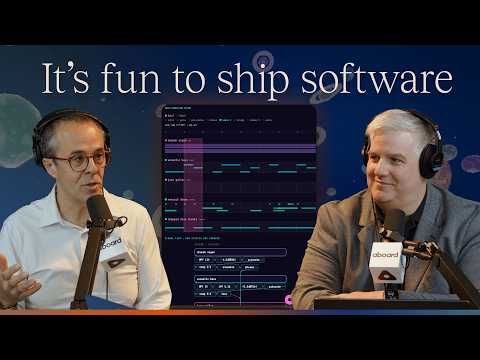
  • It’s Fun to Ship Software | The Aboard Podcast 2026-08-25

    It’s unrestrained summer fun, Paul Ford-style: Using AI tools to actually ship some software. On this week’s podcast, Paul shows Rich his recent vibe-coded project, Stellate.app, which visualizes whimsical, made-up musical genres and plays the corresponding electronically generated music. (Don’t worry: You’ll get to hear some!) This might have been a fun summer project, but what did Paul learn building it—and, importantly, getting it out into the world? Captions are auto-generated; for audio, show notes, and a full transcript, visit our website: https://aboard.com/podcast/its-fun-to...

    Watch on YouTube ↗

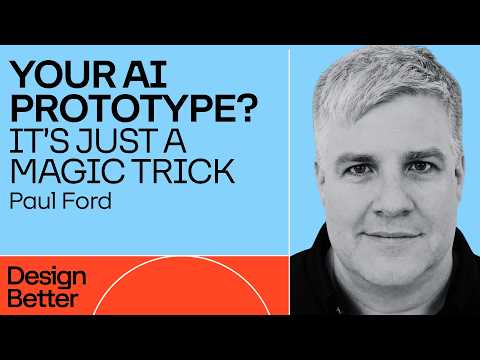
  • The Easier the Sale, the More Likely the AI-Built Project Dies | Aboard's Paul Ford

    Get ad-free episodes, weekly newsletters, and $1,000+ in tools and courses: https://designbetterpodcast.com/ AI can turn an idea into a working prototype in an afternoon, and your client's face lights up. That moment is a trap. Paul Ford, writer, developer, and co-founder of the New York software agency Aboard, has been building with these tools non-stop and watching what breaks. In this episode, you'll learn why the first 90% of the work now comes free while the last 10% is as slow as ever, why finishing anything still takes deep domain knowledge, and why taste is the one thing a model can'…

    Watch on YouTube ↗

  • Explaining Culture to Technology, Paul Ford | Compile 26

    Paul Ford, Co-founder of Aboard, on what technologists can learn from how magazines actually work, and why culture is a distributed, lossy prediction model rather than its output. 00:00 Explaining culture to technology 00:58 How a magazine actually works 03:09 Rhetoric greater than facts 04:03 What culture is 05:27 A model of consciousness 06:15 Culture as an operating system 07:17 The tech industry and risk

    Watch on YouTube ↗

  • Can AI be good? Josh Tyrangiel in conversation with Paul Ford | Aboard Office Hours

    Author Josh Tyrangiel dicussed his new book, AI for Good, with Aboard's President, Paul Ford, and CEO, Rich Ziade. In contrast to the wave of noisy polemics around AI, AI For Good tells the stories of teachers, doctors, and bureaucrats who often stumbled into AI as a means to solve specific, tangible problems, often with no prior software expertise, and the challenges and advantages the technology offers to human ingenuity. Tyrangiel is a writer for The Atlantic. He was previously the editor of Bloomberg Businessweek and chief content officer for Bloomberg Media. A twelve-time Emmy and Peabody…

    Watch on YouTube ↗

  • Is This the End of Code? Programmer Paul Ford on AI and the Future of Software

    In the last year, AI has arguably made more progress in coding than in any other domain. Its technical capabilities—harnessed through apps like Codex and Claude Code—have changed the way engineers work. Boris Cherny, Anthropic’s head of Claude Code, claims that 100% of his output is now generated by AI. But what does the rapid advance in coding tools mean for engineers and businesses? To answer that, Nicholas Thompson, CEO of The Atlantic, sits down with engineer, author, and entrepreneur Paul Ford. The two discuss how AI has changed his work, its implications for a range of industries, and t…

    Watch on YouTube ↗

  • "I Can't Believe It's Not Software!" Paul Ford on AI and the Asterisk*

    So what even is “real” software anyway? Someone builds an app over the weekend. It works. It looks good. And then the search begins — for the asterisk. Security? Design quality? Can it go to production? Paul Ford says we’re in a new era: "I can't believe it's not software!" Paul is the co-founder of Aboard (https://aboard.com/), where he helps organizations build custom software quickly, using AI tools. He's also one of my favorite tech writers. You may know him from "What Is Code" (https://www.bloomberg.com/graphics/20...," the opus he wrote for Bloomberg Businessweek a decade ago or from hi…

    Watch on YouTube ↗

The summary and quote tags on this profile are produced with AI assistance from verified, first-person interview transcripts, then checked by our team to confirm the speaker's identity and the accuracy of every quote. See how we verify →