CEOInterviews.AI
Start App
Try: AI strategy tariffs earnings guidance layoffs interest rates growth

Eswar Prasad

Tolani Senior Professor of International Trade Policy, Cornell University

Search every verified Eswar Prasad interview, podcast appearance, and on-the-record quote — each transcript cross-checked by AI and human review to confirm speaker identity. In a September 2026 interview, Eswar Prasad discussed the global push to reduce reliance on the US dollar, stating that while most countries outside the US seek to move away from the dollar-dominated financial system, no current currency rivals the dollar's depth, liquidity, and institutional support. He attributed the desire for change to factors including the weaponization of the dollar, US debt dynamics, and policy volatility, and noted that efforts such as China's cross-border interbank payment system and direct currency trading between other nations are advancing, particularly in cross-border payments. However, Prasad said that these alternatives are hampered by a lack of market liquidity and institutional trust, citing China's exchange-rate management and capital controls, Europe's economic and political issues, and Japan and the UK's domestic problems. Prasad characterized the situation as paradoxical, observing that while countries want to detach from the dollar, they find it difficult in practice because the dollar remains dominant in funding costs and market liquidity. He argued that meaningful change would require better financial markets and institutions in other countries, but noted that, as of now, no viable alternatives are capable of matching the dollar's position in global finance.

Recent appearances

  • Dollar remains dominant despite global push to reduce reliance: Eswar Prasad

    Eswar Prasad of Cornell University says countries are working to reduce their dependence on the dollar-based financial system, particularly in cross-border payments. But he says no currency currently matches the dollar's depth, liquidity and institutional support, leaving it firmly dominant in global finance.

    Watch on YouTube ↗

  • The End of Globalization? Eswar Prasad on the "Doom Loop"

    Has the global economy entered a destructive feedback loop? In this episode of Beating Sisyphus, we sit down with Eswar Prasad, Tolani Senior Professor of International Trade Policy at ‪@Cornell‬ and Senior Fellow at the ‪@BrookingsInstitution‬. We dive into his latest book, Doom Loop, to explore how the forces once thought to bring global stability—globalization, international organizations, and the rise of middle powers—are now clashing with domestic politics and geopolitics. Eswar breaks down why the US dollar remains dominant despite domestic instability, the barriers holding back the Ch…

    Read the verified transcript → Watch on YouTube ↗

  • AMPF 2026: “Features and Fragilities of the International Monetary System” by Prof Eswar Prasad

    Commissioned Paper by Professor Eswar PRASAD (Cornell University) “Features and Fragilities of the International Monetary System” For details related to this forum, please visit the AMPF web page: https://abfer.org/events/abfer-events... ======= The opinions and advice expressed in this video are those of the speakers and will not represent the views and opinions of the organisers or any of its subsidiaries or affiliates. The information provided in this forum is for general information purposes only as part of a general discussion. All of the proceedings of the AMPF, are intended for limi…

    Read the verified transcript → Watch on YouTube ↗

  • "The Doom Loop: Why the World Economic Order Is Spiraling into Disorder" | Eswar Prasad (Cornell)

    Eswar Prasad, Tolani Senior Professor of Trade Policy, Cornell University; Senior Fellow, Brookings Institution, joined IIEP and the Sigur Center for Asian Studies for a talk on his latest book, "The Doom Loop: Why the World Economic Order Is Spiraling into Disorder.” This talk was recorded on Tuesday, March 24, 2026 at the Elliott School of International Affairs. In The Doom Loop, economist Eswar Prasad argues that the very forces that we long believed could stabilize the world order are fueling its destabilization. Rather than promoting shared prosperity, globalization has instead deepened…

    Read the verified transcript → Watch on YouTube ↗

  • Eswar Prasad — The Doom Loop: Why the World Economic Order Is Spiraling into Disorder

    The United States is no longer the world’s undisputed superpower. China and India increasingly flex their economic muscle, as the West’s share of global GDP steadily declines—and America’s rules-based system risks becoming irrelevant. In business, competition brings efficiency, balance, and innovation. But not in the marketplace for global power. Acclaimed economist Eswar S. Prasad argues that the very forces expected to stabilize the world order are fueling disarray. Globalization has deepened inequality in many countries, stoked political backlash and triggered trade wars. Economic institut…

    Read the verified transcript → Watch on YouTube ↗

  • Supreme Court blocks Trump's tariffs: Economist Eswar Prasad explains uncertainty

    The Supreme Court ruled that President Donald Trump's tariffs were not constitutional. Tolani Senior Professor of Trade Policy and Professor of Economics at Cornell University Eswar Prasad said the tariffs are not going away. READ MORE: https://tinyurl.com/46sph37b _______________ Stay up to date with our social media: 7News on Facebook:   / 7newsdc   7News on Twitter:   / 7newsdc   7News on Instagram:   / 7newsdc   Subscribe to WJLA on YouTube:    / @7newsdc   Daily News Playlist:    • WJLA Washington, DC - Daily News   For more information, visit https://wjla.com/ Have a news tip? Sen…

    Watch on YouTube ↗

  • The Unintended Consequences of Globalization | Prof G Markets

    This week on Prof G Markets, Ed Elson and Scott Galloway are joined by Eswar Prasad, Professor of trade policy and economics at Cornell University, former chief of the Financial Studies Division of the International Monetary Fund, and author of the new book, “The Doom Loop.” They unpack why he believes the global economic order is unraveling, when the U.S. deficit could become a full-blown crisis, and what’s really happening in the housing market. Plus, he explains what he thinks America needs to do to get back on track. Subscribe to our Markets Newsletter! https://links.profgmedia.com/marke…

    Read the verified transcript → Watch on YouTube ↗

  • Globalization Now Being Seen as 'Zero-Sum Game,' Says Eswar Prasad

    Eswar Prasad, Professor of Trade Policy and Economics at Cornell University & Senior Fellow at the Brookings Institution, discusses his new book 'The Doom Loop: Why the World Economic Order Is Spiraling into Disorder.' In Donald Trump’s world of rushed dealmaking, patience was India’s strategy during its trade talks with the US president. Back in April, when the second-term Trump administration advertised they were gunning for 90 deals in 90 days, Indian negotiators said they refused to be swayed “with gun to head.” Ten months later, New Delhi’s go-slow approach is receiving praise after Trum…

    Read the verified transcript → Watch on YouTube ↗

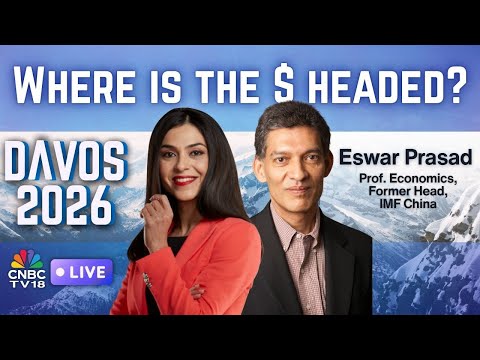
  • Davos 2026 LIVE: Tariffs & Trade Barriers With Eswar Prasad, Cornell University | N18L

    #DavosWithCNBCTV18| An Expert decodes *Tariffs & trade barriers *Is the world facing a slowdown? *Where is the Dollar headed? *What mistakes are policymakers repeating? Catch Eswar Prasad, Cornell University, Former head of China IMF #WEF26 #Davos2026 #WorldEconomicForum #SpiritOfDialogue #CNBCTV18Digital #DavosWithCNBCTV18 #WEF #CNBCTV18 #BusinessNewsLive #MarketNews #CNBC 🔴CNBC TV18 LIVE TV: https://youtube.com/live/P857H4ej-MQ SUBSCRIBE to our Channel: https://bit.ly/3nvEcxf --------------------------------------------------------------------------------------------------------------…

    Read the verified transcript → Watch on YouTube ↗

  • The Genius Act Gives Legitimacy Boost To Stablecoins, Says Cornell University's Eswar Prasad

    The Genius Act, recently signed into law by US President Donald Trump, has given a significant legitimacy boost to stablecoins, says Eswar Prasad, Professor of Economics at Cornell University. In an interview with CNBC-TV18, Prasad said the new law reflects the US administration’s pro-crypto stance and could be the first in a wave of crypto-friendly regulations. The Genius Act provides a clear regulatory framework for stablecoin issuers. Those issuing less than 10 billion stablecoins will be overseen by state regulators, while larger issuers will fall under the purview of federal agencies li…

    Read the verified transcript → Watch on YouTube ↗

  • Cornell University Professor Eswar Prasad Talks Tariffs | Bloomberg Talks

    Cornell University's, Eswar Prasad discusses the impact that Trump's tariffs might have on trade with the US for our partners around the world. He is joined by Bloomberg's Romaine Bostick and Alix Steel. See omnystudio.com/listener (https://omnystudio.com/listener) for privacy information. Bloomberg Talks curates top interviews from around Bloomberg News. Hear conversations with the biggest names in finance, politics and entertainment. On Bloomberg Talks, we round up interviews with Fortune 500 CEOs, government officials, well-known investors and business leaders. Listen to more Bloomberg T…

    Read the verified transcript → Watch on YouTube ↗

  • #DavosBrainstorm2024: Eswar Prasad, Professor, Cornell University, USA

    #DavosBrainstorm2024 #DavoswithBT #WorldEconomicForum #internationalfinance An exclusive interview with Eswar Prasad, Professor at Cornell University in the USA, as he unravels the complexities of global economics and financial markets. In this conversation with Siddharth Zarabi, Managing Editor, Business Today TV, the Professor shares invaluable insights into current economic trends, policy landscapes, and the future of international finance. Delve into the mind of a maestro as we explore his research, perspectives, and vision for navigating the challenges and opportunities shaping our inte…

    Watch on YouTube ↗

Notable quotes

“The rules of the game as embodied in these international institutions that I referred to Lourdes was one of the forces that I thought would lead us towards more balance. But, as I thought about it, I did see as you have pointed out that institutions like the IMF and the World Bank are losing credibility from emerging market countries which feel that these institutions remain stuck in a different world where the votin”

“The feature that you spoke about stability of the renminbi is of course relative to the US dollar. That one can think about as a strength of the Chinese economy that they've managed to keep the renminbi's value relative to the dollar in a relatively narrow range, but at the same time that is precisely the sort of thinking that is keeping the renminbi from gaining a lot more prominence in international finance. So, if”

“So I think right now we face this very unfortunate situation and I've called it the currency doom loop. Either we move to a world with great fragmentation which has a lot of risks or we stay with the current fragment situation which has a lot of risks. There are ways out. And here I'm looking at you Europe, I'm looking at you China, Japan and so on. Get your act together people. So I hear a lot of complaints about th”

“The story I'm going to tell you for much of the rest of the presentation lacks logic. The world should not be like this. But it is like this. And again, we will come back to what the alternatives are. And of course, the US is special in this respect. A lot of US debt is held by foreign investors, much more than in most other reserve currency economies. Although the foreign ownership of public debt in the UK has actua”

“I think ultimately, this is where the answer lies. It's really about institutions. You know, I spoke about international institutions, but domestic institutions are equally important as well. And what are the domestic institutions that are important? It includes the rule of law, an institutionalized system of checks and balances, a free and fearless press that holds public officials to account, and it includes, you k”

“The notion of the Doom Loop is that economics, domestic politics, and geopolitics are stuck in this negative feedback loop where they're bringing out the worst in each other. Let's start with globalization, which was one of the forces I had in mind as generating a better equilibrium. Once upon a time, not too long ago, globalization was seen as a positive-sum game, where countries, by trading with each other, could m”

The summary and quote tags on this profile are produced with AI assistance from verified, first-person interview transcripts, then checked by our team to confirm the speaker's identity and the accuracy of every quote. See how we verify →