CEOInterviews.AI
Start App
Try: AI strategy tariffs earnings guidance layoffs interest rates growth

Erica Chenoweth

Professor of Public Policy, Harvard Kennedy School, Harvard Kennedy School

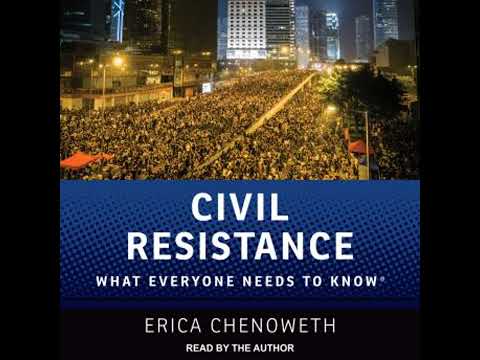
Search every verified Erica Chenoweth interview, podcast appearance, and on-the-record quote — each transcript cross-checked by AI and human review to confirm speaker identity. Erica Chenoweth, the Frank Stanton Professor of the First Amendment at Harvard Kennedy School, has been actively engaged in public scholarship on civil resistance and American democracy. In September 2026, she co-hosted the eighth session of "The Breakdown," a webinar series with Steven Levitsky, where they discussed ongoing challenges to U.S. democratic institutions. During the session, Chenoweth stated that U.S. civil society and the Democratic Party are "much more aware and much better prepared" than in 2020 to contest potential election crises, while also expressing concerns about potential disputes over close House races. She advocated for structural reforms, saying "we need to abolish the Electoral College" and that the electoral system should be more proportional, while acknowledging such changes are not "low-hanging fruit." Chenoweth's recent work also includes her audiobook "Civil Resistance: What Everyone Needs to Know," released in May 2022, which she narrates herself. In the book, she describes her initial skepticism about nonviolent resistance before finding that "more than half of the campaigns that had relied primarily on non-violent resistance succeeded, whereas only about a quarter of the violent ones did." She has noted that the first two decades of the 21st century have seen more revolutionary nonviolent uprisings than during the entire 20th century, citing examples from Armenia to Hong Kong. In her public commentary, she has distinguished civil resistance from isolated protests, arguing that the former involves "continual coordinated collective action using a mix of techniques toward a decisive outcome."

Recent appearances

Verified interview transcripts

Notable quotes

“After two years of data collection and vetting with subject experts, I ran the numbers. I was shocked. More than half of the campaigns that had relied primarily on non-violent resistance succeeded, whereas only about a quarter of the violent ones did. Moreover, when I ran a variety of regression models that included features of the regime as control variables, I could find no systematic statistical association betwee”

“I think we need to abolish the Electoral College. That's not a low-hanging fruit. It's possible, but it's not a low-hanging fruit. I think we need to change our electoral system so that it is more proportional so that the percentage of the vote translates more directly into the percentage of seats in Congress. And ideally, we need to democratize the Senate, which by giving tiny underpopulated states equal representat”

“There are many things that incumbent governments can do to tilt the electoral playing field. One of them, which I won't delve in too much, is just outright repression. You can scare oppositions into demobilizing, staying at home, either not campaigning or not voting. And so, intimidation and repression is an age-old way of tilting the playing field just by making it too dangerous for opposition to get out and campaig”

“The Voting Rights Act was effectively gutted a month ago. And when it was, for many Black activists and Black voters in the South, it felt like an elimination of the crowning achievement of the civil rights movement. Voters who were interviewed by journalists were saying that it felt like being kicked down a flight of stairs back to a history that they thought was effectively closed as a chapter of American history, ”

“Well, this is classic authoritarian behavior. Authoritarians, it is what in Latin America we call lawfare, the use of prosecutors, the use of the law in a selective targeted way to go after critics and political opponents. Orban didn't do it quite so much, but it's something that Chavez did in Venezuela, that Rafael Correa did in Ecuador that's been widespread in Turkey and obviously in Putin's Russia. And the Trump ”

“The 3 and a half percent statistic is based on a historical observation of 323 mass movements between 1900 and 2006. And it came from a conversation I was having with an activist actually who asked me if there was some kind of critical threshold above which no movements had failed in terms of mass participation. And so I just looked in the data and found that observation that among the campaigns that we had documente”

The summary and quote tags on this profile are produced with AI assistance from verified, first-person interview transcripts, then checked by our team to confirm the speaker's identity and the accuracy of every quote. See how we verify →