
CEOInterviews.AI
Start App
Try: AI strategy tariffs earnings guidance layoffs interest rates growth

Ankur Moitra

Professor of Mathematics, MIT

Search every verified Ankur Moitra interview, podcast appearance, and on-the-record quote — each transcript cross-checked by AI and human review to confirm speaker identity. Ankur Moitra, a mathematician and theoretical computer scientist at MIT who is currently visiting the Institute for Advanced Study in Princeton, appeared on the Lex Fridman Podcast in late October 2026 to discuss the recent wave of AI-assisted solutions to major open problems in mathematics, including the Navier-Stokes equations, the quasi-Riemann hypothesis, and the unique games conjecture. During the conversation, Moitra discussed the implications of AI for the role of human mathematicians, describing what he called the "doorman fallacy"—the mistake of reducing a person's job to its most obvious task and assuming automation replaces the whole role—and argued that even in a world where AI can solve theorems, human contributions extend beyond asking questions or proving results. Earlier in October, Moitra gave a talk at a Theory Lunch titled "Learning Markov Random Fields from Dynamics," based on joint work with Jason Gaitonde and Elchanan Mossel. In the talk, he presented a proof that learning higher-order Markov random fields from Glauber dynamics trajectories can circumvent computational lower bounds that apply to learning from independent and identically distributed data. He expressed the view that modeling realistic data generation processes, such as time-dependent trajectories, may make learning problems easier rather than harder, and suggested that nature may avoid computationally hard problems in many learning settings.

Recent appearances

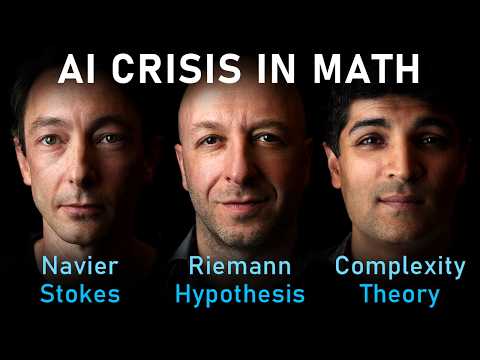
  • AI Crisis in Math: Navier-Stokes, Riemann Hypothesis & Complexity Theory | Lex Fridman Podcast #503

    Ankur Moitra, Steven Brunton and Alex Kontorovich are three mathematicians who can speak to this incredible moment in the history of mathematics, when AI solved some of its hardest problems: Navier-Stokes, the quasi-Riemann hypothesis, the unique games conjecture and hundreds of other problems. Ankur Moitra is a mathematician at MIT (visiting the Institute for Advanced Study in Princeton) working in theoretical computer science, who can speak to the unique games conjecture, complexity theory and the mathematics of how AI learns. Steven Brunton is a mathematician and fluid dynamics expert at UW…

    Read the verified transcript → Watch on YouTube ↗

  • Ankur Moitra @ Theory Lunch

    Title: Learning Markov Random Fields from Dynamics Abstract: The problem of learning markov random fields from iid data is widely studied, but unfortunately strong computational lower bounds are known when there are higher order dependencies. I will show how assuming the data is generated by a natural process called the Glauber dynamics allows us to circumvent these barriers, by harnessing the dependencies. This is based on joint work with Jason Gaitonde and Elchanan Mossel.

    Read the verified transcript → Watch on YouTube ↗

  • Ankur Moitra - Transitions in Quantum Spin Systems - IPAM at UCLA

    Recorded 13 January 2026. Ankur Moitra of the Massachusetts Institute of Technology presents "Transitions in Quantum Spin Systems" at IPAM's New Frontiers in Quantum Algorithms for Open Quantum Systems Workshop. Abstract: Classical spin systems exhibit a variety of interesting phase transitions wherein there are sudden and dramatic changes in their macroscopic behavior as the temperature varies. In this talk, I will introduce quantum spin systems and study the relationship between entanglement and temperature. In particular, I will show that above a constant temperature, that depends only on t…

    Read the verified transcript → Watch on YouTube ↗

  • Lecture 18: Transmitting Information Reliably over a Noisy Channel & Shannon’s Noisy Coding Theorem

    MIT 18.200 Principles of Discrete Applied Mathematics, Spring 2024 Instructor: Ankur Moitra View the complete course: https://ocw.mit.edu/courses/18-200-pr... YouTube Playlist:    • MIT 18.200 Principles of Discrete Applied ...   How do you transmit information reliably over noisy channels? We first discuss simple codes: repetition codes. Shannon’s noisy coding theorem shows much better codes exist. We prove the simplest case of this theorem — for the binary symmetric channel. License: Creative Commons BY-NC-SA More information at https://ocw.mit.edu/terms More courses at https://ocw.mit…

    Read the verified transcript → Watch on YouTube ↗

  • Lecture 8: Tail Bounds

    MIT 18.200 Principles of Discrete Applied Mathematics, Spring 2024 Instructor: Ankur Moitra View the complete course: https://ocw.mit.edu/courses/18-200-pr... YouTube Playlist:    • MIT 18.200 Principles of Discrete Applied ...   In this lecture we cover tail bounds; these bound the probability that a random variable is far away from the mean. We give Markov’s bound and Chebyshev’s bound. We then use Chebyshev’s bound to prove the weak law of large numbers. License: Creative Commons BY-NC-SA More information at https://ocw.mit.edu/terms More courses at https://ocw.mit.edu Support OCW at ht…

    Read the verified transcript → Watch on YouTube ↗

  • Lecture 11: Basic Group Theory

    MIT 18.200 Principles of Discrete Applied Mathematics, Spring 2024 Instructor: Ankur Moitra View the complete course: https://ocw.mit.edu/courses/18-200-pr... YouTube Playlist:    • MIT 18.200 Principles of Discrete Applied ...   Definition of a group; examples of groups: addition mod n, multiplication mod n.Definitions of subgroup, definition of cosets, statement and proof of Lagrange’s theorem. Finally, we apply Lagrange’s theorem to prove Fermat’s little Theorem. License: Creative Commons BY-NC-SA More information at https://ocw.mit.edu/terms More courses at https://ocw.mit.edu Support…

    Read the verified transcript → Watch on YouTube ↗

  • Lecture 1: Pigeonhole Principle

    MIT 18.200 Principles of Discrete Applied Mathematics, Spring 2024 Instructor: Ankur Moitra View the complete course: https://ocw.mit.edu/courses/18-200-pr... YouTube Playlist:    • MIT 18.200 Principles of Discrete Applied ...   We first describe the mechanics of the course. We then discuss the pigeonhole principle, explaining what it is and giving several surprising applications of it. The we briefly discuss foundations of probability and sample spaces. License: Creative Commons BY-NC-SA More information at https://ocw.mit.edu/terms More courses at https://ocw.mit.edu Support OCW at http:…

    Read the verified transcript → Watch on YouTube ↗

  • Lecture 10: Modular Arithmetic

    MIT 18.200 Principles of Discrete Applied Mathematics, Spring 2024 Instructor: Ankur Moitra View the complete course: https://ocw.mit.edu/courses/18-200-pr... YouTube Playlist:    • MIT 18.200 Principles of Discrete Applied ...   We introduce modular arithmetic. We then discuss inverses mod m. We give the Euclidean algorithm for finding the GCD (greatest common divisor) and use the extended Euclidean algorithm to find inverses. Finally, we cover the Chinese Remainder Theorem. License: Creative Commons BY-NC-SA More information at https://ocw.mit.edu/terms More courses at https://ocw.mit.ed…

    Read the verified transcript → Watch on YouTube ↗

  • Lecture 2: Independence and Conditioning

    MIT 18.200 Principles of Discrete Applied Mathematics, Spring 2024 Instructor: Ankur Moitra View the complete course: https://ocw.mit.edu/courses/18-200-pr... YouTube Playlist:    • MIT 18.200 Principles of Discrete Applied ...   We explain what it means for two events to be independent, and what it means to condition one event on another. We cover the law of Total Probability and Bayes’ rule. We then define random variables and expectations, and explain linearity of expectation. License: Creative Commons BY-NC-SA More information at https://ocw.mit.edu/terms More courses at https://ocw.mit…

    Read the verified transcript → Watch on YouTube ↗

  • How Do Transformers Work?

    Ankur Moitra (MIT) https://simons.berkeley.edu/talks/ankur-moitra-mit-2024-09-04 Special Year on Large Language Models and ...We're going to start with the Ankur Moitra and Daniel Hsu. They're going to give a joint talk where Ankur is going to speak the first ...

    Watch on YouTube ↗

  • The Magic of Ruzsa-Szemeredi Graphs

    Ankur Moitra (Massachusetts Institute of Technology) https://simons.berkeley.edu/talks/ank... RR-Fest

    Watch on YouTube ↗

  • "Learning from Dynamics" by Ankur Moitra

    "Learning from Dynamics" by Ankur Moitra (MIT Mathematics Department) on March 6, 2024, hosted by Yale FDS (Institute for Foundations of Data Science). Speaker: Ankur Moitra Norbert Wiener Professor of Mathematics, Massachusetts Institute of Technology Bio: Ankur Moitra is a theoretical computer scientist, and a major goal in his work is to give algorithms with provable guarantees for various problems in machine learning. He is a member of the Theory of Computation group, MachineLearning@MIT, Foundations of Data Science and the Center for Statistics. Abstract: Linear dynamical systems are…

    Watch on YouTube ↗

Notable quotes

“If you believe that BQP does not contain NP, then all of a sudden we have these classic works of Alan Sly and Nike Sun that tell us some line in the sand that we must not cross. At some value of beta when the temperature is low enough we know that the problem becomes NP hard. And now something kind of crazy has happened which is that we were trying to give algorithms for preparing quantum Gibbs states for high enough”

“So here is the experiment. You can throw a dice until you get a 6. And we're going to be interested in the number of rolls that you have to take in expectation. Now, if that were it, there would be no paradox. We already talked about that for the mean time to failure. Because if my probability of rolling a 6 is 1/6, I can look at the expected number of rolls, and that would just be 6. Fine. So nothing is hard here. B”

Other executives at MIT

The summary and quote tags on this profile are produced with AI assistance from verified, first-person interview transcripts, then checked by our team to confirm the speaker's identity and the accuracy of every quote. See how we verify →