
The Loneliness That Shaped Lyndon Johnson - Robert Caro
Full episode: • What Robert Caro learned about power after... Me on twitter: https://x.com/dwarkesh_sp
Biographer; author of The Power Broker and The Years of Lyndon Johnson
Search every verified Robert Caro interview, podcast appearance, and on-the-record quote — each transcript cross-checked by AI and human review to confirm speaker identity. Robert Caro, the biographer of Robert Moses and Lyndon B. Johnson, appeared in November 2026 on the podcast "The Master Biographer Reflects at 91," where he discussed his research methods and the subjects of his books. In the interview, Caro described his daily routine of turning off his telephone and avoiding contact with others to concentrate on his writing, noting that this practice has affected his personal relationships. He also reflected on the loneliness that shaped Johnson's upbringing in the Texas Hill Country, saying that growing up on a ranch 18 miles beyond Johnson City "formed your character in a different way" and that loneliness was "a big deal." Caro discussed Moses's loss of power, recalling that he watched the decline happen while writing The Power Broker and observed that Moses did not seem to realize he was changing, as he remained insulated by loyal aides and continued to believe he would win again. In the same podcast, Caro addressed Moses's legacy, saying that when people claim everything Moses did was bad, he responds, "You didn't read the book," noting that early sections depict a young idealist who built beaches for city residents through "an act of genius and willpower." He also discussed Moses's methods of removing obstacles, citing an example where Moses destroyed a politician opposing the Cross Bronx Expressway by making known an affair. Caro appeared in other recent clips from the same podcast series, including discussions of Moses's ruthlessness and the moment his phone stopped ringing, as well as a 2012 reading from The Passage of Power, the fourth volume of his Johnson biography, which described the procession of Kennedy's body from the White House to the Capitol.

Full episode: • What Robert Caro learned about power after... Me on twitter: https://x.com/dwarkesh_sp

Full episode: • What Robert Caro learned about power after... Me on twitter: https://x.com/dwarkesh_sp
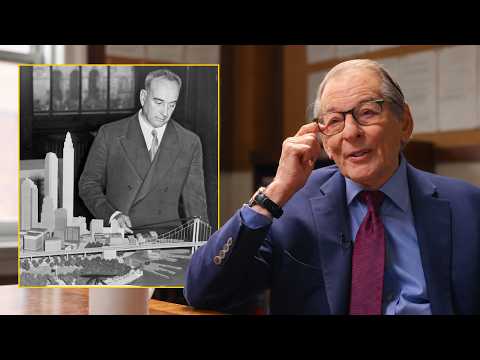
Full episode: • What Robert Caro learned about power after... Me on twitter: https://x.com/dwarkesh_sp

The Passage of Power: The Years of Lyndon Johnson, Volume 4 (Knopf) 11/13/12.

𝐄𝐏𝐈𝐒𝐎𝐃𝐄 𝐋𝐈𝐍𝐊𝐒 Transcript: https://www.dwarkesh.com/p/robert-caro Apple Podcasts: https://podcasts.apple.com/us/podcast... Spotify: https://open.spotify.com/episode/4qFE... 𝐒𝐏𝐎𝐍𝐒𝐎𝐑𝐒 Antithesis lets you run thorough simulation tests on every PR your coding agents ship. That’s because Antithesis is FAST. On a recent project, it packed fifteen hours of simulation into each fifteen-minute run: every change could be tested in thousands of hostile worlds before being merged. Every minute your software spends in Antithesis is one of the unluckiest hours it will ever experience. Learn more at https://…


Here are the first 10 minutes of a rare interview with Robert Caro in his home & office. In this portion, Mr. Caro reveals how many pages he has written for the fifth volume of his "Years of Lyndon Johnson" biography series. C-SPAN's Book TV sat down with the Pulitzer Prize-winning bestselling biographer at his NYC home and office to discuss his writing process and biographies of Robert Moses and Lyndon Johnson. Watch the full interview this Sunday at 11 AM ET on C-SPAN 2. #history #books #robertcaro #lyndonbjohnson #americanhistory #writing

Robert Caro talked about his book, Working: Researching, Interviewing, Writing, on his experiences investigating and crafting biographies of President Lyndon Baines Johnson and Robert Moses. He spoke with comedian and late night talk show host Conan O'Brien

This week on Q&A, it's a rare interview with one of America's leading historians. We tour the New York City office and home library of Pulitzer Prize-winning bestselling biographer Robert Caro, who is currently working on the final volume of his 5-volume biography of Lyndon Johnson. During the tour, Mr. Caro talks about his research and writing process on the LBJ series, and the impact of "The Power Broker," his bestselling 1974 biography of NYC Parks Commissioner Robert Moses. Download the FREE C-SPAN Now App. https://www.c-span.org/c-spanNow/ Discover the C-SPAN Video Library at https://ww…

On April 7, 2002, C-SPAN founder Brian Lamb interviewed historian & author Robert Caro for the Book TV series In Depth. Watch the full program here: https://www.c-span.org/program/in-dep... The Pulitzer-Prize winning author of Power Broker: Robert Moses and the Fall of New York (1974) and the LBJ biographies talked about his writing and his career. #history #presidentialhistory #biography #lyndonbjohnson

Pulitzer Prize-winning biographer Robert Caro, one of great writers of our time, discusses with Stacy Schiff the art of biography on the 50th anniversary of his monumental first book, The Power Broker. With a special reading from The Power Broker by award-winning actor Bryan Cranston. Your support helps us continue creating online content for our community. Donate now: http://www.92NY.org/Donate Facebook: / 92ndstreety Instagram: / 92ndstreety Twitter: / 92ndstreety Archives: http://www.92ny.org/archives

Pulitzer Prize-winning biographer Robert Caro discusses The Power Broker, his biography of one of the most powerful public figures in New York, Robert Moses. Your support helps us continue creating online content for our community. Donate now: http://www.92NY.org/Donate Facebook: / 92ndstreety Instagram: / 92ndstreety Twitter: / 92ndstreety Archives: http://www.92ny.org/archives
“When people say to me everything was bad that he did, what I say is, 'You didn't read the book.' Because certainly the first parts of the book, hundreds of pages, are about a young idealist who sees this great need for recreation, for beaches on Long Island for the city people, and is going to find a way to make them accessible to people in the city. It's an act of genius and willpower the way he does it, and that's ”
“I'm not sure there is a good spot. What you just said is the situation. To build anything on a large scale, you're confronted with dozens or scores or perhaps hundreds of property owners who don't want it built there. So the question is, how does anything get built? Then someone comes along and can do it. When Robert Moses started, it seemed impossible, actually impossible, to build roads out into Long Island because”
“So, when I was doing Lyndon Johnson, he comes to Congress at the age of 29 in 1937, and I'm going through you can't go through every page in the Johnson library. There are millions of pages, but I said, I really want to paint a picture of what a young congressman's life was like in the first years. So, I said, I'll do every page in this 10 or 11 boxes. And I'm going through these things, the very innocuous letters, a”
“Well, that's a really good question. And I'll try to give you a rather short answer to it and say that it's such a complicated question that it really takes a couple of hundred pages in the book to deal with it. Let's talk about it in terms of compassion and ambition. I'll try and just abbreviate this. Lyndon Johnson had a true compassion. He always wanted to help poor people. He always wanted to help poor people of ”
“Robert Moses was the most racist human being that I've ever encountered. I remember he had a telephone, one telephone on his desk with only one line, so if you were a mayor or a governor you had to wait till he was done with the previous call. And he had just been speaking to someone, I never knew if it was the governor or the mayor, and he slammed down the phone and he said, they expect me to build playgrounds for t”
Sign in to search the full transcript archive, filter by topic, and access every quote from Robert Caro.
The summary and quote tags on this profile are produced with AI assistance from verified, first-person interview transcripts, then checked by our team to confirm the speaker's identity and the accuracy of every quote. See how we verify →
Pro unlocks every transcript in full, plus unlimited search across every executive and company we cover.
50% off appliedPulling data at scale? The Data API gives you 30,000 transcripts a month over REST, MCP and JSON.
Compare all plans