CEOInterviews.AI
Start App
Try: AI strategy tariffs earnings guidance layoffs interest rates growth

Janet Yellen

United States Secretary of the Treasury, United States Treasury

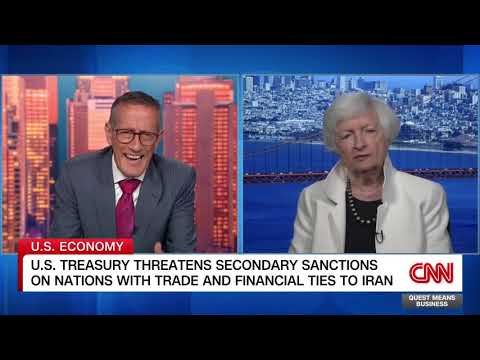
Search every verified Janet Yellen interview, podcast appearance, and on-the-record quote — each transcript cross-checked by AI and human review to confirm speaker identity. Janet Yellen, former U.S. Treasury Secretary and Federal Reserve Chair, has been active in public discussions on economic policy, trade, and fiscal issues. In interviews and appearances, she criticized the Trump administration's tariffs on Canada, calling the treatment of allies "appalling" and stating that tariffs on Canadian goods harm both countries by raising costs for American consumers and businesses. She also expressed concern about the U.S. budget deficit, describing the debt trajectory as unsustainable and noting that interest payments are approaching historically high levels as a share of GDP. Yellen advocated for addressing deficits through tax and entitlement reforms, while cautioning against relying on cuts to discretionary spending. Yellen also discussed monetary policy and the Federal Reserve's independence, saying she was concerned about what she described as "attacks" on the Fed by President Trump, including threats of criminal proceedings against former Chair Jerome Powell and the attempted removal of Governor Lisa Cook. She argued that central bank independence is essential for controlling inflation and maintaining economic stability. Additionally, Yellen addressed the economic impact of artificial intelligence, suggesting it could boost productivity but also disrupt labor markets, and she warned that the benefits of AI might be unevenly distributed. In September 2026, she was inducted into the National Women's Hall of Fame, where she spoke about her career and encouraged women to pursue leadership roles in economics and public service.

Recent appearances

Verified interview transcripts

Notable quotes

“I think it's appalling. And I understand exactly why you feel betrayed by the United States and are so angry about it, and believe that it's important for Canada and other countries not to accept this lying down and to retaliate. And I believe that both what our president has done in terms of undermining or even weaponizing our alliances, both on the security side and on the economic side, some of it has already been”

“Friendshoring was intended as a response to what had happened during COVID, where we found ourselves short of critical supplies like PPE, Russia's invasion of Ukraine. We saw how devastating it had been for Europe, particularly Germany, to be so dependent on Russian natural gas and oil. Russia was weaponizing this, and we saw that trade could be weaponized and was potentially dangerous in that way, to trade with coun”

“The problem is inflation was too high to start with. It's been too high for five years and it can become ingrained in the economy. And if it finds its way into inflation expectations or a further supply shocks come along, we can find ourselves with inflation expectations influencing wage and price. And now we're back to a 70s problem. That becomes difficult to deal with.”

“I think that the major reason it's not that we have a labor market that is so hot that wages are increasing at a pace that you would see as creating chronic labor cost pressures on firms that would be driving inflation. Wage growth has actually been declining. It's at a level that is not a threat to inflation especially given that productivity growth has been running about two around 2%. In fact unit labor cost which”

“The three big drivers are taxes, social security, and Medicare. So the first thing I would say is that anybody who thinks that addressing waste, fraud and abuse or non-defense discretionary spending that they can find a solution there. That is absolutely wrong. That amounts to a trillion dollars essentially in total and it has been falling as a share of GDP and it's been pretty much cut to the bone. I'm not seeing a ”

“In a way, I think it already has become a constraint because $1 trillion I think that's roughly 3.3% of GDP. That is really beginning to push the limits of what we have spent historically on interest payments. Interest expense since the pandemic has gone way up and we now have deficits that are threatening to, as your numbers show, escalate that over time. I think by 2036 we would be looking at something like interes”

The summary and quote tags on this profile are produced with AI assistance from verified, first-person interview transcripts, then checked by our team to confirm the speaker's identity and the accuracy of every quote. See how we verify →