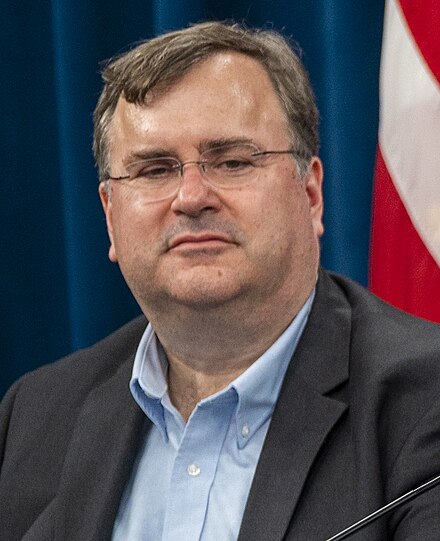
Reid really has established himself as a central figure in the development of AI, both as really one of the first check writers for OpenAI back in 2015 all the way through to this week co-founding an AI startup focused on drug discovery. So he's been in many of the conversations that we hear about, many of the decisions. Reid also published this week a book, which I read over the weekend, *Superagency*, and it was an important book for me because I'd say more recently I felt more like a lab rat—meaning this torrent, right, this overwhelming amount of AI development and new products, new features, new announcements, and that we're in this experiment. We are the species run by big tech to test or to determine if we can thrive with this co-intelligence. And so no one wants to be a lab rat, and I think really Reid's book—and we'll talk about it now—is about how to establish our agency. All of that adds up to me like AI is coming even faster than we thought. That's sort of my takeaway from the last 10 days, has been AI is coming faster. Would you agree? And since you're an AI optimist, you must think that's a good thing that AI is going to come faster.
The short answer is yes, it's coming faster. Yes, I think that generally speaking, coming faster is a good thing. It's part of the difference I did in the book *Superagency*; I divide categories into doomers, gloomers, Zoomers, and Bloomers. A Zoomer has hit the acceleration—everything that can happen is good, just go as fast as you can. Bloomer is: go fast, but drive intelligently, right? It's like if you try to drive from San Francisco to LA and you're going 2 miles an hour, it would be impossibly unbearable. You actually want to be driving 70 miles an hour or faster, a little slower most of the time. You'll slow down for some congestion, for inclement weather, other kinds of things.
And I've actually been anticipating the kind of technological progress we're in. You always discover some new things. I think the DeepSeek stuff was stuff I was expecting from China, but in 6 to 12 months versus now. And so it wasn't like, 'Oh my god, this couldn't happen.' It was like, 'Oh, okay, this happened a little earlier than I was expecting. How do I update my model of the world from that?' and so forth. Now, the other part of the human adoption that I think is particularly interesting is we talk a lot about it, and I find relatively few people are actually fully engaging with AI as it is today, and kind of what are the things that it can mean to them, their personal lives, their work lives, and other things. Part of what I'm a very strong evangelist in is to engage and to start using it.
And so, in one sense, it's like yes, we're going really fast. On the other hand, its integration into people's work and people's lives is spotty—forward, entrepreneurial individuals, not as much into the fabric of how things are operating. And you say, 'Well, why is that going slowly?' And it's because, well, I think what happens is people have a work practice that they're typically working on. Like, 'Here's what I was doing, here's how I was operating last month or six months ago, and that's why I got my job this way, and I feel comfortable,' and so forth. And they go, 'Wow, should I go try this new thing? Well, I hear it's improving really quickly, so I'm going to wait.' And it's like, no, don't do that. You want to actually start learning it as soon as possible. So yes, accelerating, but accelerating as expected.
And what else is causing the slowness? I imagine some of it's corporate slowness, you know, like you're not authorized, or you're not going to get the good AI, or can't use company data with AI. I'd imagine media anxiety around job loss, and are some people putting their heads in the sand? What's your sense of what else is contributing to the slowness of adoption?
One, I think it's actually pretty natural because part of the way that most people tend to operate is learning new things is tiring and engaging and somewhat difficult. And so I kind of want to block that off to a time, and it's like, 'Well, but that's improving, so let me wait until it stabilizes or something.' So that's a natural human operant condition. Another thing is that it's not really immediately apparent to people. Literally, part of the thing that I and a few other folks like Ethan Mollick of the Wharton Business School and others find is, like, in two minutes of conversation sitting with anyone, I can point them to three significant uses that they can use today's AI for that would actually be helpful to them. And it's not just, 'Oh, use it for when you have a medical question' or something. It's stuff that's actually in their life they're just not kind of thinking about that way because the industry and the work cases and so forth haven't really been happening.
And then that's partially also because then you get locked into working groups and companies, and companies are really, generally speaking, pretty clumsy about upgrading the work process. I think when it's all going to really accelerate is when groups of people begin to go—and it could be micro-groups, like this team of coders looks over at that team of coders and sees them moving a lot faster because they're using Copilot and goes, 'Oh, we should be doing that too,' but also companies competing and so forth, and they go, 'Oh wow, okay, we can't be behind here.' And then that's when the slow adoption moves to a very rapid adoption.
So let's stay with this for just a little bit longer. We're getting tactical, but I like it. So what about data privacy? I was with 20 executives yesterday in a workshop, and that was one of their biggest concerns: 'I don't want to use AI as a thought partner because I don't want to load up the board deck or the business plan or whatever it might be.' And that's the kind of work I do because I'm an executive; I'm not writing social media posts, which maybe AI is great for that, but for me, this is the kind of work I do. How do you respond to that in terms of what's the degree of risk for a typical executive loading up something like a business plan or a board deck?
Well, frankly, the risk is very low. If you're worried about it, you could start with stuff that the risk is much smaller, de minimis. Because people tend to imagine, 'As I'm uploading this into ChatGPT or something, and then it's going to be published on the web somewhere, or they're going to include it in the ChatGPT knowledge base and then reflect it in various ways to my competitors with my name on it.' The likelihood that any of that happens is just very de minimis.
Now, that being said, there are a number of players—not the least of which is Microsoft—that are working on solutions that have guaranteed zero there, right? And there's ways to get that. And of course, if you say, 'Hey, I don't want to be using public cloud, public market stuff,' then you need to be engaged in some paid service. But the paid services are actually pretty cheap. I would dive into it as strong as possible. So I tend to think most people, when they're kind of thinking the privacy thing, they're kind of giving themselves an excuse to not engage right now.
Right now not to engage, right? Absolutely. And that's unwise. Also probably doesn't help that I think a lot of people think they're training their replacement.
Yeah, which is, I think, sort of a media narrative that engages, right? 'Hey, your job's going to be taken by the AI you're training.' I feel fairly strongly in most job cases that the job transformation is not going to be a human replaced by an AI, but a human replaced by a human with an AI. So sure, you might be training the AI that is the human plus the AI, but if you're doing that, the high likelihood is you're the human plus the AI.
If you're like, 'No, no, no, I'm not going to do this,' then someone else who walks in goes, 'Okay, I know how to do all of this data analysis and this decisioning much, much better than you because I'm using an AI sales process, marketing process, financial analysis process, legal process, etc.' Then you're going to be very outmoded because I think what's going to happen when the rush starts going is it starts getting to, like, for example, I think even as early as the end of this year, I think it'll start being the case for software engineers that if you're not using frankly probably multiple Copilots, but at least one, you're probably kind of like saying, 'I'm a graphic designer and I'm using a four-year-old or five-year-old version of Photoshop,' or something like that, right? So you do it at your own risk at that point.
Basically, right. You are self-generating that risk in terms of your economic livelihood. All right, let's zoom back out to *Superagency*. Because, as I said, I don't want to be a lab rat; none of us do. Talk more about, first of all, what was your motivation in terms of... it felt like a wake-up call to us around that we can have more agency both individually and societally, I guess. Just riff on that for a moment or two.
A couple things. One, we go into a lot of history of this for analogy so that people understand is that literally every single major technology, the discussion that is had around it is like the discussion we're having around AI: it'll be the destruction of human agency, it'll be destruction of human society. And there's different components of that, but that sort of thing. Second thing was part of it, when we go to data and privacy, or misinformation, or job loss or transformation, all of those are versions of human agency.
And part of the question of human agency is: one, when we look at all historical technologies and we come to AI being new and distinct in some ways—each of them new and distinct at their times, but this one now new and distinct in this new way—is to say, okay, the worry is always massive loss of human agency, and then when you get through the transition, a massive gain of human agency. And matter of fact, even what we call superagency, which is like not only do you get the agency of the superpowers yourself, but when the millions of people around you also get those superpowers, you get also superpowers from them. So superagency is a collective—we all get superpowers together. So I get a car, I can go drive places, but also people can drive to me, a doctor can do house calls, etc.
And then the thing on agency is to say, well, agency to some degree is also a mindset question. Like if you get in an Uber and feel like, 'Oh my god, someone else is behind the wheel and I'm out of control of this vehicle,' you have a very bad ride.
Right, or a Waymo. But if you go, 'No, no, I summon it. It's going where I want it to go. This is actually part of how... like, I've done this because it's convenient, I've done this because I've had one too many cocktails, I've done this because this is the best way to get from A to B, and it's part of my agency,' then you have a very different thing. And so having that kind of positive mindset is super important. And frankly, the only way we get to the quality future is by going towards them. You can't get to the quality futures by eliminating the bad ones.
Right. So that's a little mindset shift. It starts with just that shift, right? 'This is where I want to go.'
Yes, exactly. And yes, you could say, 'But wait a minute, I kind of don't want the big shift. I'd kind of just like to stay here. Isn't that a loss of agency?' And it was like, well, there is that loss of agency from the 'I just want things to stay the same.' But by the way, that's part of the reason why we were talking about the Luddites in the English Industrial Revolution who wanted that for not bad immediate reasons. But if they had succeeded, they would have literally sabotaged their country, their children's, and their grandchildren's prosperities and everything else. So it's like, no, this is the economic wave. It's like saying, 'Well, I don't want everyone to have smartphones, I don't want everyone to have the internet, I don't want everyone to have PCs.' It's like, no, no, no, that's where it's going. Now steer it, because it can be so much better.
Okay, I buy it. But there's a messy middle there, right? Like, okay, I'll adopt this agency, I'll get the people around me to adopt the same mindset, we'll figure this out hopefully together, we'll steer in these more positive directions. But who's helping us get to these better outcomes? Where are the guardrails? And frankly, here's the core of maybe my question: am I relying on big tech to be the stewards of this superagency? Because they haven't exactly covered themselves in glory the last 10 years in terms of steering us to the right outcomes when you talk about humanity.
Let me just start with a defense of big tech, which is here we are right now using big tech in this conversation, right? We all use our smartphones with GPS, and people use ChatGPT. Like a friend of mine was taking a cab in Morocco, and the driver had discovered to use ChatGPT as a translation tool because he doesn't speak English, but can engage his business and so forth. And all the taxi drivers, once one started doing it, 'Oh my god, this works, let's do this,' and they're all doing it. So there's just tons of things from translation, email, Wikipedia, just tons of stuff. And so the plenty that comes from all of the stuff that's going on with big tech that completely transformed our life is huge and extremely positive.
Next thing gets to a comparison set. You say, 'Okay, so if this future is going to be built—by the way, it's only going to be built essentially by big tech and scaling tech companies—but you say I'd rather have a different institution do it.' You're like, 'Well, which institution did you have in mind? Did you have universities in mind? Did you have government in mind?' No institution's perfect, and so if your thing is it should only be built by a perfect institution, you're like, 'What planet are you on?' right? These are the questions. And it doesn't mean that big tech's perfect, doesn't mean there aren't things we should nudge it and challenge it to. I welcome the conversation and all those things that happen. But there tends to be this reflexive kind of like, 'Big tech bad, and how do you trust them doing this?' And you're like, well, search and all the information that comes from it, email and communication, all of the different messaging apps, you know?
Now, that being said, part of what I think is happening that's really good is this kind of iterative development and deployment, which is part of how your voice is heard. It's not because everyone's going to go around and speak one-on-one to the billion people using the technology—that's not really what's going to happen, even with AI to assist it. But what happens is, as we collectively engage—and we talk about this in *Superagency* as 'consent of the governed'—feedback starts emerging in various clumps. You might have expert commentators going, 'Well, this is a real challenge. We should navigate this, we should fix this,' in the car analogy like, 'Hey, we should have seatbelts,' that kind of thing. And so engaging in it, and then just being part of the network of interaction, the network of feedback, talking in various circumstances about what's really great, what's not really great, and that kind of stuff is part of the iteration. And it's part of one of the things that makes companies extremely, even like democratic, because they're very responsive to the customer base, to markets.
Right. So that's part of the reason why you're optimistic on all those variables. You have faith—there's an assumption of faith that we are going to figure this out, right?
Yes, implicit in *Superagency*. Look, part of the reason why I'm so unequivocally very positive on this is the general discourse tends to be gloomer, doomer, etc. 'AI is bad, what about our data, what about our job loss,' and you're like, look, embracing this, this is the cognitive Industrial Revolution. The countries and industries that embraced the Industrial Revolution early had the disproportionate massive increase in prosperity, wealth, influence, power, good careers for the generations to come in their communities, and all the rest. And so it's really important to do right now.
That being said, we are terrible at the transitions. I'll use the printing press as an example. The printing press—nothing in modern society works without the printing press: you don't have medicine, you don't have science, you don't have education, none of this stuff works, no middle class, the whole thing. Really, really great on the outcome. Now, when it was created, because we're human beings, we had nearly a century of religious war. So we handle these transitions poorly. Part of the reason to say, 'Hey, let's have a proactive, let's move to an AI-curious mindset, let's be steering towards what the positive is, as opposed to yelling about all the negatives,' go, 'Well, we know we're going to be in this kind of turbulent waters in these transitions. How do we navigate them with the most humanity and grace that we can?' And that's what's really important for us to focus on.
It doesn't mean stop listening to any concerns—that's part of the Bloomer category versus Zoomer that I'm part of. It's like, no, that dialogue is important. But we're going to hit a whole bunch of pain in the transition, no question. No matter what, there will be a bunch of changes in industries, a bunch of changes in jobs. And by the way, customer service jobs will be among them that will probably diminish a lot. But AI, by the way, can help people figure out other jobs, figure out how to do the other jobs, help them do the other jobs, train them to do the other job, find the other jobs, all that kind of stuff. And so part of helping transition is like, well, let's be making sure that in all of the stuff we're doing, we're making those AIs that help us with our human agency. And that's essentially with *Superagency*. There's two primary audiences for the book: one is the designers of the stuff, which is focus on human agency; and the other one is people who are kind of AI-uncertain and trying to help them think about how to become AI-curious, because that's one of the ways to help them gain and pursue this with some agency.