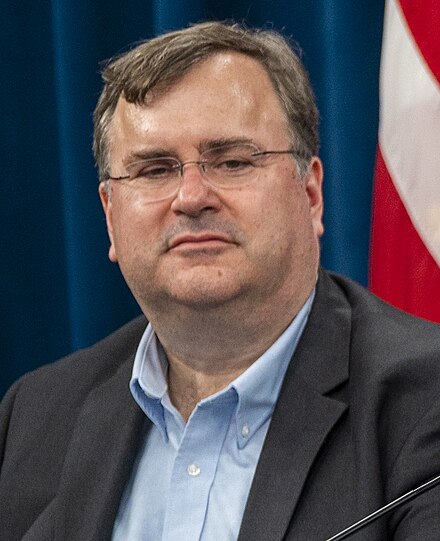
Please welcome to the stage Reid Hoffman and Secretary Hillary Rodham Clinton.
Well, I don't think I need to do much of an introduction of Reid Hoffman. Anybody here on LinkedIn? Yeah. But in addition to that, he's done so many other great investments and founded companies now working in everything from, you know, bio-pharmaceuticals using AI to, you know, helping us all understand more about the world we're entering. And Reid, really, I could not think of a better person to have on this stage who can help us chart what I call kind of the, you know, sensible understanding of where we are with AI because we've all been reading a lot of, you know, very scary articles and statements and we seem to, you know, just have the pendulum switch back and forth between the so-called accelerationists, you know, full speed ahead, don't ask any questions, the decelerationists, the risks are too great, stop right now. And I want to really get your take on this for our CGI community because you have always put yourself in the optimism camp and you are, you know, currently involved in scientific breakthroughs and trying to help solve, you know, health problems and diseases and the like. But how do we as lay people, you know, we're not in a frontier lab, but we're on the ground, we're in policy positions, we're in businesses, we're in academia and professions, we're in active civil society groups. How do we think about this? So, give us the description of the moment we're in, and then if you could wave a magic wand, what would we do to try to maximize the positive and minimize the negative of what's coming at us with AI.
So the moment we're in is we are in the process of creating amazing intelligence with the scale and cost of electricity. And you say, well, that sounds abstract. What is that useful for? And like to go super deep, one of the things is if today you have a high medical condition either as a doctor, as a patient, and you're not consulting a frontier model, ChatGPT, Claude, as a second opinion, you're almost making medical malpractice, right? That's how important it is. I personally know three people whose lives were saved by doing the second opinion, right? And it's not like I know that many people, right? I mean, it's not everyone on LinkedIn. And so, you know, part of the thing that I think is there's this amazing thing that can actually be completely transformative and while, by the way, part of doing a post there's going to be job transition and that job transition is going to be difficult just like the industrial revolution but time compressed and a bunch of other things. So really, really important issues to navigate that are super important. We don't have our current modern life without the industrial revolution, right? Everything comes from that. And so that's a similar thing on the other side. It's the reason why the journey is worth it. That's the reason why it's worth steering through this. And the problem with kind of the acceleration versus de-acceleration discussion is that when you get to thinking about risks, AI is also part of the solution. So like there's this discussion of existential risk. Like what happens with humanity and people say something like, well, can you guarantee me that there won't be killer robots? And you say, well, I can't guarantee that. They say, well, see, that's an existential risk, you should stop, QED, we're done, right? And you're like, look, if existential risk that like killer robots were the only existential risk you'd have that, but existential risk is a portfolio. We have a whole bunch of existential risks, not just nuclear, which people tend to forget about, natural pandemic, man-made pandemic, asteroids. So you have to look at it as a portfolio and actually AI I think very easily can decrease the overall portfolio existential risk even though you have killer robots and this is the mistake that the pronouncers make because they go, oh, it's this one thing and it's like, no, no, we are navigating a set of things like how do you stop pandemic? AI is actually the only thing. Cyber, you need to have more advanced models for the defense than the offense. So if you de-accelerate, you have a problem. And so that's kind of a scenario.
Now, if I could wave a wand, I do think that some of the things that are proposed are good ones. Kill switch is a good one. It's not a natural thing for a company to put in. So, it's a good intervention to kind of say, hey, you have to have that. Having essentially third-party auditors that companies are responsive to. It's actually something that I've been advocating for a few years. But by the way, now with what Dario and Sam were saying, actually more deep technical auditors are very good because, you know, Deloitte doesn't really understand frontier models either, right? Or I don't, wasn't meaning to pick on them. Your average accounting firm does not understand these things. And so those are good things to have happen because, you know, it's kind of there's a natural thing in a commercial race to say, oh, I'll get to that later. It's like, no, no, get to that now, right, as a way of doing it. So I think those are all good interventions. And then part of the like when you get to the acceleration de-acceleration, look, data centers, like I think Josh Shapiro at Pennsylvania is doing a very good job of this, is you have to have the local community bought in. You have to have something that's valuable to the local community in a durable, sustaining way, not just the construction jobs for the happening thing. That's a must, right? They must be bought in, of course, but a global moratorium doesn't help your local community and make them have their self-determination and choices. Now I think the states and the feds can go say, hey, let's set a floor by which local communities can't be auctioned against each other. It's almost like call it minimum wage and kind of like an environment but also in benefits and stuff, say, oh, this is your minimum to getting in. So I think there's some role for them too to make sure because the natural thing in business is, oh, which of you will give me the better deal and then you have an auction to a less good deal.
Exactly. So anyway, those are... So if I raise my wave my wand, I would say yes, kind of the kill switch and the safety plan and essentially the auditing and then kind of a, hey, have a way that local communities can negotiate for an intense and enduring probably economic benefit for themselves.
Well, that's interesting because we know that the auditors, at least, were mentioned in Dario Amodei's pronouncement, his statement. But what you're saying is they need to be real. They don't mean that, no, you know, just decorative auditors, but people who understand the technology and can, you know, really call an alarm if one is necessary. And similarly with the kill switch because somebody said to me the other day, well, if you've got, you know, the agentic bots who are basically in control of a system, can they override the kill switch? So give some thought to make sure that you can actually do the kill switch and then standards. I would say standards in a number of areas. You mentioned data centers and I think there was a lot of presumption and even arrogance about the data centers and I think a lot of communities, like you say, accounting firms may not understand auditing, communities didn't understand what they were signing on to. So having standards and I think either a temporary suspension or moratorium until those standards can be worked out or setting out a set of, you know, bars that have to be addressed and overcome. So I think all of that really makes sense. Of course, that requires that we have a government that can put that into place, set the standards, enforce whatever the, you know, provisions are because if an auditor comes forth and says this needs to be stopped, who's going to implement it? Who's going to make it happen? So, do you envision like some kind of, you know, AI agency, something in the federal government that we could turn to? Because you mentioned the industrial revolution. Well, a lot of our government came out of the last century because as people saw the industrial revolution, they wanted to fix the problems, keep the benefits, wanted to, you know, improve labor conditions, wanted to protect people with their, you know, safety on the job, wanted to prevent predatory companies from, you know, really forcing others out of business and all the rest of it. So how would you see this as a regulatory outcome?
So I think the important thing to start in this is say what are the things we should be measuring so that we can respond to them quickly as they happen. So start with what are the possible wrongs and ills and not trying to pre-plan it. It's a little bit like say, for example, you're trying to drive from here to DC and you said I'm going to pre-plan my whole drive. I know where the potholes will be. I know where the accidents will be. It's like you can't and if you try to do that you'll never get on the road. But you have some sense of, oh, if there's a traffic slowdown maybe we'll take this detour. You have a sense of things and some sense of what you could do but it's measuring that going into it because like for example we know that there's going to be job transformation but like what's the pacing, how does it work? And most of the AI technologists think that once you build the technology everyone's going to automatically adopt it tomorrow and then the whole job force would change. It's like that's not how human organizations work. So there's some time, like one of the places where I had that dialogue was autonomous vehicles and like, well, if you're going to create autonomous trucks what happened to the truck drivers? Well, if you started manufacturing, every single factory in the world started manufacturing autonomous trucks tomorrow, it's 10 years before half of the trucks are autonomous, right? So, it's like you got, it's not lots of time, but you have time to measure and you have time to respond and it's like, okay, what should we do early? Let's measure that and navigate whether it's jobs. Cyber I think is actually quite urgent.
Right. Bio can be very bad and is also urgent but probably hopefully nothing's going to happen, right? But, you know, those are things to actually really dive into.
Well, I want to drill down on that because that's what I think about. I think about, you know, AI in the hands of the bad actors, you know, and for my perspective having, you know, read a lot of classified material about, you know, bad guys trying to get nuclear material, trying to get, you know, bioweaponry. That happened before AI and they couldn't just, you know, dial into AI and say, tell me how to make a nuclear suitcase bomb. Tell me how to create a pathogen that can wipe out a small city. Sadly, that's becoming much more of a possibility unless we put these guardrails in very firmly soon. So when you think about the big threats and I'm glad that you, you know, mentioned that AI can help us but AI can also facilitate some of the cyber potential, bio potential and sadly even nuclear potential. Is there any alternative than other to try to forge international agreements? Try to, you know, I wish that that were on the agenda of this meeting that's going to be happening between, you know, Trump and Xi. That's what they should be talking about. You know, this new technology poses a threat to the control of the Chinese Communist Party just like it poses threats to us in keeping our democracy going and protecting our people. So, how would you think about the international agenda? Is that even possible, Reid, or everybody going to retreat to their corners?
Well, if we actually had someone who actually really was a dealmaker, then maybe. I'm a little skeptical.
But like the way you'd start is biorisk and cyber risk, like because if you can't do that, you can't do anything else, right? And the biorisk one is such obvious and I think legitimately the Chinese who like global stability have a shared interest here and so it's doable. Right.
Right. And I think it's very important. This is again part of the reason why pacing not necessarily slowdown is the defense is actually super important because humans as you know from the classified materials are capable of doing enormous bio stuff. AI can now help them because it's like having a PhD who does that. And part of the reason why you want these kind of high intelligence models, frontier models to be in a kind of a measured monitored environment is that you can't, the problem with open-weight models is if they're in an unmeasured environment, you can get them to be badly helpful if you're trying to do that. So you want it to be, you want to see what the query stream looks like. Oh, that person's trying to figure out new versions of smallpox. What's going on there? [laughter] Right. Let's go to that and so you want a measured environment for that. I think that's part of the kind of regulation that plays to open-weight models that plays to other things. But that should be on the agenda because once you get there then you can broaden to what are the other disruptions that we should pay attention to. But, you know, you'd actually have to have a real dealmaker who, you know, had some intelligence on this.
Yeah. Right. Not even super intelligent.
Regular would be fine. [laughter]