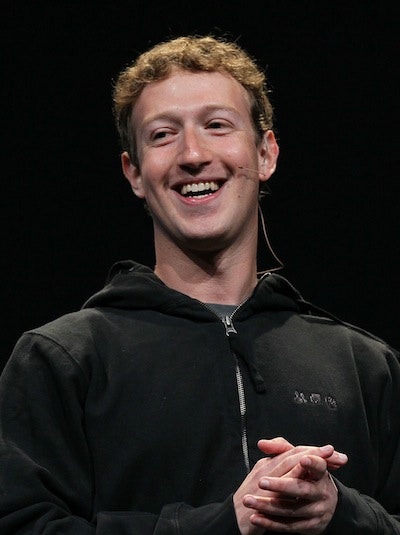
Mr. Zuckerberg, if you please raise your right hand. Do you solemnly swear or affirm that the testimony you shall give today will be the truth, the whole truth, and nothing but the truth?
Good afternoon, Mr. Zuckerberg. The law should apply equally to everyone, shouldn't it?
No matter how rich you are, the law should apply the same to you.
Yes. No matter how smart you are, the law should apply the same.
Yes. And it shouldn't matter how big or powerful a company like Meta is, the law should apply the same to it.
I think that's right. The law should apply equally to everyone.
Okay. And Meta Platforms, Inc. is one of the few companies in the history of the world to achieve a valuation of $1.5 trillion dollars. Is that right?
I think that's right. And Meta has announced a goal of continuing to grow and to try to increase its value by 500 times that to 9 trillion in the next five years by 2031. Is that right?
I don't think that's right. I'm not sure what you're referring to.
Okay. Can I have tab one, please? And what did we decide we're going to mark this as? 572.
Mr. Zuckerberg, we handed you plaintiff's exhibit 572. Does that refresh your recollection that META has a target of $9 trillion by 2031?
I'm not sure what you mean. You asked if we announced a target to increase our valuation by 500 times. And I don't think that that's right.
And you may have misspoke.
Okay. There you go. You see that highlighted part right there? That's where I got it from. Okay. Yeah. I mean, I don't think this was an announcement that we made.
Okay. Mr. Zuckerberg, you have a target of $9 trillion by 2031 for META.
I'm not sure what you're referring to. We have an incentive program for executives where they earn certain amounts of compensation at different milestones. One of those milestones, I think, is roughly corresponding to what you're saying, but there are others as well. This wasn't a program that we announced as the goal of the company. It's just a program that we have as part of the executive compensation for some of the people at the company.
Okay. The executives will get more money if they reach a $9 trillion value by 2031. Is that a fair way to say it?
That is part of the program, but I think it's true that people across the company and our shareholders overall benefit as the company does well.
Okay. You are the chief executive officer of Meta Platforms Inc.
And you were the chief executive officer of its previous company, Facebook. Is that right?
As CEO of Facebook, you started the company.
You were responsible for the things that happened there. Is that right?
And you had the ultimate power at Facebook. Is that right?
Well, I mean, I have the authority that comes with being CEO, right?
And during the time you were CEO of Facebook, you always retained the majority of the stock in Facebook, did you not, sir?
I don't think I don't have the majority of the stock in Facebook. Yeah, I have an amount of the stock that gives me a majority of the vote, which I think might be what you're referring to.
That's what I'm referring to. But I do not have the majority of the stock. And because you had the majority of the vote, you could appoint or fire the board of directors, could you not?
I suppose because I have the majority of the votes, I could win most shareholder votes.
Okay. And because you controlled the company, you had the benefit of not having to convince the board not to fire you. Is that right?
I think that that's generally true. I've given some podcast interviews where I've made that point. Although I think it's a little bit simplistic. I mean, of course, the board does have the ability to fire me if they think I'm not the right person to run the company or if I'm not doing a good job, but broadly, I mean, I do have voting control over the company.
And if the board wanted to fire you as the person who had the majority of the votes in the company, you could elect a new board and reinstate yourself, couldn't you?
In theory, over some period of time, I think it would be messy.
Okay. Isn't that exactly what you testified to in the case in California on February 18th, 2026?
Do you want to show me what I said?
Yes, sir. You were asked a question. You said because I control our company, I have the benefit of not having to convince the board not to fire me. That's an interview you gave to Joe Rogan. And the question was asked of you, do you stand by that and your answer? I think that's roughly correct because if the board wanted to fire me as the person who has the majority of the votes in the company, I could elect a new board and reinstate myself. Isn't that what you testified to just in February of this year, sir?
Yeah. And that's also what I just said.
Okay. So as a practical matter, you could not be fired.
No, I mean, I think I explained this before. The board can fire me. Your question, I think, was right that if I wanted to after being fired, I could in theory elect a different board because I'm the controlling shareholder of the company. But that doesn't mean that they can't fire me or that that wouldn't be a very complicated and messy proceeding.
Okay. You could stop things in the company of which you didn't approve, couldn't you? You had that power.
As CEO, I think most CEOs have that authority. There's always the question of what you're aware of exactly that's going on inside the company. But yes, in theory, I assume most CEOs can stop things from happening inside the company that they think are the wrong thing to do.
So, my question was just simple. You could stop things of which you didn't approve, sir. Is that right?
The promises you made as CEO of Facebook were promises on behalf of Facebook, were they not?
And the promises now that you make as CEO of Meta Platforms are promises on behalf of Meta, are they not?
If I'm making a commitment in my professional capacity, it is a commitment that I'm making on behalf of the company. Yes.
One of the things you promised as CEO of Facebook was to enforce the rules Facebook created equally to everyone. Isn't that right, sir?
It sounds like something I would say, but can you show me what you're referring to?
Could I have tab five, please? This is states exhibit 204. Mr. Zuckerberg, you testified before the US Senate Committee on Commerce, Science, and Transportation on November 28th of 2020. Is that right?
This document says October 28th.
Excuse me, I've got the wrong date then. October 28th of 2020. Is that right, sir?
Okay. And you were under oath when you testified before the Senate Commerce, Science, and Transportation Committee, I assume.
So, I don't remember this that well. But I can read this if you want me to answer questions about it.
And I'm going to ask you about what you said before this Senate committee. You were asked, Mr. Zuckerberg, can you commit that if the president goes on Facebook and encourages violence after election results are announced that you will make sure your company's algorithm doesn't spread back content and you will immediately remove those messages? And your answer, sir, on the next page highlighted, Senator, yes, incitement of violence is against our policy and there are no exceptions to that, including for politicians. Is that what you testified to, sir?
That's what this says here. So, I have no reason to believe that's wrong.
All right. And Senator Markey asked you there are exceptions. Did you say and you said there are not exceptions, didn't you, sir?
I'm not sure if that's a mistranslation. I think that this is I agree with what is written here. I'm not sure I would say there are not exceptions. I'd probably say there are no exceptions, but.
Okay. You're just quibbling with the grammar. Yes. Okay. Thanks. And then tab six please Gordon which is plaintiff's exhibit states exhibit 203. This is states exhibit 203 and it's tiny because that's how it printed out but we have blown it up at the back the two parts that I want to ask you about. You recognize that as a snapshot of your Facebook page?
And when you wanted to communicate things to people, you posted things on Facebook yourself, sir, didn't you?
Yes, that's one of the ways I communicate.
And when you post on Facebook, do you write the posts?
Are those posts run by your communications department?
Depending on the content of them, I run them by different teams internally.
Okay. This is a post from June 26th of 2020. And if you will turn to the blown up part, one of the things you said in this Facebook post was that even if a politician or government official says it, if we determine that content may lead to violence or deprive people of their right to vote, we will take that content down. Similarly, there are no exceptions for politicians in any of the policies I'm announcing here today. Isn't that what you said, sir?
You're asking about the part that you highlighted here.
And your question was just is that what you said when.
My question is that's what you said in your post.
Yeah, I was just asking you if your question was are you asking me if you were correctly reading a part from the post?
All right. And then if I can have exhibit 202, please have seven. And Mr. Zuckerberg, you recognize plaintiff's trial exhibit 202 as another one of your posts.
Mr. Zuckerberg, did you not say in that post, our current policy is that if content is actually inciting violence, then the right mitigation is to take that content down, not let people continue seeing it behind a flag. There is no exception to this policy for politicians or newsworthiness.
You are correctly reading what is in the post.
And then if we can have tab eight please. What I want to ask you about Facebook newsroom posts because that was another way that Facebook communicated its policies to its users. Is that right?
Yes. Newsroom is sort of like our corporate blog.
Okay. And I want to ask you about one of your posts from that. This is exhibit 2011 and I want to ask you about the on the first page.
So I want to ask you about two parts of that first paragraph.
Okay. And I want to ask you about the first sentence first that's highlighted in yellow.
Okay. Is there are there other parts of this that you want to ask about?
That's it. Just the first part. Focus on that.
Okay. It's under the caption cross check and it says the first sentence says we want to make clear that we remove content from Facebook no matter who posts it when it violates our standards. There are no special protections for any group whether on the right or the left. Isn't that what it says, sir?
Yes, you read that correctly.
And that's what Facebook was putting out as its policy on that date. Is that correct?
I think that that's a fair interpretation.
All right. And the date of that was July 17, 2018.
And then the second part of that talks about something called crosscheck. And I'm going to talk to you some more about that in a bit. But cross check often in the records of Facebook is instead of the word cross has an X and the word check behind it. Is that right?
I think I've seen it referred to that way.
Okay. And this part says what's highlighted in blue there. Cross check the system described in dispatches simply means that some content from certain pages or profiles is given a second layer of review to make sure we've applied our policies correctly. Did I read that correctly, Mr. Zuckerberg?
Okay. Thanks. People who paid to advertise on Facebook did not like having their content checked or removed, did they?
I'm not sure what you're referring to.
I think that's a pretty standard part of the way the service works.
Yes, sir. Did people like having their content flagged or removed?
I'm not sure anyone likes being told that their content is unacceptable.
Okay. Among the powerful people who complained about having their content removed, flagged or demoted were politicians. Among the powerful people who complained to Facebook about having their content removed, flagged or demoted were politicians.
I think that's right. I mean, a very broad set of people have complained about things that they think limit free expression and that includes politicians, but I don't think it's especially for politicians. I'm going to go through the list of other people who've complained too. Politicians who were not in office yet but running for office have complained about having their content.
Yes, among many other people.
Political pundits who were commenting on either the right or the left have complained about having their content flagged.
And celebrities who had a big following on Facebook have complained about having their content flagged or demoted, haven't they?
In some cases. And despite your promise to treat politicians the same as ordinary users, Facebook created something known as a white list, which shielded politicians from being fact checked, didn't it?
I'm not sure what that's referring to.
Okay. You are unfamiliar with the white list at Facebook that shielded politicians from being fact checked.
I'm not familiar with what you're referring to as a white list. I think the terms around the policy around misinformation and factchecking specifically said for the fact checkers what content was eligible to be focused on and we were trying to focus on like bad and harmful hoaxes not parsing words and political speech. So I think that that was the explicit direction that we gave the fact checkers because we wanted to focus on things that were kind of broad hoaxes.
So you told them not to fact check politicians.
Well, we told them what zones we thought that they should focus on. And yes, I think that we explicitly told them that the point of the factchecking program wasn't to primarily focus on like parsing the words of politicians, but to stop broad misinformation from spreading on the platform.
You actually created a list in 2020 of over 4,300 individuals and entities located in the US who were not to be fact checked. Isn't that right?
Sorry. When you say you, I assume you're not talking about me. You're talking about.
I'm talking about your company. Yes.
I don't actually I'm not actually sure.
Okay. Can we have let's see tab 12 and tab 10, please? Thanks. So, Mr. Zuckerberg, we submitted this is a I'm sorry, Hannah, this is a plaintiff's trial exhibit 598. We submitted questions to Meta in the form of discovery and asked for answers from your company about both the white list and the cross check program and these are the answers that your company gave. If you will turn please sir to page 10 and we asked about Facebook's political whitelist and the answer was that as of November 3rd 2020 Facebook maintained a politician white list that contained over 4,300 individuals and entities located in the United States. Do you see that, sir?
I do. Do you want me to read the rest of this document?
Not yet. No, sir. That's the one part I'm going to ask you about. And if we can have now.
Yeah. tab. Yeah. This is exhibit B.
Attached to this sir was a list that was the 4,300 individuals which was exhibit B to the discovery answers. This is plaintiff's trial exhibit 206. Hannah and sir, do you recognize this as the political white list that Meta maintained on November 3rd, 2020 where of the politicians who were not fact checked?
I'm not sure I've seen the list before, but it makes sense to me that if our policy was to have the fact checkers focus on broad hoaxes and not political speech that we would have to operationalize that by creating a type of list that would direct the fact checkers what types of stuff to look at and what not.
Okay. So, you don't deny that this was the list that Facebook had in 2020?
Yeah. I mean, I don't deny it, but I also am saying that I don't think I've seen this before. So, I also can't confirm it.
You weren't one of the fact checkers that was using this list to see who was exempted from factchecking.
No, I was not a fact checker.
Okay. And there were more people and more entities who were on this political white list who were outside the United States. Is that right?
I haven't gone through the list, so I can't tell specifically, but you've asked about groups like politicians. I mean my understanding are you asking specifically about this misinformation and factchecking piece or.
Let me rephrase my question for you Mr. Zuckerberg in your answer to interrogatory what Meta represented was that these are the 4,300 individuals and entities located in the United States. My question is simple. There were other lists of politicians located outside the United States. Is that right, sir?
What are you referring to?
I'm referring to this exhibit 598 that page 10 that this exhibit B represents just political figures in the US. So my question is just there were other lists of politicians located in other countries. Is that right? That were also exempt from factchecking.
I'm not sure I'm the right person to answer that question. I mean I think you could probably find this information somewhere else and I don't know what lists we maintained.
Okay. On this the people on this list were treated differently than ordinary users, were they not?
No, I don't think that's true.
Okay. Over time, the list of whitelisted politicians got even longer, did it not?
I've already testified several times that I'm not really aware of what was on the list. So, I certainly don't know how it changed over time.
Okay. If you will turn to page six in that document that you've got your hand on right there, sir. That's your answers to interrogatories. We asked for the white list as of 2025. And the answer that Meta gave was exhibit A. Well, two answers. Facebook maintained a politician white list in August 29, 2025 that contained over 5,500 individuals and entities located in the United States. Do you see that, sir?
I do, but I think I should read this document if you're going to ask me more questions about it.
Well, if you want to take a break, this is the answers to interrogatories that your company gave.
I have no reason to believe that's incorrect. But if you want to ask me questions about a thing that I'm not aware of, then I should have the time to read it.
Okay. Well, let me ask you about exhibit A. On page six, which is also highlighted, exhibit A, if I can have that, too. Gordon, is the list of the individuals and entities located in the United States that appeared in the politician whitelist closest in time to August 29 of 2025. And that is trial exhibit number 205. And my question to you, Mr. Zuckerberg is do you dispute your company's answers to this interrogatory and that this is the white list that had increased in number by 2025? The politician white list.
I have no reason to think that any of this stuff is inaccurate. But you're asking me questions about things that I'm not personally aware of the details. So if you want me to answer the questions, you're going to have to give me time to read the documents.
Okay. Let me ask you another question. The whitelist program wasn't the only system that Facebook and Meta set up that treated people differently, is it?
I'm not sure what you're referring to.
Sure. The other was the cross check program or the X check program as it's referenced in some of your documents. Is that right?
I mean, I disagree with the characterization of the question. It's not treating people differently to say that we have a policy that is about broad misinformation and not parsing political speech.
Okay. No, no, no. I'm just saying that's the same program that was referenced in this newsroom post that we talked about earlier. Is that right?
Are you asking if what you're referring to now is cross check is the same as what is referred to as cross check here?
Okay. Let's talk about who was on the cross checklist as opposed to the politician list. On the cross checklist, were there business partners that made money for Facebook on the cross checklist?
I'm not familiar with the whole list. So, I would certainly believe if there were people on the list who were business partners, but I also can't name any off the top of my head.
Okay. Were there celebrities who were on that cross checklist?
Were there podcasters and other influencers who got people to engage on Facebook on that list? The cross checklist?
I think so. And more broadly, I think it was focused on sensitive accounts where we were worried about making mistakes on review. So, wanted to make sure that we looked at them twice. So, it also included people like human rights activists and journalists and people who might have enemies who were trying to flag their content or get it taken down and we just wanted to make sure we had the right level of review. But to be clear on this, because I think you're kind of implying something here, the rules and policies are exactly the same for the people on the cross checklist as they are for people who aren't. These are this was intended to be sensitive accounts where we wanted to make sure that we really reviewed the content to be extra careful that we weren't making a mistake of either leaving something up that we weren't supposed to or taking something down that we weren't supposed to.
Do you agree with your head of civic integrity that anyone in management including you and Miss Sandberg could ask to have people added to that list? The cross check list.
What are you referring to?
I'm referring to his deposition where he said there was a friend of friends of Mark and a friends of Cheryl group of people that were added to this list at your request. Did that happen?
I'm not aware of that, but if you want to show me testimony or documents about that, I'm happy to read them and see if that refreshes my memory, but off the top of my head, I don't recall anything like that.
The cross check list included people who contacted you and asked to be put on the list. Is that right?
One of those was Joe Rogan, the right-wing bro podcaster.
Again, I don't It's possible. I don't remember it.
Mr. Rogan contacted you personally in 2023, did he not?
And complained about having his content removed by Facebook.
I do think we've taken down and made content mistakes on his content and taken things down that weren't supposed to be taken down. I don't remember an interaction around him asking to be added to any program. It's possible that it happened, but I don't remember that.
After that, you sent down word to the people that worked for you that he should be added to the cross check program.
I don't remember that, but it's possible that if we made multiple mistakes on his account that I would ask them to take steps to try to minimize making more mistakes.
This is trial exhibit 261. And if you can turn to the second to the last page, Mr. Zuckerberg, which is where we're going to start. That is an email from you, Mr. Zuckerberg. Is that right?
Okay. What was your question?
My question was Mr. Rogan contacted you directly complaining about his posts getting flagged and deleted. Is that right, sir?
I think what you're saying is roughly correct. Although I think for clarity, I'm not sure that the account that he is flagging to me is his account. It may be something that someone else makes, but I'm not sure. He said he messaged Joe Rogan messaged me that posts on the Joe Rogan Experience Companion IG page keep getting flagged.
And I'm saying that I'm not sure if he runs the Joe Rogan Experience Companion page. I think that that may be someone else that he's raising this on behalf of, but I think your point is roughly correct. I'm just trying to be precise.
All right. And you asked also highlighted there, if we have a list of accounts that we double re double review before taking action on them, can we put Joe's pages on that list to make sure we're reducing false positives on his accounts as much as possible? Do you see that, sir?
And let me ask you about just email. Email was one of the ways that people communicated in Facebook. Is that right?
Yes. It works like email anywhere.
The person whose email address it is is usually the one writing it at the time that it's written. Is that correct?
And it's the way you did business at Facebook was through these emails. Is that right?
Yes. Email is one of our communication channels.
And you did not delete those emails. You preserve them as part of your business records. Is that right?
And this is one of the records that was kept that same way. Is that correct?
I assume so. That's why you have it.
And if you can flip to the first page, on September 22nd, 2023, a fellow named Matus Sturm, am I pronouncing his name correctly?
Okay. is emailing back to you to say, We are glad to report that Joe's relationship manager has shared the full list of accounts managed by Joe's team and the relevant X check tags have been added to those accounts, ensuring a second review prior to enforcement. Is that right?
I think you're summarizing this correctly.
Okay, thanks. Let's talk about what the cross check program did. Cross check prevented content that violated your rules from being taken down right away. Is that right?
Well, my understanding is the purpose of this program is to ensure that sensitive content got reviewed twice before we took an action in either direction.
Yes, sir. So, it prevented content from being taken down right away, did it not?
I think that that's somewhat of a mischaracterization of the purpose and how the program works, but it required review of the content at a more senior level in order to make sure that we were making the right content decisions.
Which meant it didn't get taken down right away.
It got taken down as soon as it went through that process.
Okay. But not as soon as it was flagged by your AI program. Is that right?
I guess that is right. Although there's a lot of content that gets flagged by an AI program for a person to look at. So I disagree with the implication in what you're saying that that's somehow abnormal.
Even if your AI program flagged a post as being hate speech or containing gore or nudity or inciting violence or containing harmful information, if a person was on the cross checklist, it would not be taken down immediately, would it?
I mean, we have a lot of content that the AI flags to people and that people review because it's important. And for these cases, if you're dealing with human rights activists or journalists, people who have adversaries who are trying to flag their content and assert that there's a problem with it when often there isn't, it seems appropriate and important to make sure that we have an extra step of review to make sure that we handle that stuff correctly.
So again my question just was if you were on the cross checklist even if you were in one of those categories hate speech, gore, nudity, inciting violence if you were on the cross checklist that would not be taken down immediately even if it was flagged by AI would it sir?
I mean, I think I've walked through what the process is, but your question implies that like every other content would immediately be taken down, and I think that there's a variety of ways that we handle this, including often having the AI escalate it to people even if the people are not on cross check. So, I think you're implying something that I think is not right with your question, but I've walked through what the process is.
Let me rephrase it for you then. Where the average person would get a strike or be immediately put in Facebook jail. You've heard that term, haven't you, sir?
Okay. People refer to it as use that to refer to different things. So, you might want to be more precise, but I've heard of the term.
Well, where the average person would get a strike, the person on the cross checklist would get extra chances for a review. Is that right?
Again, I disagree with the way you're characterizing this. I mean, the point of the program is to make sure that we didn't make content review mistakes.
The more important to Facebook, the person of the organization on the cross checklist was, the more levels of review they got. Is that right?
I'm not aware of anything like that. I thought there was a standard process that we have for this.
You weren't aware that some were contacted and got the chance to take down content so they wouldn't get a strike on their account that could lead to their privileges being taken away.
I'm not sure what you're referring to.
Okay. You have not heard of the term of a cross check member being fire brigaded, which meant that they got three levels of review before content was removed or demoted.
The term fire brigaded, which meant that people on the cross checklist got three levels of review before content was removed or demoted.
I don't think I've heard that term until just now when you're saying this.
Some wouldn't be removed even after three levels of review unless someone in management agreed to remove the content. Weren't there people like that on your list?
Again, I'm not sure I'm aware of all of the details of the process on that.
The problem with treating certain people differently in the cross check program is that the layers of review, whether it was one or three or three plus a manager, somebody in management, it took time to do that review, didn't it?
Sorry, I'm not sure I understand your question. Are you saying what is the problem with it or are you just saying that it takes time to do review?
Yes, sir. The problem was that if you had whether it was one layer or three layers or three layers plus management for a review, it would take time for that review to happen before a decision was made about whether the content should be removed.
I mean it takes time to make content review decisions across the whole company.
And a policy violating video containing hate speech or violent content or harmful misinformation in fact could go viral within hours of being posted, couldn't it?
It could, but we also as I think an operational matter are more attentive to things that are going viral and getting a lot of distribution than things that are not seen by many people. So I think the implication of what you're saying that somehow important content would be delayed more I think in practice is not actually how this happens.
Okay. We'll ask we're going to talk some more about that in a second here. Although your AI tools had the power to detect violating content right away and remove it, it did not do so for those in the cross check program, did it?
I mean, I feel like I've answered this a number of times already, but we have AI tools that try to identify content across the company, and in some cases, they have the ability to take down the content, and a lot of other cases, they flag it for human review. The program that we're talking about here, I think, is one example of where it's flagged for human review, but there are lots of examples where the AI system either may not have the confidence or where we might require additional review before taking an action.
By 2022, the additional review was backlogged and taking about five days on average. Isn't that right, sir?
I'm not sure what you're referring to. We've had different backlogs at different periods of time. So it is possible that there was a backlog in this process but I also think we've had backlogs in other parts of the company too and we generally strive to minimize those as much as possible.
Five days is a lifetime online isn't it?
I'm not sure what you mean. I mean that's a.
Well viral content has been widely disseminated and the viewer has moved on five days later haven't they?
Yeah, certainly the lifetime of content can be shorter than five days if that's when the majority of it will be seen. But again, like I said before, when something is going viral, we're more likely to prioritize seeing it and reviewing it sooner. And it's most of the times when something is not being seen by a lot of people is when we allow it to get prioritized below things that are getting seen by a lot of people.
One of the groups on your cross checklist was the right-wing news outlet Breitbart, wasn't it?
I don't know that for a fact, but as a prominent outlet, it seems like they might be.
That site was one of Facebook's managed partners.
Again, I don't actually know the list of all of our managed partners, but as a prominent news site at the time, I think it's conceivable that it was.
In July of 2020, during the pandemic, Breitbart created a live video with false information about COVID-19 in violation of Facebook's misinformation and harm policies, did it not?
I think you'd have to show me the specific content. I'm not aware.
This is plaintiff's trial exhibit 258. Mr. Zuckerberg, this is one of the emails retained inside of Facebook. Is that right, sir?
And it talks about the Breitbart COVID misinformation and harm. Do you see that, sir? In the first paragraph there.
Let me read it. Okay. What was your question?
My question was the content from on the Breitbart COVID misinformation and harm was flagged immediately by your AI system. Is that right?
This summary which I think I'm reading for the first time. I'm not on this email suggests that it was flagged by a system. And then it looks like X-check required it to be reviewed further and then it was escalated to someone else and eventually an enforcement action was taken. But I think that the point of this is we continually try to improve our enforcement. So, I think I read this email as basically trying to describe a way that we could have handled the enforcement faster and the team striving to do that, which is an important part of our overall process.
By the time that the cross check review was done, the broadcast already had 40 million views, did it not, sir?
It is saying here that it had that it VPV I think means it showed up in feed. That doesn't necessarily mean that those people watched the whole broadcast but which I think is probably your objection but 40 million people it would have showed up and at least 40 million people would have scrolled by it in the feed.
Okay. Thanks. I want to talk about how many people were exempted or on the list of your cross check program. And if we can go back to the interrogatory answers, which is this one, 598. We asked how many people were on your cross checklist as of November 3rd, 2020. And your answer was that it contained 13,500 individuals, entities, groups, and pages located in the United States. Do you see that, sir?
I see what you've highlighted, but I'm going to read around it as well.
Okay, if I can have exhibit D, too.
We're handing you what's been marked as plaintiff's trial exhibit 208. This is exhibit D2 to Facebook's answers to interrogatories, which is the list of 13,500 individuals that were on the cross checklist as of November 3rd of 2020. Do you see that, sir?
Okay. And then that group of 13,500 folks in the US were getting different treatment than the rest of your users, the ordinary users on Facebook, were they not sir?
The process for reviewing the content was handled more sensitively, but the rules that were applied were the same.
Oh, I see. Okay. Then if you can flip to page 15 of again back to the answers to interrogatory sir. We asked you for how many people were on your cross checklist as of five years later August 29 of 2025 that's on page 15. Sir are you there?
Okay I'm there. What are you asking about?
And by 5 years later the cross check list had expanded in the US to include 799,000 individuals, entities, groups, and pages located in the United States. By 2025, the cross checklist had expanded to 799,000 people that got an extra review that ordinary users did not.
Right. I mean, I can just read from this document. Facebook maintained a cross checklist that contained over 799,000 individuals, entities, groups, and pages located in the United States comprising individuals, entities, groups, and pages that received additional level of review after content is identified.
Okay. And you don't dispute that, sir, do you?
No, I assume that this was reviewed very carefully and very accurately.
And on exhibit on the next page 16, you provided exhibit C, which was the list of individuals, groups, entities, and pages. Exhibit C is what Facebook produced as the list of individuals, entities, groups, and pages on the cross checklist as of August 29, 2025. Is that right, sir?
And if we can get exhibit C, please.
Would you mind clearing the space a little bit so I can Okay.
Yeah, we can push that maybe here. Yeah. Okay.
Okay. All right. Good deal.
Okay. Mr. Zuckerberg that is exhibit C that Facebook Meta Platforms provided as the cross checklist as of August of 2025. This is trial exhibit number let's see exhibit it is 207 trial exhibit 207 and on that cross check list from 2025 if you will turn to well first of all there are about 164 people on each one of those pages there's about almost 5,000 pages of names on this cross checklist that are provided. And that number, 799,000 people could fill the 10 largest stadiums in the United States. That number of people could fill the 10 largest stadiums in the United States. Is that right, sir?
Almost 800,000 people. I don't know how many people fit in the 10 largest stadiums, but you know, I mean, I haven't seen the document before, so I can read it if you want, but I think that would take probably more time than we have today. But I mean our team tries to do a thorough job and review content sensitively and I assume that that's what we were trying to do here is have the content that we really wanted to make sure that if there was someone who was trying to get something flagged inappropriately that we had the right level of review to minimize the mistakes that we were making.
Okay. And they got a different review than ordinary Facebook users, did they not? Sir.
We have different review processes for all kinds of different things across the company in accordance with the level of sensitivity and likelihood of making mistakes. We're trying to minimize the number of mistakes we make, either taking things down that we're not supposed to or leaving things up that we're not supposed to. But, you know, it's a challenging problem to get right. We have I'm very proud of the systems that we have in place. We have more than three billion people on our platforms. So while you can say that some number of thousands or tens of thousands of people is a large number in absolute it's a relatively extremely small percent of the overall community. And when there are things that are sensitive, I think having a process that allows us to review that and treat it more sensitively is appropriate.
Okay, let's talk about some of the people on that list who got extra review. If you can turn to page 119 on that list, and they're all in numerical order, sir. So 119.
Do you want me to I mean.
On 119, Alex Jones was one of the people that got extra. Alex Jones was one of the people on your cross checklist that got extra review that ordinary people didn't get.
Page 119. Sir, what is this? Did you print the same thing over and over again just to make it look like this is more pages?
No, sir. I don't think so.
Okay, let me ask just a question without you looking it up and see if you remember Mr. Zuckerberg. Was Alex Jones one of the people that was on your cross checklist?
I don't remember who was on the cross checklist, so I have to look through this.
Okay. How about Andrew Tate? Do you recall whether he was on your cross checklist?
Again, I do not remember specific people.
Infowars. Were they on your cross checklist?
I'm not sure. Again, I didn't maintain the list, so I'm not sure I'm the right person to ask, but you also have all the information, so I think it's there.
Do you know if the Oathkeepers were part of your cross checklist, sir?
Same answer. I don't know the specifics.
Mr. Zuckerberg, on October 2021, the Wall Street Journal did an expose series called the Facebook Files. And one of its stories revealed and was critical of your cross check program. Do you recall that, sir?