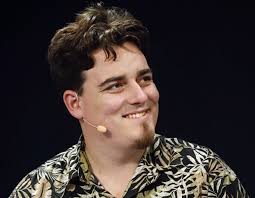
Wow, it's so much brighter out here.
It is. It's, you know, the future is bright.
There's lens flare in the future.
Yeah. So, welcome everybody to the Oscars of optimism that, of course, we're opening up the summit with the king of autonomous weapon systems.
All right. So, I want to start with the fact that we're awarding three X prizes this week. Palmer, congratulations for winning our Wildfire X-P prize.
Yeah, this one's been a long time. And let's get the slide up here. So, Palmer won $2.2 million for Anduril, as if you need it. A million of that from Lockheed, which was kind of interesting.
We do a lot of work with Lockheed. We also compete with them, but in the defense space, we compete with their fighter jet division and we partner with them on some of their payloads. And so we do a lot of stuff together. But me and you have both been trying to get this autonomous firefighting stuff going for a long time.
For a while. I mean, you got this prize announced back in 2019. It's been a long time. And one of our first two products was an autonomous firefighting tank that we started building in 2017, finished in 2019.
It's insane that we let fires become conflagrations before you put them out.
And well, and it's kind of insane that people are saying, 'Oh, the technology's finally made this possible.' And I'm not going to correct him too often in public, but it's, I mean, this has been possible for over a decade. It's just that it's become politically impossible to ignore the problem.
Let's watch. I'm going to watch a one-minute video clip of what your team achieved and if you'd walk us through it here.
Sure. So this was an example of what we were doing at the test site where we were detecting fires, classifying fires. What you don't really see in here is that you also need to reject false fires. That was part of the test as well. So you have to know, you know, who's a guy smoking a cigarette, who's a guy, what's a campfire, what's a road flare, and then what's something that shows the characteristics of real fire? That's what you need to flag to people. That's what you need to flag to emergency services. And then you need to matchmake the type of fire to the right asset that's in the area. And so you want to basically use the most cost-effective thing that can respond and get there in time. And if something's growing faster, you might need something different. If it's in woods versus on a brush hill, you might need something different. And so, you know, it's about detection, classification, rejection, matchmaking, and then going and hitting the target. And the last thing I'll say is that with most of what we do, our work with the military, you go through many of these same steps, but if you find a target, let's say it takes you, you know, an hour to get to somebody versus 10 minutes, it usually doesn't make as much of a difference. When you're talking about fire though, the difference between 10 minutes and an hour response, totally different tools you're going to need to respond with. You know, a bomb is a bomb whether or not it takes a day or an hour or a minute to get there. But when a fire is metastasizing, you need to pick the right thing that can put it out before it gets too large.
Amazing. You know, we're going to be announcing something in a month's time, that you're funding a new X-P prize and, it's going to be secret until then, but we're going to tease it now. Another $10 million prize. Would you share with us what we're going to do?
Sure. You know, we should keep the details secret because there's some good twists, but suffice to say that, I'm not interested in joining the race to push AI forward with my money. I think that the artificial intelligence side of models is pretty well covered by plenty of people. I think we've not been doing enough understanding biological intelligence, particularly beyond people. And so this is going to be a prize around understanding how animals think and making so that we can communicate with them 10 times better than the current state of the art for the current smartest species. And not just trained animals but wild animals in their own language.
Amazing. And I think that there's actually a lot that we're going to be able to learn. I mean if you look at large language models, they're kind of this, you know, they're based on humanity's way of thinking and communicating distilled. And I think that there's plenty to learn from all of the other species that are on this planet. And I wouldn't be surprised if it has applications for AI, particularly AI, where you need to be more efficient, you know, more power efficient, more time efficient, a different point of view, two heads are better than one, whatever metaphor you want to use.
Love it. Love it. All right. I'm going to kick off the first official question here. Poom, you're in the AI industry, the defense industry. What's your P-doom?
I'm just not worried about AI dooming the... I guess I'm not worried about AI doing the killing. I'm very, very worried about evil people using moderately competent AI to do evil things.
And I am kind of frustrated by a lot of people who are new to the dooming hobby. And it's sort of like how we had to deal with the war in Ukraine happens and all of a sudden all these people who have had the dumbest opinions you've ever heard about the military for their whole life. And people who believed we lived at the end of history, that we had moved past conflict, that we lived in a world where you could just write a nasty letter in the UN, forgetting that that only works if it's backed up by credible threat of violence. And all of a sudden they change their minds. You're seeing this with AI. People who have not thought about this problem for more than a couple years or maybe even just a couple months are saying, 'Oh my god, this is the biggest threat to humanity.' And these are people who have spent almost no time actually analyzing what the largest threats to humanity are. They haven't spoken to any of the experts in this area. They certainly weren't buying freeze-dried food and building prepper bunkers, you know, like me and many of my buddies who have indulged fantasies about what doom could look like and also thought realistically about it. And so yeah, the AI doom is way down the list for me. I'm a big optimist. I think it's going to massively reduce the cost of resource extraction, processing, transformation. You're going to see every part of society become subject to the same economies of scale and efficiency that automated industries that automated without AI have seen. So think like agriculture or textiles. You can buy two weeks of calories for less than one hour of federal minimum wage labor. That's crazy.
Let's give it up for Palmer here.
You're going to see that for everything.
So, I got a really pressing question on my mind. I'm kind of a feeds and chips and AI foundation models guy. And so, when you're putting systems in the field, weapons in the field, you can put the intelligence inside it, and this has always been a big problem for the Air Force, like if we're going to start flying drones instead of pilots, who's going to unleash the weapons, and how's that decision going to get made? And the downside of transmitting it back to headquarters is you have latency. The upside is you have a lot more compute. What you can put locally in a device in a robot in the field in a plane is limited but it's really, really fast. So, what's your philosophy on like, you know, I think a lot of people would say, well, are we going to have self-contained decision-making weapons wandering around enemy territories or are we going to have, you know, control at the headquarters? How does it work?
More or less. The real concern isn't so much the latency or the speed of computation. The problem is that if you rely on a central location to do your compute, you now need to have command and control that has good high bandwidth communication back and forth between you and potentially thousands or tens of thousands of active assets. And if your enemy jams your communications or intercepts your communications or hacks your communications, you're done. Or worse they just skip targeting all the stuff in the field and they go for the place where it's all being controlled. You know, we saw this... there was this documentary that George Lucas was working on and the Trade Federation, they had their central AI command and control blown up and that was how the battle of Naboo actually resolved was all the battle droids lost.
Oh yeah. They all fell over.
That's right. And they all fell over. And so I think that's the practical reality that's driving the need to have autonomy living not back home but forward. There's other areas like you go underwater, you can't talk to things, and sometimes you could talk to things but you don't want to. Having radio emissions actually exposes you necessarily and so you for better or for worse you're going to need this. I actually don't think it's as much of a shift as people think. There's a lot of people who look at and they say, 'Oh my god, Pandora's box is being opened. You're going to have weapons that are making their own kill decisions,' and they don't recognize the reality, which is that that's been the case for decades. You look at the Aegis system on destroyers. It has a fully autonomous mode. You can flip a button and it will shoot down anything that comes within whatever range you programmed it with without any human confirmation. You look at SeaWiz and CRAM for shooting down incoming missiles, incoming mortar, incoming artillery fire, incoming missiles or incoming speedboats. Same thing, you can put them in fully autonomous modes. And I mean going back to Vietnam, we had missiles that you could launch from an aircraft. They flew over the horizon, tried to identify the right radio emitters that they believed corresponded with a surface-to-air missile site, and then struck them without any, you know, the person had to decide, I'm going to send it in this area. They're going to look for this signal and I know that there's this probability they're going to get it right. That decision is going to remain with people. But autonomous weapons are widely... there's a whole another talk we're not going to have today. But I do have a rant about this where actually autonomous weapons have existed for thousands of years. If you look at and they're defined as kind of weapons that can execute the intent of what you program to do independent from the operator or the engineer. You look at, for example, pitfall traps that allow people to walk over them, but then capture the commander on his horse when he walks by and it's heavier. You look at certain poison traps that would kill people who had certain characteristics, not kill people who had other characteristics or not kill animals. You look at many types of landmines and sea mines and even torpedoes. And so it depends on your exact definition, but even going into myth where people are creating golems that can, you know, go out and fight on their behalf or defend their city. I guess my argument is we've had autonomous weapons for a very, very long time. It's just a new set of technology that's making them better.
So technical question on that. The foundation models that go into those remote systems right now.
Yeah. Well, so right now the open source models are all Chinese. So I'm pretty sure you're not going to be putting Chinese models into remote weapons. Are you going to build foundation models or how are you going to get AI in those devices? I mean, we've been doing it since 2017. So we're way ahead of everybody. We're a decade beyond that question. I think that we also don't... the foundation models that people are building are not the types of models you want to be doing this. They're largely non-deterministic. They're non-auditable. It's a very different category. The thing that we are building unfortunately has very few consumer applications and vice versa. There are of course LLM use cases for defense that make a lot of sense, but it's not guiding my missile or classifying radar feeds. I mean, and we're also... we can't build models that ingest text and then spit out text. I need to process raw radar data feeds. I need to process sonar data from passive listening stations on submarines. That's pretty highly specialized. And I will take some credit here. All these people who are talking about how AI is going to change everything, they are mostly recent converts. And Anduril Industries, you might notice the acronym is AI. So that was not a mistake.
Okay, Alex, jump in.
Yeah, I think maybe dovetailing on our discussion of driving benchmarks, we're now in an era when it's possible to take frontier models, drop them into a robotic embodiment and get pretty stunning results. So, I'd love to ask you a question maybe about the scaling hypothesis as it applies to autonomous weapon systems or autonomous systems in general. If you have to extrapolate out, is there a Moore's law? Is there an experience curve for what a... as obviously the capabilities of underlying frontier models whether they're from frontier labs proper or from Anduril, as those progress do we see any equivalent of a Moore's law for the autonomous systems themselves and maybe the second half of the question would be do you think ultimately we achieve some sort of convergence, you'll... it makes a variety of embodiment in a variety of different form factors. Do you see ultimately some general purpose category killer robot that is equivalently the generalist robotic embodiment just like we now have generalist models that are capable of doing substantially any task?
No, I don't think so on the defense side. I think that for manufacturing and for hospitality and medicine, you might see this because you get economies of scale that are really material for those types of businesses. And you know, a humanoid robot may not be the optimal form for a burger griller, and it may not be the optimal form for a firefighter. It may not be the optimal form for a nurse or an assembly technician.
But even if it's not optimal, the fact that it is shared with humanity in its form makes it a really, really good form factor. And now I can make one robot that does all of these things. And I would probably rather have a let's say robot that's 5% slower or less reliable than the optimal burger-flipping robot if I can share commonality with that nurse. In defense, that's not really the case. Because you are in this constant race to not just barely beat your adversary, but to massively overpower them, to try and make it where the goal is not to just barely win a conflict on the margins. It is to fight unfair, to have overwhelming threat of violence underpinning whatever diplomatic overtures or negotiations you have. And everyone's always pushing the limit. So if I have a jet that has a reliable 5% every time edge over the enemy, that's worth paying a lot of money for, right? And I think the loss in performance you would see through lack of specialization probably makes it nonviable. Like to go to the extreme, I build robot submarines and those have a specialized form that needs to dive to 6,000 meter depth and sit on the bottom of the ocean for months at a time and then I have other stuff that's on the surface and you know they're robotic systems that roll up a hill and they loiter and then I have other things that are aerial vehicles that are doing very specialized tasks and I just can't imagine a convergence that would make sense unless you're telling me that we're going to get something cool like humanoids that have onboard fusion reactors and they could dive to 6,000 ft depth.
So Palmer, why aren't you building those? I mean, if anybody you should...
It's look, you could potentially build such a thing. But then very quickly you realize that specialization would allow you to build something even better. You say, okay, I've built something that can dive to the bottom of the ocean and fly to the moon. Man, it could get to the moon a lot faster if it didn't have to also dive to the bottom of the ocean. So I think defense is going to be this one where kind of like you look at for example the difference between cars where everything has shared platforms within a manufacturer and they also share a lot of the same standards and interfaces. I think that you compare that with like motorsport where it's all completely different and it's continuously pushing forward. I think the defense side is probably always going to be this weird branch of exotic, highly specialized robotic systems.
You know, Palmer, I expected if anybody was going to be building humanoid robots, it would be you.
I've opted out because I believe in them. If I didn't believe that humanoid robotics had such a powerful future, then I would probably build them. But I want Anduril to build things that wouldn't exist otherwise. That's what I generally want. You want to maximize your marginal impact, but they... correct? All the other people are already doing a great job. Like I want to use their robots and do things with them. Like I think humanoids are going to be an incredible general artificial intelligence interface between AI and remote systems and a lot of legacy platforms that were designed for a person, you know, pull the lever, push the button, read the screen. Like we're going to be able to take all those and automate them without replacing them entirely. So, you have a lot of things like radar systems that cost millions, tens of millions, even hundreds of millions of dollars. Nobody wants to man them during a hot conflict because they're the first thing that's going to go. But if I can put humanoid robots in them, I've now been able to automate them without that. So, yeah, I'm not going to build humanoids. This is also why Anduril is not building like small quadcopter attack drones. Too many other companies doing a great job. There's a lot of areas and we're not going to do space launch like we do space products. We have a lot, we operate a lot of our own satellites and a lot of our own sensors in space. But I don't want to be a launch provider. That's for all the other billionaires to...
Yeah. Yeah. Let them handle that. That's fantastic. So, you know, when you're operating Anduril Industries, you're decentralizing defense, right? The Pentagon and Ministries of Defense globally have been the most centralized entity in the history of humanity. You're sitting on the edge dealing with that. You must have a massive immune system problem where people inside the entity are going, 'No, we've done that before. We can do it better. They either try and suck you in or they try and spit you out.' How are you navigating that interface? Because you're doing it in a way that I've never seen anybody succeed do it.
I think that this is a problem that's very, very hard at the beginning.
Oh, I said the wrong thing.
Wow. No idea. Well, until someone gets on the intercom and tells us to go a million dollar.
Um, what were we talking?
Seriously, I knew the intercom was going to come on.
What were we talking about again?
Centralization of Pentagon versus decentralized...
I'm going to keep talking too. So we've gotten through this a bit. I think early on there was that concern that Anduril was not going to be able to get through that. Our hardest problem raising money.