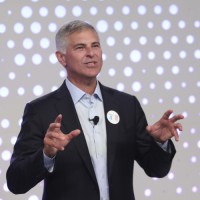
Now, Spain offers one view on growth and new opportunities within the sector, but let's broaden out the conversation. For the next discussion, we'll be hearing from two powerhouses within the industry. One from the US, the other right here in Europe. And they will be tackling one very simple question: Where will future growth come from? So, to lead this session, please welcome back to the stage WTTC Chairman Manfredi Lefebvre d'Ovidio for a conversation with Christopher Nassetta, President and CEO of Hilton and former WTTC Chairman, as well as Pierfrancesco Vago, Executive Chairman over at MSC Group. Please give them the warmest of welcomes.
Manfredi Lefebvre d'Ovidio
1:01 ↗
Hello. Hello. Good morning. Nice to see you again. So, Chris, we know each other, I calculated, since 19 years.
Manfredi Lefebvre d'Ovidio
1:16 ↗
It was when you joined WTTC as head of Hilton. Since then, we've been good friends and working together.
Manfredi Lefebvre d'Ovidio
1:25 ↗
With you, it's 23 years. When you married Alexa, and you became head of the travel passenger division of the Ponte Group. And we became such good friends that you were my wedding witness. So, which is not many are so good friends.
I want to start from... we were having a chat together with Pierfrancesco and Chris the other day. We were the three of us chatting, and the conversation was extremely interesting because it was a conversation between three people of the industry. They were exchanging views. I was stimulating them. I would like to continue that the same way as if we were three of us alone here. And they're hearing by chance.
Yeah, with a few of our close friends.
Manfredi Lefebvre d'Ovidio
2:22 ↗
So, in two words, Chris, very short, what is Hilton today? And the same thing to you, what is MSC in general and the division that you're heading today? Two words.
Fair. You know, I'm not sure when, so I can't do anything in two words, but I would say Hilton today, our goal is to serve any customer for any travel need they have anywhere in the world they want to be.
Manfredi Lefebvre d'Ovidio
2:50 ↗
How many hotels?
Close to 10,000 in 150 countries.
Manfredi Lefebvre d'Ovidio
2:56 ↗
Growing by two hotels...
We were the... We were the company...
Manfredi Lefebvre d'Ovidio
3:00 ↗
You're the ones I always cite.
We're opening two hotels a day. Today we'll open two, tomorrow we'll open two.
Manfredi Lefebvre d'Ovidio
3:05 ↗
But something...
So, first of all, I want to say good morning to everybody. I'm very pleased not only to be with two great friends here today, but I'm very pleased to be here in Malta. I mean, I heard the Prime Minister before saying what we went through together through the pandemic, what we did together, what we achieved together. So, it's very good memories in so many ways, especially when the tough times hit us. So, very proud to be here today. I represent the passenger division of the MSC Group, so we do shipping, that's what we do, that's all we know how to do. So, shipping, whether it's cargo, containers, passengers. So, the passenger division. Cruising is still a very small penetration to the global tourism. Today we're talking about 4% penetration globally. We reached this year in the region of 38 million passengers. So, there is still a great opportunity to grow in cruising per se. Cruising where there is contemporary, where there is premium, where there is luxury cruising, because the ships are becoming technologically more and more advanced, and that is what is the challenge, what keeps me up at night. You know, the technology. We amortize...
Manfredi Lefebvre d'Ovidio
4:26 ↗
I'm going to question you on that.
Manfredi Lefebvre d'Ovidio
4:28 ↗
It's going to be that. So, you are operating in a business I followed how much you bought, how much you gave back to the shareholders, how much you paid back to the leverage, and you're a $70 billion company. You're private. But, if we take a proxy to you, Royal Caribbean, more or less it's the same value, $70 billion, $70 billion. Two completely different models. You're very asset light. They're very asset heavy. What is the secret of your both success? Why both of the two areas, such a successful company in sector as the cruise industry is and such a successful as the hospitality?
Well, for us, we at one time were very asset heavy. The long history of Hilton is that we would typically, not unlike, you know, the cruise business, we would not build ships. We would build hotels, own and operate hotels, and that's how we grew around the world. But, we realized as we were trying to build the business over many, many decades and in the 20 years I've been running the company is that, back to where I started, we want to be able to serve every customer for any need they have anywhere in the world they want to be. That's a big world. That would require an awfully big balance sheet. It would also require local knowledge that would be hard for any one company to be able to have to be able to accomplish our objectives. And in building that, you know, customer base and serving them all over the world, we're building a network effect. So, we're building, you know, we're building luxury all the way down to premium and economy and everything in between. And every time we add the right hotel in the right location, we add with the right partner, we are ultimately able to better serve customers and gain greater share of wallet. So, when we think about building network effect effectively in a very big world where we have to connect the dots all around the world, the reality is it would be impossible for us to have done it with our balance sheet. It'd be impossible for any, the largest government in the world to a degree, to be able to do it. So, it sort of took us down a necessary pathway that has been very healthy from the standpoint of being able to deliver great hotels and great destinations with great partners that have lots of local knowledge and we bring hospitality knowledge to bear, which is fabulous and it's been very rewarding for our shareholders because we're capital light. We're leveraging hundreds of billions of dollars of investment around the world, but that investment is, you know, with partners and not ours. And so, we've been able to deliver...