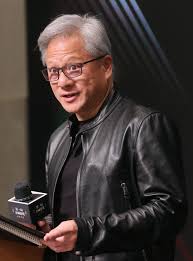
Thank you, Chancellor, for this welcoming address. You may now take a seat on the right-hand side.
It is now my pleasure to introduce to you someone who you can already see, someone very special, one of the most influential figures in tech. He co-founded Nvidia in 1993, led it ever since, and built it into the most valuable company in the world — last time I checked, right? More than five trillion, not billion, trillion US dollars. And along the way, he has earned a reputation as a kind of rock star of tech. Not only because of his trademark leather jacket, but because wherever he goes, crowds gather and are waiting for an autograph or a selfie. We might just be so lucky tonight, Mr. Chancellor.
And I do hope you don't take this as a prompt. Don't rush the stage, but please give a very warm welcome to Jensen Huang. Welcome to Germany.
I can see you're already getting comfortable for our fireside chat.
Well, Chancellor, if you could swap jobs with Jensen for just a day, what would you do first, do you think?
Oh, that's a great idea to swap the jobs. Would you like to go there? No? Well, thank you. I give you my answer. I rather would put my leather jacket on. I would take a flight to Berlin. I would like to see the German Chancellor and I would tell him I'm ready to invest.
Well, that's exactly what I'm doing.
I think you could arrange a meeting.
No, nobody has invested more in Germany.
Thank you for that. We are really grateful. Thank you for doing this. And this is a great signal for our country. Thank you.
Thank you. You know, Nvidia's story and Germany's story played a very large role. In fact, in the year 2000, Nvidia was a consumer-oriented technology. We were only building for PC gaming. And it was a company in Germany, Elsa, that partnership led us into workstations, which led us into all of the car companies. And today we work with the car companies from styling, design, engineering, simulation, manufacturing, all the way out to the cars. It was in 2005 that Audi brought us into the car industry inside the car. And it was 2023 — was it 2023 or 2020? Yeah, 2020 — that Ola and I established a partnership to build autonomous vehicles. And so Germany and Nvidia have been very close for a long time.
Jensen, I think I already heard that you wouldn't like to swap jobs. So I won't even get there asking you what you would do as a chancellor. We let you be you for now. And I suspect you can already picture things that we might not even imagine yet. So take us into an engineering office or a factory of the future. What do you see? What is this going to look like?
Oh, that's interesting. In fact, the factory — every single company in the future will have two factories: the factory that is real and the factory that is digital. And the factory that is digital will be so real it might as well be real. It manifests itself when you create the digital twin of your company, of your car company — that digital twin might as well be real. And so in the future, I believe that most people here in Germany will mostly work inside a digital twin of their company. They will build digital cars. Those cars will have digital brains. The manufacturing, the factories will have digital — of course, artificial intelligence robots building inside a robotic factory, building cars that will be robotic, and everything will be completely software-driven, everything will be completely AI-driven. So every company will build two things: they will build brains, and the brains that go into the products that they ship. And so...
Yeah, it's going to be cool.
Chancellor, of course the ambition is to bring AI into everyday use across German industry, from large manufacturers, Mittelstand, to also smaller firms. Could you perhaps share a few concrete examples of how you and the German government are ensuring that this widespread deployment is actually taking place?
Sure. First of all, I would like to say that I'm really impressed with what Nvidia and German companies are already doing in this country. Ola Källenius just handed out a model from the new S-Class of Mercedes to me, promising that this car will be autonomous driving in Germany by the end of this year — safest and the most autonomous. So this is happening in Germany. So we in the government, we are fully committed to be one of the most advanced places in the world, not just in the European Union, but in the world, to work with AI, to integrate AI into our industry. And one of the biggest, if not the biggest advantage we have in Germany is our so-called Mittelstand. And I'm very happy to see that we have here tonight many smaller and medium-sized companies from Germany. Please open your doors for AI to make use of your data. This is so decisive for the German future. This is a real secret and a real advantage for Germany, to make use of all the data which are already available in our companies. And if we could combine this AI with companies like yours and our companies in Germany, the big ones, but also the so-called Mittelstand, I'm really optimistic that we will be one of the leading, if not the leading, country in the world in terms of spreading AI for all the companies of our manufacturers, machinery, automotive industry, suppliers of the automotive industry. I think this is a great opportunity and I'm delighted to meet that.
Yeah, you're absolutely right. So, first of all, the data of Germany is part of your natural resources. It belongs to the nation. The data of your — the digital experience, otherwise known as data. The data of your country is your culture, your values, your knowledge, your experience. It's your natural resource. It belongs to the nation. And you're absolutely right that you should import the technology to harvest that data and turn it into your national intelligence. But you should not export your culture, export your values, export your knowledge, export your history, and then import German intelligence back. Makes no sense. So that's number one. And so you're going to, of course, use the best AI technology available in the world and AI services in the world, but you have every capability to build your own AI. So that's number one.
The second is, the next wave of AI is physical AI. This is where AI interacts with the physical world: robotics, manufacturing, cars, heavy industry — that will never be replaced by digital technology. The work that you know, that knowledge belongs to you. The expertise of your domain, that belongs to you. Artificial general intelligence will never replace domain expertise. You could be as smart of a general intelligence as you want. You will never be as smart as somebody who is very, very specialized in a particular field of electromechanical technology. It cannot be replaced. And so AI can only augment your capability. It will not replace your capability. So take advantage of the technology.
It's a new instrument.
As for some of these advantages, Jensen, we have on the one hand decades of industrial data. We have very skilled labor, if you like. We have the engineering expertise. So this certainly, as you seem to point out, speaks for a lot of advantages for Germany. You have a global perspective. However, there are other countries that also have strengths and also like to take advantage of their strengths. You talk to so many governments across the globe, to so many companies across the world. If you take this global perspective, how is Germany braced for this sort of next race in AI?
As you know, the last major industrial revolution was electrification, before the one I'll describe. Electrification resulted in really three geographical leaders: Germany, United States, Japan. For the last 50 years, because of the current industrial revolution, which is computing and digital technology, the United States has largely exported its heavy manufacturing, its building, its craft, really, to China. So now the world has three again, but it's Germany, Japan, and China. The advantage that China has is that they came into their industrial revolution, if you will, their economic transformation happened during precisely the time of the computer industry. They are quite computerized. China is probably the only nation today that is deep in manufacturing and deep in computer science and very comfortable in both.
Well, the good news is there's a complete reset. The last 50 years was about software programming. The United States is obviously world-class. But there's a new era now. The computer programs itself. You just have to show the computer what you want. Computer programming — all of the advantages of the last generation has now been absorbed into artificial intelligence. There's a complete reset. All the digital technology in the world will not replace electromechanical physical technology. Electrons will never replace atoms.
And that's an advantage that you have. The work you know, the domain expertise you have, the craft that is here, it will remain here. But you have to take advantage of this new technology. This industrial revolution is so mighty, is so powerful. You don't have another chance because you've always... Yeah.
Whether we have another chance or not, we should always assume we don't. This transition is so important. You should combine your deep skills, your deep expertise in the physical products, in the electromechanical products, and combine it with artificial intelligence. I would not be surprised if currently most of the Mittelstand, their challenges are reduction in labor because people are getting old. The craft that is captured in the knowledge, the skills of the people are starting to get older and older every generation. Take advantage of artificial intelligence. Let them codify. Let them program. Let them teach this artificial intelligence and keep it here in Germany, and let it re-engineer the Chancellor's words. Chancellor's words: re-engineer Germany. This is your chance to do it.