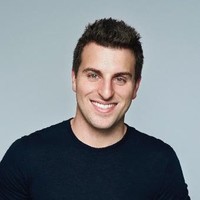
I think that outside of Silicon Valley, people are very afraid of AI. And that is understandable. It changes their jobs and leaves people without a place. And in some ways, these fears are justified. But I want to say something else. Now everyone has an opportunity.
This is Brian Chesky, co-founder and CEO of Airbnb. The company is on the Fortune 500 list and is worth 95 billion dollars. Brian believes that because of artificial intelligence, the gap between people is growing, even though everyone has the same tools. And I wanted to understand what really helps to pull ahead in a world where everything revolves around artificial intelligence.
And it works like an amplifier. It makes the strong even stronger, and adds almost nothing to the weak.
Let's apply this to those who are currently choosing what business to get into. How do you know if an idea is worth launching?
I would start by saying that those who have been watching this channel for a long time will be very happy for me right now. So, the year is 2018. I am starting my Silicon Valley Girl channel, my English-language channel, and posting these stories. I want these three guests on my podcast. The first of them was Brian Chesky, the creator of Airbnb. When we were building Hvattrip, he was the entrepreneur I looked at constantly, starting with the fact that I had data on their first bookings, and I compared how fast our bookings were going to how theirs were in the first year. And ending with the fact that we had an advisor who worked at Airbnb, who would tell us what color to make a button and what to experiment with. We went to the Airbnb office very often. I watched how Brian takes his designer brain and applies it all to entrepreneurship. If anyone remembers, write in the comments who remembers. In 2019, I saw him at the Los Angeles airport. Even back then I thought, the company, excuse me, has a 30 billion dollar valuation. The man is standing in the economy class line for a flight from Los Angeles to San Francisco. My mom says to me: "Come on, go, go up to him. What are you scared of? Don't be scared," she says, "Go up to Brian." I went up to Brian and said: "Brian, I love you as an entrepreneur. Can I interview you?" He said: "I don't do interviews, but we can take a photo." And he chatted with us very nicely. Later, he helped me out a little bit with my affiliate program. But the point is, 2 months ago Brian's team wrote to me, and they said: "You know, we are just starting to work with creators. Brian hasn't really done interviews with bloggers, but we chose you for our new announcements and for an interview with Brian Chesky." It was a magnificent day in my life, we did this interview, and now you are going to see it. And he is the kind of person who didn't disappoint. Sometimes I have guests whom I start interviewing and realize, "Damn, well, this isn't what I had imagined." Brian exceeded my expectations 100 times over. And the feedback I receive from the audience every single day—I still meet people who tell me, "Your interview with Brian was incredible." Or I wake up and see that Fortune published an article with a link to our podcast, which is very, very important to us. In short, I am incredibly grateful to this man. Firstly, for the fact that he guided me on the path of entrepreneurship, without even knowing it. And now, for the fact that we made such a wonderful podcast, and you now have the opportunity to enjoy it in Russian. We did a voice-over for you, so let's go.
Podcast with Brian Chesky. I came to San Francisco back then to build a startup in the study-abroad sector. Then, during the pandemic, we had a very hard time, and your example of how you worked with your company at that time supported me a lot. Today I want to talk about how you are changing the company in the era of artificial intelligence. I want to approach this from two sides so it helps those who are thinking about business in the field and those who are having a hard time at work right now because everything is changing rapidly. Airbnb is moving to artificial intelligence. What does that mean? What will your customers get out of it? I actually rent out property myself. We have a house in Hawaii, and we rent it out through Airbnb. What does this mean for both sides?
Essentially, it means rebuilding every part of the app so it becomes smarter and more convenient. I will explain with a more concrete example now. Let's say you are a guest. Previously, the search was standard. You enter a city and get a bunch of options, but as of today, you can flip a switch to search with AI, and you write in simple words, just like a chat. And the search understands you. For example, I want to go to Paris for the weekend. There are this many of us. I need this kind of view from the window and this kind of architecture. And it won't just show you options, it will pre-set the necessary filters itself. Because in Airbnb, everything largely relies on filters and settings.
You know, it's so funny. I came to Silicon Valley 19 years ago. Back then there was this thing, a social network. It was Facebook, and everyone was on it. It was mostly your friends there. You talked to them, and they told you what was going on in their lives. And now none of my friends are on Facebook, and Instagram isn't about connecting with friends anymore, it's media. What I mean is Instagram, YouTube, TikTok. These aren't really social networks, they are stages, broadcasting platforms. And I'm not saying that's a bad thing. It's just that now on the internet, there's no place to find out how your friends are doing. And I used to really like knowing who was traveling where, where the people in my life had been, where they were going. Most of the time, people want recommendations from friends and family, not from celebrities or creators. They increasingly need people who feel like they know them. Like you know me, you understand me, I like you, but this problem isn't solved, because you don't know where everyone in your life has been. And another one of the best things about Airbnb is meeting new people. And today it's difficult to meet people.
And I think you're also helping small businesses. Yes, now you can order groceries, baby gear, and food from restaurants through you. You've launched over 700 new features.
If I'm not mistaken, we're releasing about 80% more features than a year ago. And mostly that's thanks to AI. AI is, of course, a real superpower. Ten years ago, or even just a couple of years ago, all the code had to be written by hand. Everything was much more complicated. But now we do everything much faster, so new features come out faster too. Previously, it took us a whole year to launch a new service, and now it takes a couple of weeks. Take services, for example. Guests often tell us: "I love staying in apartments and houses, but they don't have the service of a hotel." And we thought: "What if we did it not just like a hotel, but even better?" For example, baby gear for those traveling with children. Hotels sometimes have cribs, but there might only be two or three for the whole hotel. And if they're all taken, that's it. I don't have kids myself, but that's what my friends with children say. Or, let's say you need to do laundry. Hotels have laundry service now. And through Airbnb, you can order laundry service. In general, we just went down the list, like ski equipment rental. I'm going skiing, but I don't have my own gear. And renting it can be, you know, not very convenient. You just arrived, you're tired, and now you have to look for where to get skis. But we can make it so that all the gear in your size is already waiting for you. We really try to make Airbnb as simple as possible. You arrive, and everything already works the way it should.
Brian has an incredible number of ideas. After every podcast, I record voice messages for my team about what we're going to do or tell Dima about my main takeaways. And I thought, "Why not record these for you as well?" We turn all those voice notes into my newsletter, which is completely free. We try to release it every week. So, to get those insights from Brian, subscribe to the free newsletter. The link will be below. This is that formatted voice note I sent to my team and to Dima after this incredible podcast. What do you see as the main opportunity for a small business that wants to work through Airbnb?
Let's say I'm a massage therapist working in Tulum, Mexico. I'm just using that as an example; where do I get my clients from right now? Only from locals who know about me. How do I reach tourists? Most likely, I can't. Unless I get a job at a hotel, and then the hotel sends me clients. But now, I can have my own business. I can tell everyone on Airbnb who's going to Tulum and needs a massage about myself. They open the app and book an appointment with me. It's like Airbnb in the very beginning. Someone had a house, but no one knew about it; we gave them a platform, and they got guests, just like social media gives an audience to everyone. Now we can provide all these small companies with clients—travelers from all over the world. We truly believe there is an entire economy of people who provide services. Massage therapists, chefs, photographers, companies renting out gear or baby items, laundry, cleaning, car rentals, airport pickups, anything really. Simply put, now you can offer more than just accommodation on Airbnb. You can offer anything through Airbnb.
You must have tested all of this before the launch. Tell us about the testing. What criteria do you use to make a decision?
For every feature we launch, there are far more that we've tested. We have dozens of services in the works right now, for example, skis and all ski equipment. Picking up gear on the slope, standing in line, waiting to be sized. How much more convenient is it when you arrive at your place, and they already know your boot size and ski length, and it's all ready to go. That's what we're testing right now, I believe in Italy. But we hope that later it will appear in ski resorts all over the world. Usually, we test in one country, in one city. If everything works, we roll it out further. And everything we announced today has already passed testing. So, there are many more services to come. There are, by the way, literally hundreds of them. The most interesting part here is the multitude of small services. There is a huge number of them. And maybe none of them will grow into a giant business with an app that everyone knows. That is the difficulty. For getting around the city, there is Uber. For food delivery, Uber Eats or DoorDash. But most other services are too small to have a global brand that everyone goes to immediately. And even if there is an app, it's not connected to Airbnb, and everything becomes quite complicated. Take Instacart, but now you can get groceries delivered right to your Airbnb. You can order groceries from Instacart through Airbnb. It already knows your address and how many guests there are. Groceries are delivered, the host opens the door, puts everything in the fridge, and it's full by the time you arrive. That's much more convenient, isn't it?
What criteria do you use to decide that it's time to launch? Do you have internal metrics? For example, that 10% of guests use the service. I'm trying to frame this for those who are currently choosing what business to start, but don't have access to big data like you do. How can they know if an idea is worth working on?
That's a good question. Well, we started with the most popular and in-demand services. A chef, a masseur, a photographer, car rental, airport transfers, luggage storage. But the strength of Airbnb is increasingly that you can offer anything at all. So if your service is needed by even a couple of people coming to your city, we would love to hear about it. We are interested in any idea. I don't want to dictate what to bring, because the best ideas are often ones I wouldn't have thought of myself. But if you have something valuable for others, you just need an audience. And I hope we can provide it.
That's really great. And I understand you were able to release so many things thanks to artificial intelligence. Do you have an internal metric that shows how much AI actually adds to productivity and results, rather than just creating a bunch of stuff that nobody uses?
At the beginning of the year, everyone went crazy over tokens. Company leaders demanded that everyone use AI and measured it by the number of tokens spent. At first, there was even this management style: shaming those who spent too little. Token rankings appeared; maybe for a couple of months it made sense just to ensure people actually started using AI. But in the long run, it didn't work, of course. And suddenly everyone was like: "Wait, why are we spending so much money on it?" So, in my opinion, the main thing is this. The customer doesn't care if we use AI in development or not. They need the product to get better and faster. That's why we look at the speed of product release. How fast you release new ones, how well they are made, whether they work. For this, we have our own metrics. And so we are releasing 80% more features. It's truly madness. Just imagine 80% more for such a huge company, two factors. First, it suddenly turned out that code almost doesn't need to be written by hand. And second, culture. Tools must be used, and used properly. And this is striking, because with AI. Airbnb has exactly the same thing as any company on the planet. We all have access to the same tools. There is a code of conduct, there is code. Like with Photoshop back in the day. I was a designer, an illustrator, and everyone had the same program. Now everyone has amazing tools, but not everyone can handle them equally well. The best know how to dive into them and get the most out of them. That's why we tried to make sure people learned to use them correctly. And nothing replaces the ability to think well. You still need good data, you still need a cohesive team, and it helps move an idea from your head to reality faster, but it won't come up with better ideas for you. Great ideas are still needed, and the ability to think is too. Now everything is decided by how you think, how deeply you understand, and how truly interested you are. And I think AI rewards the truly curious, because with it you can infinitely try new things. AI works as an amplifier. It makes the strong even stronger, and adds almost nothing to the weak. So, in my opinion, with AI the gap in results is only growing. The best are becoming even better. I am actually a designer by education. I studied at RISD. And years ago, when I was just starting, I couldn't program at all, but today I can, because I know how to set tasks, and in that sense, everything has become very accessible. Each of us can do much more of a wide variety of work, but at the same time, the ability to think, taste, understanding, and grasping what the user actually needs now means even more. Because the question is no longer whether you can do it. The question is what to do, whether it's worth doing, and if it's needed at all.
A short piece of advice for those who want to level up. You described people who work at the limit of their abilities, constantly coming up with something new and interested in everything. Is there something you learned yourself?
There is this phrase by a Nobel laureate, I think a chemist, Linus Pauling. To find a good idea, you need to have many ideas. Airbnb seemed like a good idea, yes, but it was one of many. And we had plenty of bad ideas. I think it's all about quantity. To draw a good picture, you need to draw many pictures. To do anything well, you have to do it a lot, rely on quantity. You are very strong at what you do right now. And that is surely the result of hundreds of repetitions. There was no moment when you suddenly became a pro, just like with training. One is not enough; you need dozens. The best ones simply practice more than the rest. Workouts are the perfect metaphor. It's all about repetitions. So, the same rule works for ideas. Practice is what matters. At IDEO, a very famous design studio, there was an exercise for coming up with ideas. Everyone is given sticky notes. You write down an idea, stick it on the wall, and then the next one. And they had a rule: do not criticize ideas. At the first stage, no one plays devil's advocate, no criticism at all. Because when you criticize, you start to hold yourself back, get scared, and a bad idea is sometimes one step away from a good one. So, quantity decides everything. I have, without exaggeration, about 100,000 ideas a year. And I think 99,000 of them are no good.
But how do you know which of all these ideas are not worth working on?
It's rather the opposite: good ideas stand out on their own. For example, I have a notebook. Every thought there is one or two sentences, and I write about 1,000 words a day. That's about 300,000 words a year. If every line is one sentence of about 10 words, you get about 100 ideas a day, that is, about 30,000 ideas a year. And so on. Let's say I have 30,000 thoughts a year, and 99% of them are no good. You just write down everything that comes to mind and don't stop. And at the end of the day, I highlight in bold what caught my attention. If there are 100 lines for the day, I highlight 5-10. And so it goes every day. And at the end of the month, I review everything, and now my AI can just read what is highlighted. I used to have to write them out by hand and reread them, but now it pulls out all the highlights itself. And it can also read what I thought was nonsense and show which ideas are actually good. It notices patterns. That's how I build a shortlist of the best. I refine these ideas again and again. You know, The Catcher in the Rye has about 70,000 words, and I have four times as much text, and I write a thousand times worse. These are truly terrible, low-quality texts. If you read them, you'd say it's just nonsense. I understand it, but no one else does. But that is the whole point. Most of what I say is no good, just like most of my ideas. And that's perfectly fine. Nobody knows about the bad ideas, they only know about the good ones. And the conclusion is: good ideas don't die. If you write down a good idea, you'll write it down again a month later without even realizing it; it keeps coming back. So, good ideas don't want to die, they sort of stay alive, while everything else just gets filtered out. Good ideas haunt you like ghosts, and you think, "Okay, this isn't going anywhere." I don't know if this is helpful. I've never talked about this before. But in my opinion, it's about the sheer volume, about constant work.
I remember hearing about Eminem. He wrote all day long. He had a notebook, and he spent all day writing down lyrics and rhymes. Bob Dylan wrote songs constantly. He wrote and wrote endlessly, but not everyone is like that. Jay-Z, they say, doesn't do that. He works it all out in his head, which is a very rare and phenomenal talent. Leonardo da Vinci left behind a pile of notebooks. He was always drawing and writing, drawing and writing. By the way, Da Vinci mostly wrote rather than drew. If you look at his notebooks, they are 80% text and 20% drawings. And he is the most famous artist of all time. He only has about a dozen paintings in his entire life. The Mona Lisa is one of the twelve or fifteen paintings he ever actually finished. Imagine the volume of things he created. Vincent van Gogh's main productivity came in the last 3 years of his life. And he painted more than one picture a day. Every single day. And that's not even counting the sketches. Every day he painted and painted and painted without stopping. Or, for example, Hemingway; he would wake up at 6:00 AM. From 6:00 AM until noon, he would just write, until by noon there was nothing left to write. It's just the habit of doing the same thing every day. It doesn't matter if you've founded a tech company, if you're an artist or a writer, quantity is what decides it all.
And that doesn't mean you put out a bunch of trash. On the contrary, you don't show that to anyone at all. You edit, edit, and publish only the very best. But people don't understand that. They only see the few things that were released to the world. And they don't see how much stands behind it. And I admit, I have one problem, and I think almost everyone watching this has it too. We spend too much time on social media, watching what others are up to. My weakness is X. And most of us spend too much time on X, also known as Twitter. We are obsessed with what others are doing. God, now it's Instagram, now this, now that. We are all like children at a soccer game, chasing the ball in a pack, following trends, and copying what everyone else is doing. And it's incredibly distracting. Sometimes I think it might be better if we all knew a little less about what's happening in the world. You know, I sometimes think Van Gogh couldn't have spent hours on his phone. And if he could have, maybe he wouldn't have painted so many pictures. If Da Vinci could have been glued to a feed, maybe he would have accomplished less too. And what if we all blocked out what others are doing a bit more and told ourselves, "It doesn't matter what people think"? Or, even if you do care about people's opinions, let them judge you in a few years, while I put on blinders, dive deep into my work, and work for years without chasing attention right now. I'll earn that attention later, if I even need it at all. But for now, I'll train quietly, and I don't need the whole world watching me do it. I'm just quietly doing my own thing. I want to become a master at my craft, and when I'm ready, I'll show it to the world. I think it's a very valuable approach: just put on your blinders, focus, and go.