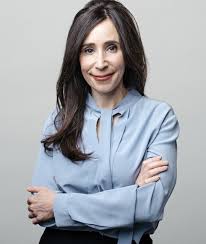
Axios communications strategist and writer Eleanor Hawkins speaks to The New York Times Company President and CEO ...
Questions asked in this interview
5
4:20And that's not the story for most newsrooms, right?
4:49How concerned are you about the state of trust, but then also how concerned are you about press freedom?
7:46You all have been sued by the president and you and executive editor Joe Kahn have vigorously defended your reporting. What's next in that process?
9:23Why did you decide to sue versus strike a deal?
12:10We're seeing a lot of journalists depart traditional newsrooms and go out on their own and start very successful ventures. How are you keeping talent?
This time we're going to focus a little bit about how AI is changing the information economy and the media landscape. So, please join me in welcoming to the stage New York Times president and CEO Meredith Levien.
Did I get it right? Good. Well, thank you so much for being here. You have seen so much change and growth in the media landscape since you took over at the New York Times about five years ago. So, I'd love to hear kind of what's the biggest shift that you've noticed in the past five years.
Oh, that's a big broad question. Delighted to be here. I think that the thing that we do at the New York Times and that is done at a number of other extraordinary news organizations around the world like the Wall Street Journal and the Washington Post and the BBC and CNN and others. The thing we do, high quality independent news journalism and also at the Times market-leading lifestyle products that help people make the most of their lives and passions, that has become even more rare and even more valuable at great scale to consumers. I think in a sea of misinformation and an information ecosystem where it is hard to find things that are true and of a particular quality and made by professionals, that kind of work means more than it ever has to society.
You bring up lifestyle. I want to ask you about the evolution of the New York Times and maybe you could share more about the percentage of subscribers that are drawn to news versus the percentage of subscribers that are drawn to games, lifestyle, etc.
Yeah, let me do a little bit of context first. The Times has, you know, somewhere between 50 and 100 million people who use our site, come to our site and our apps on a weekly basis. And that's before you get to anything we do sort of out on social media. And we have more than 12 million paying subscribers. So giant sort of free audience and also a growing paid audience. Within the paid audience, the majority of our subscribers subscribe to either our bundle of products which includes news and everything else we do, but they are most often subscribing because there's news in it or to news itself. So the majority of people who are paying for the New York Times are paying for news and something else. And the way we think about our lifestyle products. So we're in the games business. We've got now 10 games, five free, five paid. We have the largest sports newsroom on earth. We've got more than 550 sports journalists on The Athletic. We've got, I think, the largest paid recipe site with NYT Cooking. And we've got an incredible shopping advice product in Wirecutter. All of those products now provide us just new ways to be of value in people's lives. They provide us new ways to kind of introduce new people into the New York Times ecosystem, but they are highly valuable in and of themselves. Tens of millions of people play our games every single day. But the sort of heart of the value proposition of the New York Times, I think to consumers and to society is what we do in core news journalism. One of the things I'm proudest of, I've been at the Times more than a dozen years. We have almost twice as many sort of core news journalists today working at the New York Times as we had when I got there.
Well, and I'll also say the reason one of the reasons we have such a great big games opportunity and a great big sports opportunity and so forth is because the brand New York Times stands for a level of authority and sort of trustworthiness that imbues everything else we do and I just don't think you can separate those things.
Yeah, I want to talk a little bit about that. You know, we've seen trust in media decline significantly. How concerned are you about the state of trust, but then also how concerned are you about press freedom?
12 more exchanges in this transcript
Sign in free to read the rest of this interview. No card required.
Levien, M. (2026, January 20). The New York Times’ Meredith Kopit Levien & Axios’ Eleanor Hawkins [Interview transcript]. Axios. CEOInterviews.AI. https://ceointerviews.ai/interview/650632/
MLA
Meredith Levien. "The New York Times’ Meredith Kopit Levien & Axios’ Eleanor Hawkins." Axios, 20 Jan. 2026. Transcript, CEOInterviews.AI, https://ceointerviews.ai/interview/650632/.
BibTeX
@misc{levien2026_650632,
  author       = {Meredith Levien},
  title        = {The New York Times’ Meredith Kopit Levien \& Axios’ Eleanor Hawkins},
  howpublished = {Interview transcript, Axios. CEOInterviews.AI},
  year         = {2026},
  month        = {jan},
  url          = {https://ceointerviews.ai/interview/650632/},
  note         = {Speaker-attributed transcript with timestamps}
}