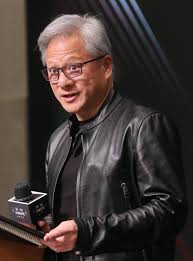
Hey, thank you so much for the warm welcome and welcome back. Today is a special day, but a few minutes before, just to do a quick summary of what I discussed with you yesterday. If you remember, we talked about the future, but more importantly, we talked about how we are building it. And the future is not only about empowerment. It's also about inventing new things, new openings, new possibilities with you and for you. So if we step out for a moment, you know the previous century, the 20th century was really about the industry using and producing objects. In this new century, industry is producing knowledge and know-how, and the knowledge and know-how are generating the objects. This is where the true value lies. This is where the power is, and that's why we bring together the virtual twins and the 3D universes. 3D universes are not applications. They are knowledge factories. Factories where the knowledge is enriched, the know-how is scaled, and the results are trusted. And to supercharge this, we are using AI. Not a generic AI, not a surface-level AI, but what we call a real-world AI grounded in industry, engineering, and science. So it's not only about large language models. It's about what we call the world models, because LLMs do not build satellites. They don't design aircraft. They don't discover cancer therapies. You do, and we help you to certify it. So the world model makes in fact the virtual twin truly generative. And to make this possible, we combine the power of a virtual twin with accelerated computing. And to continue these conversations, I'm now very pleased and honored to invite on stage someone who is defining, someone who is shaping the foundation of artificial intelligence. So, please give a warm welcome to Jensen Huang, founder and CEO of NVIDIA.
Are you called Solid Workers?
Hard workers. So, welcome on stage, Jensen. Jensen, thank you. It's always a pleasure to have you. I don't know if people realize, but we have a long-standing relationship, right? I think we almost started the collaboration 30 years ago. A quarter, yeah, over a quarter century ago. Do you remember how it started?
Well, we started during the last computing platform revolution. In fact, the personal computer revolution, and what used to be Unix workstations was migrating to Windows-based workstations. And the technology that made it possible for us to collaborate was based on OpenGL, and we invented a technology called CgFX, which is the precursor of CUDA. OpenGL became RTX today, fully path-traced and physically based, and CgFX of course became CUDA. And here we are working together again as we reinvent the computing platform. You know, everything that we do is in the digital world. 40 years ago, Dassault Systèmes revolutionized the idea of virtual twins. The idea of a virtual twin, of course, is to represent the physical world in a computer. And so now we're going to represent the physical world at a much, much larger scale in a completely revolutionized computer, an AI computer. And so this is a really, really fantastic, fantastic time.
You're right. It's an incredible journey. And as you said, now we are entering into a new chapter. We are now, what we call, in the generative economy, where, you know, we are powering the virtual twin with accelerated artificial intelligence. From your perspective, Jensen, what is happening in the global industry right now?
Well, we're reinventing the computing stack all together. And as you know, in the last generation, the representation of the designs were structured representations, meaning we specified every geometry, we specified every material, we specified literally everything. Now, it's going to be a generative computing model. And in the world of generative computing models, the entire computing stack is being reinvented. And because AI is foundational to every single industry, it is going to become an infrastructure. Just as water was infrastructure, electricity is infrastructure, internet was infrastructure, now artificial intelligence will be infrastructure. We're growing so fast because every single industry needs to build it. Every single country will be powered by it. And literally every society will have it. And so this is the beginning of a new industrialization, which is really fantastic for you because as you know, Dassault Systèmes is the engine of the representation of everything that you want to build. And in the future, in fact, you know, in the past I would say that we spent a third of our time in design and digital, maybe two-thirds of the time in physical. It is very likely in the future we're going to spend 100% of the time in digital. And even after we're done designing it, simulating it, validating it, we have to integrate it with software. And so everything that's inside the Dassault Systèmes systems, whether it's CATIA or SIMULIA or BIOVIA or let's see, what are the other brands we got? We got...
DELMIA, we got ENOVIA. And listen, all of those brands are going to be built on top of NVIDIA.
[Laughter] Did we know that a quarter century ago? And so, anyhow, the design, the representation, all the simulation, and even the operations of it, because everything will be software-defined in the future. You know, everything from a pair of tennis shoes will be software-defined in the future. And so cars are software-defined. The robots that build the cars are software-defined. The factories where the robots are orchestrated to build the cars are software-defined, and the cars themselves are software-defined. So everything will be software-defined. Everything will be represented inside the system, and so we'll be designing everything, operating everything really as a virtual twin, and realizing your vision for the first time.
Yeah. You know, before we go further, if you look around the crowds, you know, at... kind of a ruckus crowd. Yeah. At Dassault Systèmes, we work with 45 million people around the world, 400,000 customers, more than 15 million engineers, researchers. So I think we are, you have here probably one of the, if not the largest engineering community in the world. They do more than half of the products surrounding us every day. Robots, you know, drones, planes, cars, medical devices, drugs, home, city, factories. So this is an amazing community. Don't you think so? I know they think so.
Absolutely. Yeah, we're all engineers.
Yeah. Yeah. Sure. I'm still an engineer.
So you belong to this community.
I am. If I was to start all over again, I'd choose to use SolidWorks.
[Laughter] You know, that's why the world model matters. In fact, because for these communities, the success is not about automation. They don't want to automate the past. They want to invent the future. And this is the reason why we are announcing this new chapter in our partnership because together we are bringing the virtual twin factory with the AI factory. This opportunity is really enormous for you guys and for us. So to prove the power of this, right, we have some concrete examples. I think Jensen and I, we have selected some use cases we want to share with you. Let's start with research and engineering first. Yeah. And so, you know, I remember that almost everything that we do together starts with the computing platform. And when PCs went into the cloud, Dassault Systèmes reinvented yourself again. Now we're extending from cloud to AI, we're reinventing again. And so today we're announcing a massive partnership. This is the largest collaboration our two companies have ever had in over a quarter century. Dassault Systèmes is going to integrate NVIDIA CUDA-X acceleration libraries, NVIDIA AI for physical AI and for agentic AI, and NVIDIA Omniverse, our version of digital twin technologies. And so all of these libraries represent our body of work over the quarter of a century. Now we're going to fuse these technologies into the Dassault Systèmes platform so that all of you will have the benefit of accelerated computing, artificial intelligence, and be able to work at a scale that's a hundred times, a thousand times, and very soon a million times greater than what you were able to do before. What used to be, you know, pre-rendered or what used to be offline simulations will now be literally the virtual twin vision that you've always, always had along. Everything will be done literally in real time. You know, we'll design products and simulate it in a wind tunnel in real time. We'll interconnect these robots and let them operate in a factory in real time, and they'll be building your products literally in real time. And all of this is going to be happening, you know, in the next 5, 10 years, this is going to be extraordinary. Speaking about this, let's start with life. I think life is the most complex system ever created, right? When you think about it, how much knowledge is encoded in the living world. With our virtual twins, you know, we are learning from life. We are also understanding it in order to replicate and to scale it. So this is possible.
This is NVIDIA AI integrating with BIOVIA.
Yes, BIOVIA, right? We will come back to this. Yeah. But you know, this is possible because I think we have this foundation. We call it the world model.
Yeah. The world model where it's grounded in biology, in physics, material sciences. So the key question I have for you is what does it take to compute a world model for life, of life?
Well, the most important thing, the first thing that we have to do is understand the language of life.
Yeah. And so, you know, of course in the world of physical design, the design started with your imagination and you represented that physical object using structured information, geometries, and textures that were designed by you. However, life is different. Life existed before us. And so we have to go learn the language of DNA, learn the language of proteins, and learn the language of cells, and understand how they interact and its properties. That first stage of learning the meaning of life is what we are in the process of tackling. The second part, of course, is generative. Once you could learn something, learn the meaning of something, we can translate it between languages. We can translate between human language and the language of biology, between the language of biology and interpret it so that we can understand it in human language. Beyond that, you can now translate and generate new proteins that could be used for a drug, or generate new chemicals that could be used for a drug, and then of course generate new materials that could be stronger, be more heat-resistant, lighter, easier to manufacture, last longer. All of those properties are now kind of within our grasp, and this is one of the reasons why this is likely going to be one of the most impactful areas of engineering in the next decade.
Exactly. And it is already happening. In fact, we have a case, you know, the Bel Group, you know them, they do the famous Babybel, right? And their mission is very simple. They want to basically produce healthier foods for millions of consumers. But at the same time they want to consume less water and they want to progressively change or at least complement the dairy protein with the non-dairy proteins. So that's the reason why they are inventing what we call the food science. Before, you know, hundreds of physical tests for one single product, now they generate automatically, and this is what you can see on the screen, they generate automatically the protein from the virtual twins because it's again powered by the biological world model. So the result is not only faster innovations, it's also certified decisions because you cannot play when you have the life of the people in your hands. That's what we do. Now let's move to something else and you started to speak about it. You know, you have seen on screen, this is changing in fact the daily life of the engineers in the space. You know, now you define the specs, you run your simulations, and automatically the generative experience is producing and exploring in fact the space of possibilities and finding the optimum solutions for you. Actually the virtual twin is exploring an infinite number of possibilities. So the question I have for you, could we compute infinity?
We can't compute infinity, but we can imagine infinity, which is the reason why these surrogate and emulation models, the fusion of simulation and artificial intelligence, is so powerful. Eight years ago I introduced the idea to scientific computing and simulations, the idea that in the future not only will we use principled simulations where the equations, the laws of physics are well understood and well represented, however the simulation time takes way too long. Why don't we augment that with generative methods of predicting the future using artificial intelligence? It's a little bit like the analogy I would give. It's a little bit like, are dogs able to catch a ball out of the air? And yet they're not doing physics simulations of balls bouncing or the elastic nature of the ball. They're just literally watching us and predicting where it's going to go and they snatch it out of the air. And so the idea that an AI could learn how to predict physics and learn how to predict very accurately how materials would crumble, what happens to a crash, those things, those capabilities are within grasp. We have a technology called PhysicsNeMo. PhysicsNeMo is essentially a physics-aware AI model simulation system and AI framework that allows us to create these AI models that are either trained by principled simulators or work alongside principled simulators. So it's grounded in the laws of physics but able to predict 10,000 times faster. And now if everything is already running in real time, then you can predict it 10,000 times greater scale. And that's just where we are right now. Imagine where we're going to be in the future. The idea of simulation and emulation coming together to help you design is going to be really revolutionary. And again, this is exactly what you see here with a customer called Lucid. You know, we know them. They are one of the most innovative car companies in the world. And what do they do? In fact, they embed the crash behavior, the aerodynamics, the vehicle performance upstream early in the vehicle program's development. So the engineers, they don't only design the shape, they design the behavior, and we certify it.
So this is exactly what you say. This is Dassault Systèmes' vision empowering designers and engineers and also unlocking the business people, you know, to develop the delightful experience for their customers. Now let's talk about factories. You started to touch a little bit this topic. The factories are not anymore today only physical assets. I think we are all in agreement with this. It's made of virtual and real at the same time. So let us know how physical AI is really used to run the factories.
Well, the way that people used to think about designing products is they design the product and they build the factory. In the future, it's very likely that the products that you are able to design and build will a lot be impacted by the factories you design and build. And so, it's very likely in the future, well, it will be. It's in fact now that every single factory is designed in CAD. That's obvious, but it will be simulated and operated completely inside a virtual twin. And operating a factory of these gigantic scales inside a virtual twin is extraordinarily complex. A factory is not just one object. It's millions of objects. And we want to also simulate or emulate how these factories will operate in the real world so that we could arrange the manufacturing lines properly, arrange it in the right sequence, space it properly, organize the robots within it, run the robot AIs so that these AI robots could be operating inside the factory, manipulating things, assembling things, moving things, keeping things safe. All of this is going to happen inside a virtual twin. And so, you know, the products that Dassault Systèmes is going to help people build and design are going to become gigantic in the future. These are going to be systems of objects, systems of AI, systems of robots all coming together into a giant factory. This is exactly...
They're going to need fast computers is what I'm saying. [Laughter] And again, this is exactly what we do with Omron. You know, you have seen on the screen, they don't use the virtual twin only to visualize the factories. In fact, they do much more. They engineer what we call a software-defined factory.
And where the difference is coming from is in fact they are designing the autonomous part day one. It's not something they come when the production system is already up and running and they try to infuse the autonomous part in it. So as a result, those factories, they become much more flexible, resilient, you know, and also adaptive. But there is another kind of factories, right? And you talk a lot about this, the AI factories they are building everywhere. They are extremely complex. What does it take to make them or to build them and to make them a reality?
Well, we're going through what clearly is a new industrial revolution, a fundamental technology that impacts the productivity of many industries. That's why it's an industrial revolution. Just as energy did that, just as mechanical energy, power did that, just as electricity and of course the internet did all that. We're now seeing artificial intelligence doing that. In order to make this possible, we need to industrialize and really scale three different giant industries. The first one, of course, is building a lot of chips, which is the reason why the number of chip factories are increasing. You're going to be, you're involved in a whole bunch of chip factories, and so chip factories and packaging factories just to make all these semiconductor products. The second is computer factories. Once the chips are done, it goes into another factory. What comes out of that is a supercomputer. Those supercomputers go into an artificial intelligence factory. Right now, as we're speaking, these three entirely, what used to be three different industries, are all growing incredibly fast so that we could create the infrastructure for intelligence and manufacturing the AIs. While these factories are incredibly complex, you know, a gigawatt AI factory is about $50 billion. And now we're building tens of gigawatts around the world. It's an enormous infrastructure buildout. The largest industrial infrastructure buildout in human history. And so the amount of technology that comes together inside these factories are extraordinary. And we want to make sure that they work the first time. And so the way we're doing it, we're using MBSE...
Model-based systems engineering.