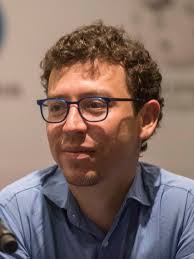
Our guest today is a bonafide genius. Luis Von Ahn is a math prodigy with a knack for inventing things. At 28, he won the MacArthur Fellowship, also called the genius grant. He was a computer science professor at Carnegie Mellon University before he gave up teaching to build the wildly popular language learning app Duolingo. Luis co-founded the app in 2011 with primarily one thought: that language learning should be free and fun. In the last 15 years, Duolingo has reached several hundred million accounts worldwide. According to its latest investor presentation, it had over 131 million monthly active users as of the first quarter of 2025. People that take its 100 courses that teach 40 plus languages. One of the first steps to really go big on gamification and marked by quirky, irreverent, random humor. Duolingo with its mascot, the green owl, has been actually called quite the case in branding, marketing, and even behavioral psychology. So in today's corner of his conversation, we have Luis himself to talk about Duolingo's journey, his own arc from CAPTCHA, which he invented, to chatbots. How does he continue to make language learning fun for more than 500 million people? How does he see AI as a tool, a catalyst, or competitor? Will the green owl eat a chunk of traditional academia? And of course, where does India stand for Duolingo as a market and how is it growing? Listen on. It's Tuesday, the 13th of May. We are your hosts Anirban Chaudhuri and Himani Kotari. This is the Morning Brief.
Hi Luis and welcome to the Morning Brief.
Hi, thank you for having me.
Luis, you're the CEO and co-founder of Duolingo, but that's not how you started. You also invented the most annoying thing known to humans, CAPTCHA. Can you tell us a little bit about your experience with CAPTCHA and what learnings did you take from that to Duolingo?
Let me first start by saying it is not the most annoying thing known to humans. It is annoying but there are probably more annoying things. So yeah, CAPTCHA is these tests that you have to pass to prove that you're a human on the internet. Common forms of it are these distorted characters that you have to type or more common nowadays is having to click or tap on all the different traffic lights or all the different bicycles in a grid of images. I helped invent that about 25 years ago. The reason this started was because before CAPTCHAs, anybody could write a program to do a lot of kind of bad things on the internet. So for example, anybody could write a program to obtain millions of email accounts for free. And what a CAPTCHA does is it makes sure that only a human can get email accounts or only a human can buy tickets on Ticketmaster or something like that. And the reason it worked is because at least at the time, 25 years ago, computers weren't able to, for example, read distorted characters of text. As time has gone on, most of the things that computers couldn't do now computers can do. We still have a few things that humans can do that computers cannot, but that number of things is quickly disappearing.
That's fantastic, Luis. And as Himani just said, lessons from CAPTCHA would definitely have come in handy in building Duolingo as this really tech-advanced sort of pioneer in gamified learning. But from what I understand, and this is to take you to the very initial days of conceptualizing Duolingo, one of the initial hiccups was just designing the modules. So at the start, you created the Spanish module and your co-founder made the German module, and both of you realized that they were really, really boring, right? So what are the kind of changes that you made? What kind of heuristics did you bring in to make the app engaging and interesting?
Yeah, this is exactly what happened when we started working on Duolingo. I am a native Spanish speaker, so I decided to make the first Spanish course. And then my co-founder is a native German speaker and he made the first German course. And the idea we had is we were going to learn each other's language through Duolingo. But we found that we couldn't get ourselves to even do our lessons because it was so boring. And that's when we learned something that still to this day we believe to be true, which is the hardest thing about learning something by yourself is staying motivated. So we started making Duolingo as much of a game as we could. We started, you know, for example, at first the lessons lasted half an hour. Then we made them last two minutes. We also made it so that there were progress bars everywhere that you had to fill. Every time you finish the lesson, you got points. There's a lot of animation, etc. So that made Duolingo really successful. By the time we launched, it really felt like a game.
I mean, it's entirely free to learn on Duolingo. Yes, you can subscribe to remove the ads, but you can learn entirely for free as much as you want. And the combination of... I think 91% of your users are free, correct?
Correct. 91% of our monthly active users use the free version.
Right. And also what really startled me was another data point that I saw, that 80% of your users in the US and UK had not learned a new language before. Is that correct?
That's correct. 80% of our users were not learning a language before Duolingo. That's in the US and UK. It varies per country, but in the US and UK, that's true. And what's amazing about that is that we really are growing the market. And so we're very happy with that.
Luis, I read the Duolingo handbook. It's quirky. It uses unhinged humor, something that's also reflected in your marketing strategy that more often than not goes viral. What was the thinking behind this decision? Is this part of the gamification experience or is there more to it?
Yeah, I mean, as a company, we don't take ourselves too seriously. You know, one of our operating principles is make it fun. In terms of our marketing, the reason it goes so viral is because we have this owl mascot, this green owl that does a lot of unhinged things. And the way that started was a bit of an accident. It started because our own users would look at the notifications that Duolingo sends you, sometimes they're passive-aggressive, and our own users started making memes on the internet about how the owl was willing to even kidnap your family for you to do your lesson. And then what we did is we started leaning into this and over time a whole personality emerged in social media for us and by now it's very successful. I mean, we recently had this campaign where the owl faked his own death and it got 1.7 billion impressions on social media and the cost of that campaign for us was $10,000. The only thing we paid for was basically making the videos that we put out. So we're very happy with that.
Luis, in a way, your initial success came from fighting bots or AI. Now, you use a lot of AI in your business. Which side do you like better, with or against AI?
Oh, I much prefer with AI. I mean, what we're doing with Duolingo is we really are teaching hundreds of millions of people different subjects, mostly languages. And AI is beautiful in that it is really a scalable way to teach people. I mean, human teachers are great, but most people in the world don't have access to a great human teacher. And fortunately, as AI advances, it can get close to as good as a human teacher.
And Luis, if you were starting out today, what would you do differently given the advances in Gen AI? Would you still have started Duolingo today?
Yeah, I would. I really do think that education is a major thing that's going to change with AI. I believe that no matter what, even if there are no jobs, I believe that humans still need to be educated and I think education is going to be done by computers. So yeah, I would still do that.
What kind of new trends are you seeing in learning patterns or in demand for new languages and how are you reacting to them?
Learning patterns are remaining the same. I mean, people at the end of the day are people and they continue learning the same thing. Demand for languages does change. Of late, the last few years, we're seeing a lot of demand to learn Korean. That has to do with K-pop and K-dramas.
Yes. So we're seeing a lot of demand to learn Korean, that is a change over time.
So, I have a question here. So, on your India strategy, Luis, for example, what I read is that you have a lot of Bengali to English, Tamil to English, but you don't have Indian language modules on your app. Is that... do you see that changing because that would really lead to an explosion in your users if volume game is what you're going for in the future.
Yeah, we do see that changing. That is something that's on the roadmap, that we're going to teach other Indian languages, you know, between different Indian languages. So yeah, that is something that we're going to do over time.
Okay. Is India a focus market for you, Luis?
Yes, it is. About 12 markets that we pay attention to. India is one of them. And the main reason India is a focus market for us is just because the size of the market is huge in terms of number of people, obviously. And we expect that over time, we're taking the long view with India, we expect that over time it will monetize. I mean, at the moment it's not monetizing very well, but we expect that over time it will monetize.
Luis, could you give me a sense of how big is the business in India in terms of number of users? How much time do Indians spend on Duolingo?
Yeah, our business in India in terms of users is growing quite a bit. We have millions of monthly active users and they really do spend quite a bit of time. And people in India mainly learn English. We're very happy with that. One thing that is not unique about India but it is striking about India is that there's a real reluctance to pay for the paid version. So worldwide, 9% of our monthly active users pay for the paid version to remove ads. In India, that percentage is well under 1%. So as a business in terms of revenue, it's not a big business in India, but as a business in terms of users, it's quite a big business. I believe it's the fifth largest country in terms of users.
Do you have a strategy yet to make the Indian user pay?
No, but if you have good ideas, let me know. The thing is, we're trying to do the same. I also come from a poor country. I come from Guatemala, which is a relatively poor country. What I know if I look at my family is that people go through great lengths to not pay. I think over time this is going to change a little bit. I think people are going to be more okay with digital subscriptions, but at the moment, when we have geographies that have lower GDP per capita, they don't pay for our product very much because our free version is too good.