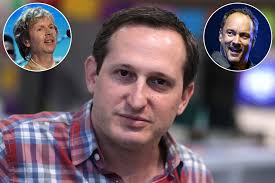
Well, hi again everyone. Jimmy Roberts, thanks so much for joining us once more here on the Big Swing and we are on the road once again. We're in Augusta, Georgia for the Masters, 90th playing of the year's first major championship. And we have come to talk about gambling, sports gambling. You know, depending on whose numbers you believe, last year in the United States the total handle for sports gambling was something like 167 billion dollars and there are a lot of people who think that that is an underestimate. At the top of the food chain of the industry, legal gambling is DraftKings. We've come here to talk to Jason Robins, who's one of the founders of DraftKings. He's the CEO. Talk to him about gambling, talk to him about his business, how they got here. He's an interesting guy. Jason Robins of DraftKings.
Well, first of all, thanks for inviting us to join you here. This is quite an operation you have here. Thank you. It's pretty awesome. I think they did such a great job setting up and the party last night was amazing. It's been such a good start.
How long have you been doing this down at the Masters?
I think this is our second year doing this. So, you know, we've always had a little bit of a presence, but this is the second time we've done something like this.
So, if I were to say to you rotisserie league sports, okay, I see the smile on your face and you know what it is.
Not only do I know, I played in many, many rotisserie leagues.
Oh, yeah. When you were a kid?
Oh, yeah. Yeah. I was a big fantasy sports player when I was a kid. I loved rotisserie.
You know what's amazing to me is that from that, which for those who don't know, it was the original fantasy sports league, and it's called rotisserie league because a bunch of sports writers got together at a restaurant called La Maison Rotisserie in New York. And from that rotisserie league and from that this industry, which is, I mean, if you had told those guys all these years ago that it was going to turn into this, I can't imagine that anybody saw this coming. You obviously did though.
No, I mean, I didn't see it coming back then certainly. You know, as it evolved it started to become more clear where it was going, but you're absolutely right. I mean, thinking back to those days, it was, I mean, this is probably the furthest thing from anybody's mind. It was just a bunch of guys meeting in a restaurant, putting together a fun little game.
Baseball. Just because they were all manually tracked. Right. Had to every day look up the stats in the box scores and record everything by hand and there was one guy in every league that had to do that. This was before the internet had all the, you know, fantasy websites that would do it for you.
Yeah, before internet, before phones. When you were a kid, how big a sports fan were you?
Massive. I mean I loved sports pretty much from, I don't know, first memories of life I have. I remember having sports in them and I grew up in Miami. My dad was a college professor at University of Miami. I went to every single Miami Hurricanes game. Pretty much maybe missed like count on one hand how many I missed between the age of four and when I graduated high school. And that was the heyday for the Canes, too. It was the late '80s and early '90s when I was growing up and it was a fun time to be a fan there and, you know, everybody's seen The U and all that. I also was just a huge fan of every sport though and I got into fantasy sports when I was a teenager. You know, played some rotisserie leagues when I was a little younger, but like once the internet really started to take off and there were fantasy leagues all over the place, I was just a nut. I was in like a hundred plus leagues one year.
No, I didn't bet. I mean, I was more just playing. I didn't bet until I got older.
Right. Because I remember when I was in high school we had the sheets. Of course, it was illegal. Don't tell anybody. But we had the sheets and, you know, betting was a very kind of shady operation. You know, and gradually it changed to an industry which has become a powerhouse in the economy. Tell me, I want to know a little bit about how your business got started.
Well, first, just a comment on kind of what you just said. You're right. I think it used to be, to use your word, a shady and it was an illegal thing and it was definitely not above board. It sounds like, you know, as a kid you were exposed to it. So, one of the great things about, you know, the legalization movement and the regulation has been that this has been brought into the light. It's a safe place that's regulated. We make sure kids don't get on the platform and all those sorts of things. The way I started the business though, we actually started as a fantasy sports company. I was in middle management of corporate America. My two co-founders, Matt and Paul, we all worked together. And all of us had this, you know, entrepreneurial bug. We wanted to do something and really just never had a great idea. Nothing kind of ever came together and then one day Matt brought me this idea of you could do these short duration fantasy contests you could win money.
Were you guys all kind of sports fans?
We were, Matt and I for sure. Paul, we always joke with him. Paul was not a huge sports fan. He's since become more of a... I would hope so. Oh, we still tease him all the time. We're like, Paul, how many players in the NFL can you name? He's like, stop. Because like probably, you know, 15 years ago, I don't know if he could have named five. But he's a much bigger sports fan now.
So, yeah, you guys were all working in conventional jobs and unhappy?
No, I wouldn't say we were unhappy. I just I wanted something, you know, that I could build on my own and with my partners. And also, I just felt like I was at a point in my life where I wanted to take a chance and go try to do something big and I knew that because I had had some, you know, reasonable success early in my career that I felt safe like if I didn't succeed, I could go back and get a job in corporate America again. So, you know, I wasn't the typical entrepreneur starting it out of my dorm room or anything like that. I worked for almost a decade in corporate America before I started this.
I was doing a bunch of different things. My core background was in analytics and marketing though.
But in college, I was a computer science major and along with economics. So, I used to love to code, but the one thing I figured out in college is there are way better coders than me. I think it's important, right, to figure out what you're good at and what you can be the best at and I knew I was never going to be like, I loved it, but I knew I was never going to be an elite coder because there were just so many better people than me. So, I decided after that I wasn't going to focus on it as a career. I was going to go on the business side.
I don't think I've ever heard that term before, an elite coder. So, you and your two partners, you come up with the idea and then what's the process like?
Well, it was Matt's idea. I can't take credit and he brought it to me and he knew I was a huge fantasy sports fan, so it immediately resonated with me. I then said, look, we got to bring Paul in and he said, okay. And we went and we recruited Paul. And for a while we were just working nights and weekends out of Paul's spare bedroom in Watertown, Massachusetts. It was like probably about 7:00 we would all leave the office each day and then we go over to Paul's house and stay there till like...
Did you guys all work in the same place?
We all worked at the same place. So, we would leave together, go to Paul's house and work till like 12:00, 1:00 in the morning and then on Saturday and Sunday we get up around 6:00 or 7:00 and go over there and work during the day. And we realized after doing this for, you know, 6, 7 months that even though we were putting in probably 30, 40 hours a week on top of the 40, 50 we were doing in our day job it wasn't enough. We needed to put all of that, you know, 80, 90 hours a week into DraftKings. So, we decided we were going to try to raise some money. That was a grueling process. I had never done that before. I had no idea what I was doing. I made so many mistakes trying to raise money, but eventually scrapped together some money, raised through a venture capital firm. Guy named Ryan Moore who believed in us and still is on my board today. And, you know, from there we just kept kind of grinding. We were in a very competitive market. We were playing from behind. We ended up catching up and becoming the biggest in fantasy sports. And then, you know, we went through a bunch of different things on the regulatory side and all of a sudden it became clear that betting could become legal and we went all in on that. So, it's been a lot of pivots and twists and turns along the way.
You said you made some mistakes. Is there one... Yeah, we learn, I think we learn more from our mistakes than we learn from our victories. Can you point to one mistake that you made or one that kind of stands out?
And like when I was raising money. Yeah. Well, the biggest one that I made and I made, you know, like you said, you got to learn from it. I made it this time and I did not make it again for the future fund raises was I just figured any venture capitalist was worth talking to. And so, I was spending time talking to people who had no interest and no previous investments in anything like what we were doing. And I went and I visited one of the VCs that had said no to me. But this is a guy, his name was Alex Finklestein. He's at Spark Capital that really actually, you know, at first liked it and was interested and it didn't end up working out. His firm said no. But I went back and I was like, hey, you kind of were interested in this. Why have I not been able to get other interest? And he said, who are you talking to? And I told him the last 10 people I'd met with and he's like, 10 out of 10 wrong people. What are you talking about? And he shows me this guy's website. He's like investing in solar energy projects. It's nothing that looks like what we're doing. And so, I said to him, well, but he took the meeting with me. He goes, we're VCs, we take every meeting. Like you can't read anything into that. I'm like, oh, okay. So, he's like, talk to people who invest in consumer tech. Talk to people who invest in sports, talk to people who invest in stuff that looks like what you're doing. And then literally that same night he introduced me to Ryan Moore, who's the guy who ended up making the investment. And Ryan was this consumer tech investor, is a former Princeton college football player and a fantasy football nut. So, ended up being a much better match than some of the other people I've been talking to, but I wasted so much time talking to people that zero chance they were going to have a right to chat.
How many rounds of raises did you go through?
Oh, I don't even know. Including the ones we did after we went public, I mean at least a dozen. A lot. We raised a lot of money.
And how much money did you raise?
Billions. Several billion, yeah.
So, you went from, you know, digging in the couch, you know, for coins, to basically bathing in money. Was there an inflection point for you? A point at which not only did you get it, but it turned around and why?
Well, it was more of an up and down journey than like really an inflection point where everything kind of turned. I guess in that sense there were multiple inflection points both on the positive and negative side. So, in the very beginning the tough thing was we were in a very competitive space and we were playing from behind. And so, you know, VCs...
Who was the leader back then?
FanDuel was the fantasy sports leader. And so, and they had about a three-year head start on us. And so I would go talk to investors and they'd say you were so far behind them, why should I invest in you? There's... And by the way, there's 50 others doing what you're doing and you're like maybe number 10. I mean, you're not even like, you know, in the top five. And we really had to like find the right person who understood we had a different strategy, a different skill set. And eventually, you know, it became a thing that sort of stopped becoming the question and just became an exciting space. And then at that point we were the second largest. We ended up combining with the third largest, a company called Draft Street. And, you know, around 2015, late 2014, 2015 is when it really started to feel like that first inflection point where all of a sudden it went from I was struggling to just get anyone interested in doing anything and I would have, you know, basically taken any money I could get to I was, you know, selective and able to like pick my investors and I was raising. We went from in 2013 we raised it at a 12 million valuation to in 2015 raising it at a 1.8 billion valuation. And then as quickly as that up happened, it went the other way. We started getting attacked by... We had this big marketing war with FanDuel. And, you know, that caused a lot of regulatory attention. We started having states that were, you know, saying, 'Hey, is fantasy sports gambling? Is it skill? What is it?' And, you know, had a bunch of battles on that front. Really it was an existential moment. I all of a sudden went from people throwing money at me to I couldn't raise a dime and I had to go back to my existing investors. Thankfully I'd raised enough money that I had enough people invested that they didn't want to just let the thing go. They were able... They were like, 'Okay, let's give it some support and see if we can get it, you know, out of this rut. Get the business out of this rut.' So, you know, I basically did a pass the hat round on horrible terms. It was like I got crushed. We ended up doing okay, so I'm not complaining, but it was really just a brutal period between, you know, having to raise money under duress and also not knowing if your business was going to exist in a few years or really in even a few months. That was just really... And it was so quick. It went from... but I actually remember when I was raising on those big valuations earlier in 2015, somebody said to me like something like, 'Oh, like you made it. You're there.' And I remember looking back at them and saying, 'No, we haven't.' And he was like, 'What are you talking about?' And I said, 'We haven't done anything yet. Like we're still a business that is not making money. And we're not, you know, this is all... None of this matters unless we actually can turn this into a real business and anything can go.' And I, you know, because we had been through the tough part, right? And so I just had in my mind it can easily swing either way and I didn't think it was going to swing that badly. I mean, that was just a really... And at the time, I mean, I was working nonstop. I would every single day. Did not take... I took probably almost three years straight I didn't take a day off.
I would work from 6:00 a.m. till like 12:00 or 1:00 in the morning. And, you know, basically just go to sleep and wake up and do it again every single day. It was a lot.
So, what changed? When did it change? I mean, I know a lot of regulatory stuff changed and, you know, obviously in 2018 there was an enormous change, the Supreme Court decision. But when did you kind of break through the clouds and realize that you could maybe not work all the time?
You know, this whole period I was talking about it was not just the regulatory challenges, the business started to because of that really slow down too. And then we tried to merge with FanDuel, that got blocked by the FTC. And then all of a sudden sports betting, you know, the Supreme Court took up the case, the federal ban on sports betting and less than a year later overturned it. And between that time we said we're going all in on this. So, this whole period I'm still working nonstop because the company is still trying to survive. We're trying to pivot to this completely new space. It wasn't really until probably, you know, two, three years ago that I was able to dial back a little bit. I still work a lot, but it's not like literally every day. I'm able to take a little time off, although it's kind of like being like a doctor who's always on call. You never really get time off because at any moment something can happen that requires your attention. But I've got enough of a team established that those moments aren't happening as often now and I have been able to, you know, we were just talking about skiing earlier. I went on a ski trip earlier this year and I think this is maybe the first trip I've ever taken where I didn't have any kind of crisis come up the entire time. So.
Yeah, it was nice. It was nice.
So, you started with three people, you and your two partners, two co-founders. How big is your organization now?
We have about 6,000 people.
6,000 people. And what's been... What's scaling that like? I mean, you started in what, 2012? So, that's, you know, it's a long time to now. But what was the trajectory like and that whole process like for you building a business and becoming more than just something you did out of your friend's spare bedroom?
Well, the key thing for us in the very beginning, we had our founding group. But then the next set of people that we brought in were all A plus. And we were like really, really just uncompromising when it came to the talent bar. We knew that with just a startup where you have 10, 15, 20 employees, they all had to be A plus. And so, we were I think very fortunate that we were able to get some great people. Most, actually not all, but most of them were people we had known and worked with before. I remember sitting down with my team in the very beginning. We had three of us plus one or two others at the time and I said, 'I want you each to make a list of the top 10 people you've ever worked with. And you got to try to get them. And if we can get one or two each of those, then that's the next 10 people we should... eight people we should hire.' And that's kind of what we did. And when you get that first core group right, everything builds from there because those are the people that then are going to be making sure the next group of people you bring in is meeting that talent bar. And so, a lot of it scaling organization is scaling people. You have to obviously scale technology, all those things too, but if you get the right people in, they're the ones doing those things, building it, and you can't make all the decisions yourself. Be involved in everything yourself. In the first days, I was doing a little bit of everything. We all were. I was answering customer service emails. I was setting up marketing campaigns. I was creating product wireframes. I was not writing the code. I had people, but everything else I was pretty much doing and at least contributing to. And then you get to a point where you start to have to really delegate things. And one of the things that I realized too when it came to this sort of scaling is you can't just, you know, focus on the things that you want to and you're personally drawn to. I'm a product and marketing person. So, I was very drawn to that. But I actually spend less time on those things now than many other parts of the business that I had no experience or interest in. Like there I spend way more time on the government affairs side, for example, but it's because that's where I should be spending my time. And so, thinking about it not as like what is interesting to me, but where do I actually have competent people, whether I want to get involved there or not, I don't need to. And where do I not necessarily not have competent people, but I also for whatever reason it might just be the nature of the work. Like the government affairs stuff just having me involved helps. Even though we have very competent people doing that as well. And so, you know, those types of things, big business deals, you know, stuff like that that I hadn't really done or spent time on before. And I enjoy it. But I also really am passionate about the product and marketing side. And I think I can spend a little time there now, but I don't really... I mean, if I'm getting involved in the product roadmap at this point, I'm just slowing us down.
Yeah, I was going to say you started as a kind of a quantitative guy. That was your background and then you ended up having to kind of train another muscle and learn a different part of the business. That must have been an interesting process.
At, you know, the amount that I had to learn in areas that I never imagined I would learn is extremely... Such as? Oh, I mean I think I've basically gotten a law degree at this point from what I... and I had such a... I was so naive and under... I didn't even know states had attorneys general. I thought I knew we had a US attorney general but I literally didn't know... Or you found that out... I found that out the hard way. But you know, I just it wasn't something that I was really paying attention to. We weren't thinking about that when we started the business. We saw that there were others doing it. We saw that big companies like Yahoo, ESPN all had, you know, season-long fantasy games for money. So I just assumed it was fine if these other companies are all doing it and no one would have an issue with it. And it ended up being a, you know, when all the court cases that we're in resolved it did end up ruling in our favor. What I realized later is that sometimes, you know, it's not about whether it's, you know, you're going to win or not. It's certain things that happen that lead people to just want to go after you or to, you know, challenge what you're doing.
Yeah, yeah. And I think because we had this, you know, fierce competitive battle it resulted in this big marketing thing and that just immediately put us on so many radar screens but we weren't thinking about that. We were thinking purely about the customer, about the competitive side of it. How do we win the customer? How do we beat our competitors? And all of a sudden all this legal and government affairs stuff was thrown at me and it was like drinking from a fire hose but I had to learn it all quickly and thankfully I had really good people around me. I'm very lucky because, you know, I didn't know what I was doing. I was learning on the fly. But I had good people helping me and now I feel like at this point I really do feel like I have a law degree in some ways. I'm sure there's some things I don't know but I think I have a real understanding of it in a way that I never could have gotten... well, I guess I could have gotten through law school but I don't think there was any other job in corporate America I was going to have that was going to get this.
So you mentioned that you almost or you attempted to merge with FanDuel. What's your relationship like with them? They're your chief competitor, right?
It's really interesting. So I personally have a great relationship with their executives. I actually do a lot with them because of the government affairs collaborations. We have shared mutual interests there and so, you know, pretty much every week I have meetings with them, not just them but with other companies. We have a coalition that includes them and...