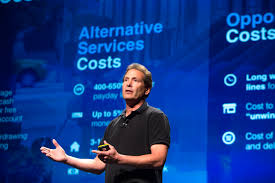
For the last several years, we've basically gently ceded market share to the other players in the industry. And I came in and said, that's a no-go. That is unacceptable. We're going to win in the marketplace. I'm a big martial artist. That doesn't work for me. I don't like going into the ring and just getting punched. If somebody's going to punch me, I'm going to punch back.
Today on the CEO Signal, we're talking to Dan Schulman, the CEO of Verizon. He came out of retirement to lead this company as it resets. Verizon is moving out of an investment cycle and into a new phase of execution, growth, and customer focus. It's also going through a major restructuring. So why did Dan Schulman decide this was the job to come back for? From Seapur, this is the CEO Signal.
So, I'm very pleased that we got Dan Schulman on this show today. I first knew him when he was running PayPal, but he started his career in the telecoms industry, and now he's back quite dramatically to run Verizon. I'm really interested how someone with his values leads at a time when he's got to make really hard choices.
Yeah, because this company has been under quite a lot of pressure and he's had to make some very difficult decisions.
The CEO Signal is sponsored by PwC.
AI, AI, AI, AI. Isn't that great? We help cut through the AI noise so you can solve the business problems that matter most. Here's the plan. AI solutions from PwC.
Well, Dan, welcome to the show.
Thank you so much, Penny. Appreciate it, Andrew. Pleasure. Thank you for joining us.
We're really thrilled you're here. So, you've reinvented yourself a number of times and very few CEOs are able to do that. You've gone from telecom into fintech, then back to telecom. And I think you had a really meaningful retirement in between there.
You know, I did have a great two-year stint or so retired, which was unbelievably fantastic. I'm massively in love with my wife. We have a beautiful ranch in Montana, and that's kind of where I was hoping I'd spend the rest of my life until things happened within Verizon. We had to make a change. I was on the board and out of really a sense of loyalty and obligation stepped in. And seven months later, I'm so glad that I did because I'm loving it.
So I want to dig into that. You weren't on the bench completely. You were, as you say, still on the board here, but not many people make that decision to go from a board role to an executive role again, especially after they've retired. What was it that you saw at Verizon as needing you to do that?
Well, the company was, from my perspective at least, in need for a pretty complete turnaround. We had been losing customers and market share for five years. Our market cap had dropped from being first in the industry to last. Customer satisfaction results were going down. Our churn rate was going up. There wasn't really many encouraging things you could point to. So we had to make a change. I have a lot of telecom experience. I spent 18 years at AT&T. I was president of the consumer division there. I was the CEO of a mobile virtual network operator, Virgin Mobile. I did that for seven years. Took that public. So, I know the industry pretty well. I'm comfortable being a CEO. I knew the management team and obviously I knew the board. And I also felt very importantly that there were a tremendous number of assets that Verizon has that if we could unleash them, there was a real good chance that we could turn around the company. It still was a hard decision, just to be very clear. As I said, I was incredibly happy living the life I was leading. And so when it was first broached with me, I said, you know, I don't really think this is a thing that I want to do.
Yeah. Well, I said no a couple times. You know, the board knows how much I love Summerly. And they were like, well, talk to Summerly and maybe she'll talk some sense into you. It took a while for me. I was quite reluctant to go in. But as I also said, I felt immediately comfortable in the job. There was no telco language that I had to learn, all the different words that people use in different industries.
So, as you were making that decision, you were in your retirement, if you will. Were there things you learned about yourself being in Montana, being on a ranch, and learned about leadership that you're bringing that maybe hadn't quite come to the fore before?
Yeah, that's a great question. Because being out on a ranch, and our ranch is an authentic working ranch. It's been a cattle ranch since 1888. And we have cowboys and horse wranglers and we sell our beef and it's a real operation. And the ranch really taught me a ton of lessons on just what it means to be dedicated to something. Like when we have branding at the ranch, all the neighbors come over. We did it over Memorial Day weekend one weekend. I was like, I really feel bad about taking people away from the holiday weekend and they're like, this is what we do. We all come over to help each other. And it's a pretty beautiful thing, actually.
So, have you brought any of these ranch management insights to your leadership team?
No branding yet. No branding yet.
You know, if they miss Q2...
I think they're going to do pretty well. But yeah, I mean, I think that whole selflessness and just everybody in, and if there's a fire on the ranch, everybody comes right away. So, it's a beautiful communal type of thing. And it's way bigger in a company like Verizon where we have 100,000 full-time employees. But I want to create that same sense of we're all in this together. We have a mission that we're trying to go do. We want to reclaim our market leadership and rally around that. And if you can create that, it's kind of a pretty beautiful feeling.
So Dan, can you bring us up to speed? Where is Verizon at now?
Well, I think we've accomplished a lot, but we have a ton more ahead of us. So I think the things that we've accomplished is there's a new attitude within the company that we are playing to win. For the last several years, we've basically gently ceded market share to the other players in the industry. And I came in and said, that's a no-go, that is unacceptable. We're going to win in the marketplace and we're going to do that in a fiscally responsible manner, but we're not going to be a punching bag anymore. As you said, I'm a big martial artist. That doesn't work for me. I don't like going into the ring and just getting punched. If somebody's going to punch me, I'm going to punch back.
So Dan, what does it mean to play to win?
Play to win for me, it's not a marketing slogan. It is an attitude. And it's a reality of what I want to see. I want to see us regain our swagger in the marketplace. I want to make sure that we're doing all the right things, and there's so many of them, to satisfy customers. And then I want to see us start to gain share, gain the trust of our customers, and start to grow again. And a lot of this comes from philosophies that I've had for a long time. I've done a form of martial arts called Krav Maga, which is the Israeli MMA form, full body, legs, arms, elbows, knees, head, teeth, whatever it takes to win. And there's so many things that I've learned through martial arts. Probably the biggest one is being very humble. You can't judge somebody from how they look. Like I think I can probably beat up Andrew.
But I don't know because you could be an amazing martial artist. And also when we're in the middle of it, you always are thinking to yourself, I wish I had trained more. So, it's just you never know it all. You're always learning. And I love that attitude because I think the world that we're in today, which is so ferociously changing, you have to admit both to yourself, I want my team to be able to admit as well, and I want the company to know, we don't know everything that's going to happen in the future. We want to prepare ourselves as best we can, but we can't say absolute truths anymore because you'll be proven to be a liar in like a year.
Am I right in thinking there's another principle of Krav Maga, which is never stand still? How relevant is that when you're trying to get that pace and intensity?
Well, I think it's massively important. And that never stand still is, if you stand still in a fight, there's more tendency that you'll get hit. If you're moving, there's less tendency. And so, I think inside a company, it's exactly the same thing. When the pace of change external to a company is greater than the pace of change internal, you're falling behind. And that's a high bar because the pace of change is intense right now.
You set a great example, but sometimes being the example isn't enough. You have 100,000 employees. How do they experience that?
I think like the role of great leadership is to define reality, which can be a real bummer for people because that might mean that we have to have layoffs going forward. It might mean that the industry is under a lot of pressure, whatever it may be. But you have to define reality and really define it because if you don't, your employees know what's really going on. They're all adults. They read the news. They get a sense of it and they want to know that as a leader you understand reality and you're saying it very clearly to them because it can also be like a wake-up call and a clarion call to action. But if you only define reality, that can be a real downer for everybody as well. You also have to inspire hope. So you're defining reality, then you're inspiring hope. Like what is the vision? Why is that vision possible? And then really importantly, how do we move from reality towards that vision? And so I would say where are we now on the journey? Because you asked that question. Bet you thought I forgot about that. We've defined reality extremely well and we understand what we want to drive towards. Like we want to be one of the most trusted brands in the country. Not within telecom but in the country. We want to reclaim our market leadership and we want to do that by putting the customer at the forefront of everything that we go and do from every little thing. And then you've got to define that path. That path starts with understanding like what is our culture like and where does it need to change? And Verizon is not that different from most big companies that have been around for a while. You know, it's bureaucratic, it's very hierarchical, it's process-oriented, not outcomes-oriented. It's very risk-averse. And all of those things mean that we have a kind of a bloated cost structure. We move slowly when the market is moving very quickly and because we're risk-averse, people are afraid to be more confrontational than collegial. And so I feel like we are now on this path where we have identified what we need to do, where we are, and it's now a matter of that cultural reset coming into place. And we've got a full transformation program in place, like 10 different initiatives that are the key initiatives for us with leaders assigned to each of them, cross-functional metrics that I want to see met every week, every month, every quarter, every year. And so we really have a playbook in place and so far it seems to be working. Like we're at the beginning stages of it, but it's exciting to see people react to it. People like being part of a winning team. Big companies, the biggest impediment to their future success is their past success. They want to redo what got them to the dance, which is fine if the world isn't changing that much, but it's almost like steering by the wake of a boat. You're looking behind you thinking that it's all calm, but there are rocks everywhere. And if you steer by the wake of the boat, you're just going to crash. And so you constantly have to be moving quite a bit.
So Dan, you talked about having 10 things that you were undertaking. One of the first big moves you made was a restructuring and a big layoff. And I know you and I know how much you care about your employees. Tell us about that decision and also the commitment you made to investing in their future in terms of reskilling in AI.
That was a really hard but necessary decision. I mean I think that's part of the burden of leadership, like you need to be able to make the difficult calls so that your company can thrive moving forward. I knew that we needed to make a significant investment in all the infrastructure that enables us to serve our customers. And so, I felt like I needed like $5 billion of cost savings, of which I would give the vast majority of that into upping our ability to serve customers and then some of it to our shareholders as well. And so part of that was looking at underperforming pockets in the company, places that we weren't going to focus on anymore because it just wasn't part of our priorities. And so we did take out about 13,000 employees, which is really, really hard. And I talked about this at an all-employee meeting. Which again, most CEOs don't love to talk about this, but I talked about it before we did it and then I talked about it after we did it. And I said, look, firing one person is incredibly hard. It doesn't just impact that one person. It impacts their family. It impacts their friends. It impacts colleagues at work that enjoyed working with them. And so I take that decision very, very seriously. But at the same time, we can't be a great company. We can't offer any kind of security to our employees if we're just shrinking as a company as well. We have to turn it around. And so what I opted to do is to make a significant cut as opposed to just bleed it out over multiple quarters and multiple years and that kind of thing. So those are difficult decisions, Penny, but they are decisions that have set us on a course now that everyone can see. And I think everyone is appreciative that we made those hard decisions.
When you've got a difficult decision like that you know you're going to have to take, how do you go about it? Are you consulting the board, the senior team, or are you just getting on a horse in Montana and spending some time with yourself to think before you press the button and send that email?
Well, I usually have a pretty good idea myself, like here's what I think we need to go do. Like I know philosophically we want to put customers at the forefront of what we're doing. I know that we don't have investment dollars to put against that. I know that our shareholders are quite frustrated because our stock has gone down 30% in the last five years and their confidence is not high either. And so I'm trying to weigh all the different constituencies and then I try and come up with what I think is an integrated set of actions that can address that situation holistically. And then once I have that, then I start to bring in like a brain trust and say, okay, let's pressure test this. Like, I think we need to take out 15,000 people in order to be able to go and do this. And then the team will come back and go, yikes, all right, let's think about that. How could we do it? And then we came up, the right number was 13. And then of course I talked to the board. I have a very open relationship with all of the boards that I've had in the past in all my past CEO jobs. I think they need to know everything that I'm thinking. Not just what I'm going to go do, but why I'm going to do it and what are the debates that I've had either just while I've been kicking it around or inside the team as well.
Does that invite more openness from the board members? More trust.
Of course. Of course. I mean open communication, that's like secret to a good marriage. It's the secret to a good board relationship, to friendship. So the more open you can be about it, and for me, boards are really important constituencies. They've got a ton of experience. I think most CEOs do not use them as constructively as they could. But the only way you can use them constructively is not if you give them the perfect presentation and try and monopolize the conversation for 90% of the board meeting and then they try at the very end to say a couple of things and then the time is over. I think the way you really leverage a board, theoretically they've got great skill sets and experiences and they can give you a different perspective or they can point out pressure points that you might not have thought about and then your plan just becomes better. But you need to be confident as a CEO, quietly confident, but confident nevertheless to be able to say it's not perfect. These are the issues, these are the vulnerabilities, these are the things, and then they're all in with you because they're part of that process.