
The Executive Podcast Boom Is Happening on Channels You Have Never Heard Of
Verified executive appearances tripled in 2025 to roughly 55,000. The surprising part is where they happened: 70 percent landed off the 100 biggest channels.
I built the chart below from our own corpus of verified executive appearances, and the top line is easy to read. Two decades ago a public company CEO sat for an on the record long form interview a few times a year, almost always on CNBC or Bloomberg. In 2025 our system verified roughly 55,000 such appearances. That is three times the 2024 count, and more than every year from 2006 through 2019 added together.
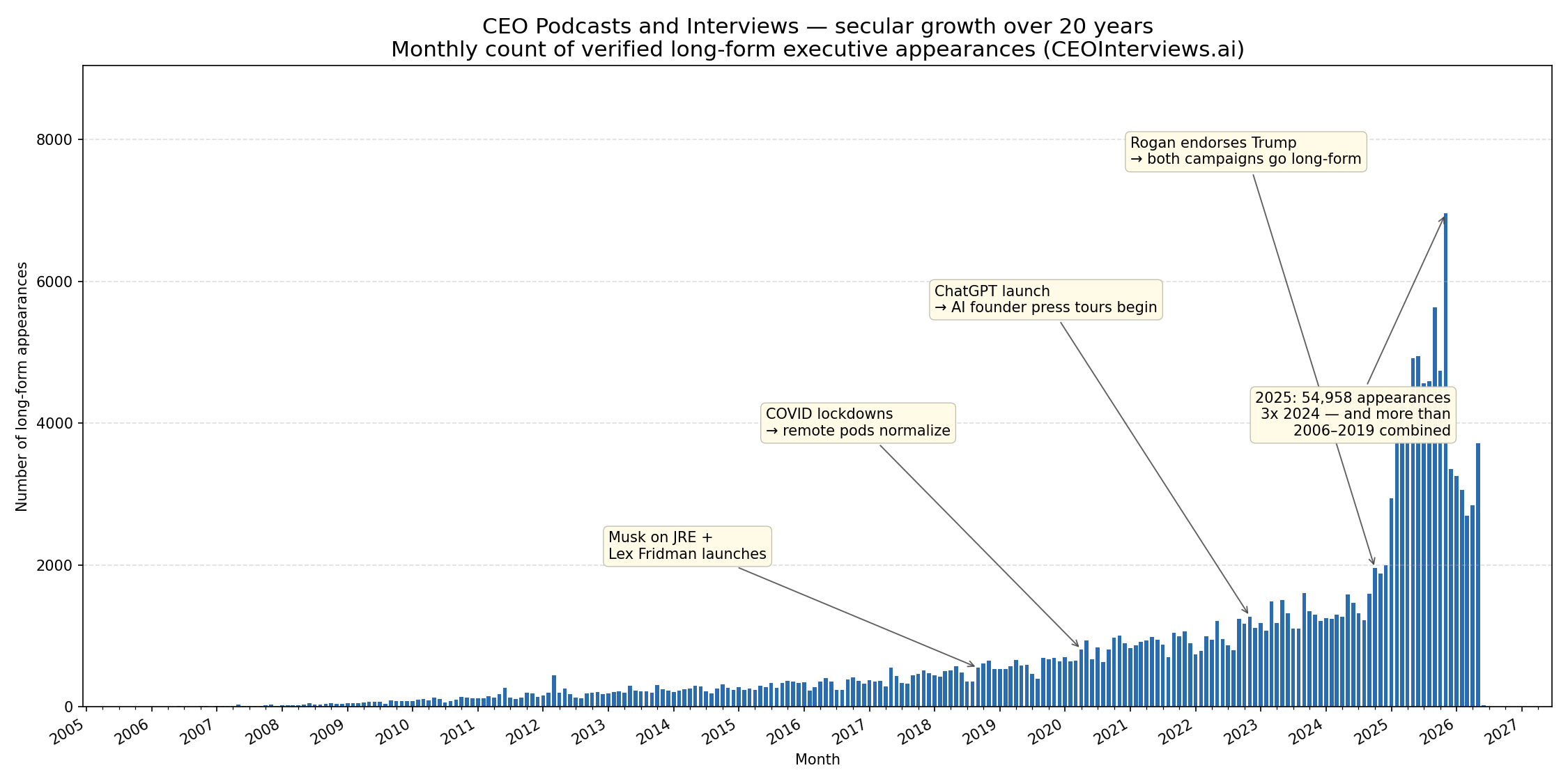
The climb is real and it compounds. The annotations track the obvious turning points. Elon Musk on Joe Rogan and the launch of the Lex Fridman show pulled founders into multi hour formats. COVID normalized remote recording, so a CFO no longer needed a studio. The launch of ChatGPT kicked off a wave of AI founder press tours. The 2024 election sent both campaigns deep into long form audio. Each event ratcheted the baseline higher and it never fell back.
That headline number is the least interesting thing in the data. I went back into the corpus to answer a narrower question. Where do these appearances actually happen? The answer changes how a serious investor should monitor this surface.
The growth is happening in the long tail, not at the top
The intuitive story is that CNBC, Bloomberg, and a handful of giant podcasts got bigger. The data says the opposite. The number of distinct channels carrying a verified executive appearance grew faster than the appearances themselves.
| Year | Verified appearances | Distinct channels |
|---|---|---|
| 2018 | 6,033 | 2,600 |
| 2020 | 9,654 | 3,818 |
| 2022 | 12,218 | 4,694 |
| 2024 | 18,271 | 6,346 |
| 2025 | 54,676 | 13,849 |
The venue count more than doubled in a single year and is up more than five fold since 2018. Concentration collapsed alongside it. In 2020 the ten largest channels carried 23.8 percent of every verified appearance. By 2025 that top ten share had fallen to 11.2 percent. Seventy percent of all 2025 appearances happened on channels that sit outside the 100 largest. Of the 13,849 channels active in 2025, more than 8,700 of them carried exactly one verified appearance.
To put a number on how small these venues are: among the appearances where we have a subscriber count, the median channel has about 233,000 subscribers, and 44 percent sit on channels with fewer than 100,000. These are not household names. They are niche industry shows, regional business programs, founder run podcasts, and single topic channels.
Look at who the leaders were, then and now
The clearest way to see the shift is to line up the top channels in 2020 against 2025. In 2020 the leaderboard was traditional financial media, top to bottom.
| Top channels, 2020 | Verified appearances |
|---|---|
| CNBC Television | 864 |
| Daily Earnings Calls | 521 |
| Bloomberg Television | 292 |
| Yahoo Finance | 154 |
| Bloomberg Technology | 98 |
By 2025 CNBC was still the single largest channel, but its share of the whole had fallen from roughly 9 percent to about 3.8 percent, and the names sitting right behind it had changed character entirely.
| Top channels, 2025 | Verified appearances |
|---|---|
| CNBC Television | 2,085 |
| DRM News | 774 |
| Bloomberg Television | 508 |
| EU Debates | 432 |
| Anthony Scaramucci | 425 |
| Forbes Breaking News | 381 |
An individual operator now ranks alongside Bloomberg. Channels that first entered our verified data in 2024 or later account for 47 percent of all 2025 appearances. The roster of executives barely widened over the same period, from about 2,461 distinct people in 2024 to 2,626 in 2025. The same group of leaders is now appearing far more often and across far more venues. The conversation did not just get louder. It scattered.
What this means if you trade on it
For a fund or a corporate strategy desk, the practical takeaway is blunt. A monitoring process that watches CNBC, Bloomberg, and the ten famous podcasts now sees less than a third of the surface. The other 70 percent lives on channels a terminal will never index, hosted by people a sell side analyst has never heard of.
This matters because the small venues are where the candor is. An executive reading scripted talking points on a flagship network is managing a brand. The same executive two hours into a niche industry podcast, talking to a host who actually understands the supply chain, says things that never appear in the 10 K. We have watched CFOs walk through capacity plans, founders pre announce pricing posture, and operators give real opinions on export controls and immigration, all on shows with audiences in the tens of thousands.
Three concrete shifts follow from the data:
- Coverage has to be channel agnostic. You follow the executive, not the network. The moment you whitelist a set of "credible" channels, you have blinded yourself to most of the signal.
- Speed favors the small venue. A niche channel posts a two hour conversation with no compliance desk and no embargo. The material line is public hours before a wire story summarizes it, if a wire ever does.
- Breadth beats prestige. Because the same executive now appears across dozens of venues, contradictions surface. A CEO who frames guidance one way on CNBC and another way on a founder podcast is telling you something. You can only catch it if you capture both.
This is the entire reason CEOInterviews.AI exists. We verify the speaker and the date on every appearance, across all 13,000 plus channels, not just the famous ones, and we make the whole thing searchable down to the quote. You can read more about how we source and verify the data, or start from any executive's profile.
Watch the long tail, not just the networks
Every verified executive appearance, across 13,000 plus channels, with speaker level verification and searchable quote transcripts. The signal moved off CNBC years ago.
Browse the latest quotes →Frequently Asked Questions
How many executive interview appearances happened in 2025?
CEOInterviews.AI verified roughly 55,000 long form executive appearances in 2025. That is about three times the 2024 count, and more than every year from 2006 through 2019 added together.
Are CEO interviews still dominated by CNBC and Bloomberg?
No longer. In 2020 the ten largest channels carried 23.8 percent of all verified appearances and CNBC alone held roughly 9 percent. By 2025 the top ten share fell to 11.2 percent and CNBC held about 3.8 percent. Seventy percent of 2025 appearances happened on channels outside the 100 largest.
How small are these channels?
Smaller than most people expect. Among appearances where we have a subscriber count, the median channel has about 233,000 subscribers and 44 percent sit on channels with fewer than 100,000. In 2025 more than 8,700 channels carried exactly one verified executive appearance.
Why does the rise of smaller channels matter for investors?
A monitoring strategy limited to CNBC and Bloomberg now misses about 70 percent of the executive interview surface, and the small venues are where executives speak most candidly. Capturing the long tail is how you find the material commentary before it reaches a wire.