
AMI Founder & Chair Yann LeCun at Silicon Valley & The World | Semafor
Moderator: Shelly Banjo, Deputy Editor-in-Chief, Semafor.
Co-Founder & Executive Chairman, AMI Labs
Search every verified Yann LeCun interview, podcast appearance, and on-the-record quote — each transcript cross-checked by AI and human review to confirm speaker identity. Yann LeCun, co-founder and executive chairman of AMI Labs, has been active in public discussions about the limitations of large language models (LLMs) and his vision for next-generation AI. In recent appearances, he argued that LLMs, which are trained to predict text, lack the ability to reason, plan, or understand the physical world, and he described them as "intrinsically unsafe" but not particularly dangerous due to their lack of objective-driven behavior. LeCun advocated for a shift toward "world models" and the JEPA architecture, which he said can predict abstract representations of the world and enable systems to learn from sensory data, similar to how humans and animals learn. He stated that human-level intelligence will not be achieved by training on text alone and encouraged students to focus on physical AI rather than LLMs. LeCun also addressed AI safety and open-source development, dismissing claims of existential risk from AI as "completely made up" with no scientific basis, and argued that open-source AI is necessary for security, diversity, and innovation. He criticized what he described as fear-driven narratives from some Silicon Valley figures, suggesting these serve the interests of those controlling the technology. At AMI Labs, which he co-founded after leaving Meta, LeCun said the company is in a research phase, developing world models for applications in robotics, industry, and health, with teams in Paris, New York, Montreal, and Singapore. He also encouraged countries like Japan and France to leverage their manufacturing strengths and invest more in AI research and infrastructure.

Moderator: Shelly Banjo, Deputy Editor-in-Chief, Semafor.

Chatbots mastered language because language was the easy part, and a house cat still knows things about the world that no machine does. | Subscribe to Futurology: https://bit.ly/subscribe_futurology The machines that frighten us are very good talkers. They answer in confident paragraphs, so we assume there's a mind in there that will one day want something. But a system built to predict the next word acts without thinking ahead, which makes today's AI intrinsically unsafe but nowhere near smart enough to be dangerous. So the danger isn't the machine. It's who owns it. In this episode, Yann L…

Get to know the personal side of a pioneer. In this casual, behind-the-scenes interview at NTU Singapore, Turing Award Laureate Prof. Yann LeCun sits down with us for a candid conversation. Moving beyond his academic lectures, the "Godfather of AI" shares his personal journey, what keeps him motivated, and how he balances his ground-breaking research in advanced machine intelligence with life outside the lab. 🌐 Learn more about NTU IAS events: https://ias.ntu.edu.sg #yannlecun #behindthescience #AIPioneer #TuringAward #deeplearning #NTUIAS #NTUSingapore #sciencecommunication #machine…

What lies beyond generative AI? In this Distinguished Professor Public Lecture, Turing Award Laureate and AI Pioneer Prof Yann LeCun explores how "world models" could enable machines to understand, reason, and plan, bringing us closer to human-like intelligence. Recorded live at Nanyang Technological University, Singapore (NTU Singapore), this public lecture delves into the frontiers of advanced machine intelligence and the future of deep learning. This landmark session was organized jointly by the Institute of Advanced Studies (IAS@NTU) and the College of Computing and Data Science (CCDS…

1:45 p.m. — AI at 70 Award Presentation & Keynote: World Models: Enabling the Next AI Revolution: Yann LeCun, founder/chair AMI Labs; professor of computer science, New York University, winner of the 2018 ACM Turing Award, presented by Peter Chin, AI at 70 Conference Faculty Chair, professor of engineering, Dartmouth. October 29, Moore Theater

日本の強みやフィジカルAIの可能性、次世代AIの本命と言われる「世界モデル」について、「AIの父」と言われ、メタのAI研究開発部門でトップをつとめたヤン・ルカン氏らが語りました。 ▼テキスト記事 「AIの父」ヤン・ルカンが語る「LLMの限界」、次世代AIの本命「世界モデル」とは? https://www.sbbit.jp/article/cont1/18... ■出演者プロフィール■ ヤン・ルカン(Yann LeCun) AMI Labs 創業者 会長 元メタ チーフAIサイエンティスト 2018年コンピュータ科学界のノーベル賞といわれる「チューリング賞」を受賞。 「AIの父」とも呼ばれている。 【動画の目次】 00:00 オープニング 00:43 日本の製造業と産業データが持つ強み 03:40 AI主権と特定企業への依存をめぐる課題 05:12 生成AIやLLMが抱える限界 08:18 現実世界を予測する「世界モデル」とは 11:39 次世代AIのアプローチ「JEPA」 12:52 フィジカルAIが切り開く未来 IIAC 2026主催:Industrial AI Federation/運営:Aitomatic ・iiac.events https://iiac.events ・iaf.foundation https://iaf.foundation/ ・aitomat…

最先端のテックストーリーをわかりやすくお届けする番組「1on1 Tech」。 今回のテーマは【AI界のゴッドファーザーが「人類滅亡論」を全面否定】です。 「AIが人類を滅ぼす」という議論に、「科学的な根拠は何もない」と異を唱えるヤン・ルカン氏。MetaでチーフAIサイエンティストを務めたAI研究の第一人者は、なぜAIへの悲観論を否定するのでしょうか? AIの危険性を訴えるAnthropicの主張や、OpenAIのGPTによる外部システムへの侵入問題をどう見るのか。そして、自らを改良するAIや、人間を超える「超知能」はどこまで実現に近づいているのか。「今のAIは大して賢くない」と語るルカン氏に、その真意を聞きます。 さらに、12年間在籍したMetaを離れ、「AMI Labs」を立ち上げた理由にも迫ります。 LLMの限界とは何か? 次のAIを担う「世界モデル」とは? 製造業や自動運転、家庭用ロボットへの可能性まで、じっくり伺います。 ぜひ最後までご覧ください! ◆チャプター◆ 00:00 AI界のゴッドファーザーが「人類滅亡論」を全面否定 01:42 「AIで人類滅亡」全否定の理由 07:53 最新AIは本当に賢いのか 14:14 AIサイバー攻撃は「正しく恐れよ」 18:52 MetaのAI研究トップから降りた理由 26:04 なぜAIを「オープン」にすべきなのか 30:49…

AI pioneer Yann LeCun tells Evident’s Alexandra Mousavizadeh that large language models remain limited in their ability to reason and plan in the physical world. He explains why he sees world models as a potential next paradigm, and why “we still don’t have domestic robots.” He also shares how AMI Labs’ JEPA architecture predicts in an abstract representation space, ignoring unpredictable details – a prinicple he likened to finance, where data is “mostly noise with a little bit of information in it.” Speakers: Yann LeCun, Executive Chairman, AMI Labs Alexandra Mousavizadeh, Co-Founder & C…

A conversation with Yann LeCun, AI legend, Co-Founder of AMI Labs and NYU Porfessor and Rob Toews, Partner at Radical Ventures.

Opening keynote : Yann LeCun (Founder, AMI Labs and Turing Award laureate)
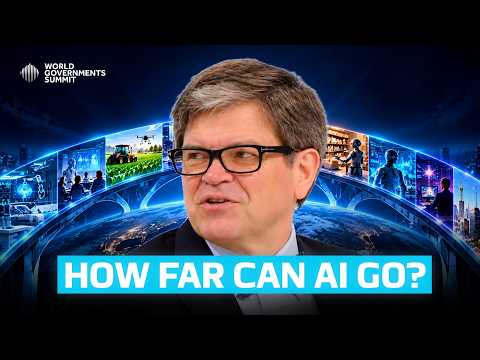
"How far are we really from the next generation of artificial intelligence? Dr. Yann LeCun, Turing Award Laureate and Vice President & Chief AI Scientist at Meta, explores the future of AI and why today’s systems may still be far from achieving true intelligence. In this conversation, he discusses the limitations of large language models, the breakthroughs needed to move AI forward, and why building machines that can understand the world remains a major challenge. In this video: The future of artificial intelligence Why today’s AI is still limited The future of large language models What c…

On the occasion of AIM 2026, Yann LeCun explains that AmiLabs, still in the research phase, is developing 'world models' based on JEPA so that systems can understand reality and predict the consequences of their actions, beyond the limits of LLMs. The first advances should appear in the form of scientific work, then serve industrial applications, before possible uses in robotics and health, without a precise timeline. He also advocates for open AI to preserve sovereignty and diversity, and calls on France and Europe to invest more in computing, research, talent, and venture capital. #AIM #I…
“We raised about 40% of the funds from European sources, about 33% from the US, 27% from Asia with one fund from Dubai. But here's the thing: zero from Silicon Valley, not a cent from Silicon Valley VCs. I think we were pretty early on, we figured we were oversubscribed, and a lot of Silicon Valley VCs want control and they were not going to get it. So I think that's one of the reasons. Also, we are a French company, ”
“I think the LLM approach has some shortcomings which, you know, all very useful, there's big business around it, nothing wrong with that, it's very helpful, we all use it every day, but not as a path towards kind of humanlike intelligence or certainly not super intelligence. And the problem is that a lot of Silicon Valley is LLM pill, and so that's what's wrong with Silicon Valley.”
“LLMs are system one essentially because they're trained to basically reproduce and they're trained to reproduce human behavior. I have said that LLM in their current form are intrinsically unsafe. Now they're not particularly smart so they're not particularly dangerous either. Because they're not objective driven. It's not like you can give them an objective, a task has to accomplish, and they will do nothing but acc”
“The first misconception is that we're going to have super intelligent system by next year or two years from now. That's not going to happen. It's going to take much longer. What we have already are AI systems that are extremely useful. They can answer a lot of questions. They're not particularly smart. They just have a lot of accumulated declarative knowledge so they can regurgitate it at the right time. We have syst”
“So first of all, most of the world models that companies like Google, Nvidia, Wave, the autonomous driving company, and others have been building are all generative models. They're basically video prediction, right? Most of them use diffusion models of some type because that's the only way to train, you have to use latent variables to make predictions in pixel space. They all do pixel space prediction, which I think ”
“LLMs are trained on human produced text of which there is a limited amount. All the publicly available text on the internet represents roughly 2 times 10 to the 13 words, 20 trillion words. You turn those words into tokens, you get roughly 30 trillion tokens. Each token is three bytes. And so you do the arithmetics and you get roughly 10 to the 14 bytes. That's the size of the entire corpus that LLMs are pre-trained ”
Sign in to search the full transcript archive, filter by topic, and access every quote from Yann LeCun.
The summary and quote tags on this profile are produced with AI assistance from verified, first-person interview transcripts, then checked by our team to confirm the speaker's identity and the accuracy of every quote. See how we verify →
Pro unlocks every transcript in full, plus unlimited search across every executive and company we cover.
50% off appliedPulling data at scale? The Data API gives you 30,000 transcripts a month over REST, MCP and JSON.
Compare all plans