Jeff Neuman discusses the new gTLD subsequent procedures PDP
The importance of the new gTLD subsequent procedures PDP explained by the Co-Chair of the Working Group Jeff Neuman.
Senior Vice President, Corporate Secretary & General Counsel, Tronox Holdings
Search every verified Jeffrey Neuman interview, podcast appearance, and on-the-record quote — each transcript cross-checked by AI and human review to confirm speaker identity. In a September 2016 discussion, Jeff Neuman, co-chair of the working group on new generic top-level domain (gTLD) subsequent procedures, described the policy development process (PDP) as addressing how to introduce new gTLDs in the future. Neuman stated that ICANN's core mission since 1998 included fostering competition among registrars and registries, and that the introduction of new gTLDs had increased competition and innovation. He noted that the Generic Names Supporting Organization (GNSO) had called in 2007 for a predictable, ongoing process for new gTLD introductions, and that the last round occurred in 2012. Neuman said the PDP would examine whether future introductions should occur in rounds or on a first-come, first-served basis, and would also address rights protection mechanisms, registry outreach to customers, and application process efficiency. Neuman explained that ICANN 56 in Helsinki would feature two types of sessions: a face-to-face working group meeting to advance its activities, and a cross-community session to update other ICANN groups on progress and gather input. He emphasized that the entire ICANN community had an interest in new gTLD introductions and that participation was open to anyone, either in person or online through email lists, teleconferences, and webinars. Neuman added that new members could join the working group by contacting the GNSO Secretariat.
“Ever since ICANN's inception in 1998, one of its core missions was to foster competition amongst not only domain name registrars but also domain name registries. ICANN has had several rounds of introduction of new gTLDs, and in the last 15 or more years since ICANN has launched new gTLDs, we've seen an increase in comp...”
“The Generic Names Supporting Organization said in 2007 that we should introduce a predictable process for the introduction of new gTLDs on an ongoing basis. The last round of new gTLDs was in 2012, and in accordance with the GNSO's policy in 2007 to keep introducing new gTLDs, this new policy development process is to...”
“The key issues really all revolve around how should we introduce new gTLDs in the future, meaning should we do rounds of new gTLDs or should the accreditation process for new gTLDs be like the accreditation process for domain name registrars, really first come first serve on an ongoing basis.”
“This PDP is important to look at issues around rights protection mechanisms, to look at how we can allow domain registries to reach out to its customers, and how we can talk about improving the efficiency of the application process.”
“ICANN 56 is going to be a unique first-time experiment of a new format of an ICANN meeting, and what's great about this new format is that it really focuses on the policy issues of ICANN, and one of those policies is the introduction of new gTLDs subsequent procedures for new gTLDs.”
“At the ICANN meeting in Helsinki, we have really two types of sessions: one is a face-to-face meeting of the working group itself, primarily to get to the next stage in the working group's activities to discuss face to face some of the pressing issues at that time; in addition, there's going to be a cross-community ses...”
“The entire ICANN community has an interest in the introduction of new top-level domains. Community members can get involved in a number of different ways, including showing up to the ICANN meeting in Helsinki, but a lot of our work in the working group and in most working groups that ICANN has is really done online thr...”
“The working groups are always open to anyone that wants to participate, even at this late stage. The group is already formed, but new members are always welcome to join; they just have to send an email to the GNSO Secretariat saying they want to get involved, and they'll be added to the list as either an observer membe...”
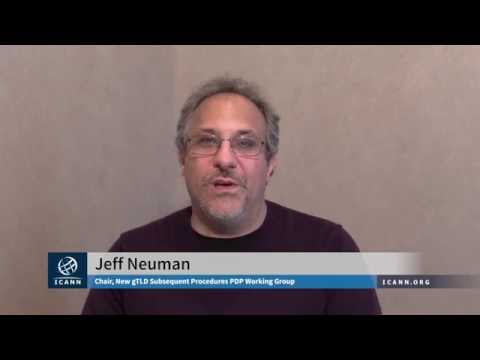
The importance of the new gTLD subsequent procedures PDP explained by the Co-Chair of the Working Group Jeff Neuman.
Sign in to search the full transcript archive, filter by topic, and access every quote from Jeffrey Neuman.
The summary and quote tags on this profile are produced with AI assistance from verified, first-person interview transcripts, then checked by our team to confirm the speaker's identity and the accuracy of every quote. See how we verify →