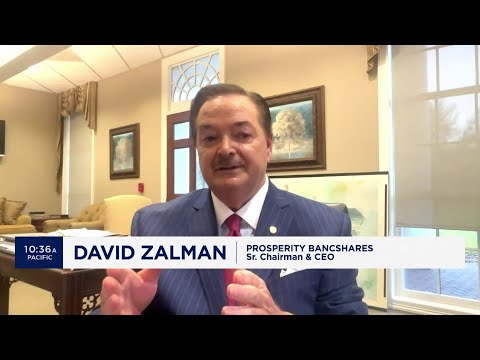
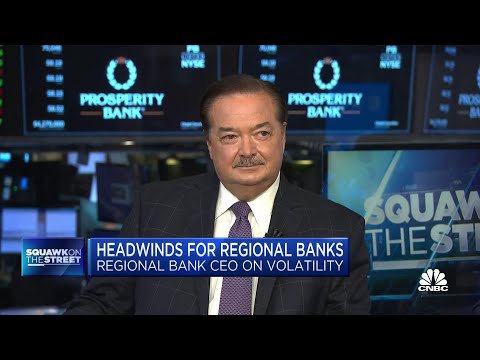
Dr. Laura Murillo interviews David Zalman, Senior Chair of the Board & CEO, Prosperity Bank
Information about the Houston Hispanic Chamber of Commerce | InformaciΓ³n sobre la CΓ‘mara de Comercio Hispana de HoustonΒ ...
Senior Chairman & Chief Executive Officer, Prosperity Bancshares
Search every verified David Zalman interview, podcast appearance, and on-the-record quote β each transcript cross-checked by AI and human review to confirm speaker identity. David Zalman, senior chairman and CEO of Prosperity Bancshares, discussed the bank's performance and outlook in several media appearances in 2024. In September, he stated that the bank had increased loans by about 12% for the year, though he attributed part of that growth to an acquisition. He said that rising interest rates had made borrowers more cautious, and he expected loan growth to be stronger in the second half of 2024 than the first half. In November, Zalman reflected on the bank's growth from about $40 million in assets and 10-15 employees to a $40 billion bank with about 4,000 people, describing his legacy as wanting to be known for working hard, being competitive, and helping people. In earlier appearances, Zalman commented on broader banking and economic issues. In 2023, he characterized the stress on some banks as a "confidence issue" rather than a credit issue, and he advocated for temporary measures to address short-selling and deposit outflows. In 2020, he described the oil price war and the coronavirus pandemic as a "double whammy" for the bank, but noted that many of the bank's oil and gas customers were hedged. In 2018, he argued that mortgage rates of 5% or 6% would not kill the housing market, calling such rates a "normalization" after historically low levels.
“Today we're a $40 billion Bank with about 4,000 people and we started with about 10 or 15 people and 40 million in capital market cap of about $7 billion and we had a mil 600,000 so we've had a tremendous amount of success and that's all been a part of so my life has always been a part of this at the same time.”
“We went public on the NASDAQ Stock Exchange in '98 when we were a big $300 million at the time in size, and from 98 we went public in 2001 what really changed our dynamics because we had a lot of banks around Houston, some in Houston but probably more outreach or more rural in nature.”
“The oil crash from '87 through '92 was tough, but the only good thing we had going for us is that we were a small bank and the regulators really loved us because we managed the bank pretty good and they let us do things that probably today you couldn't do, like letting our capital go down.”
“A lot of banks go out and just buy a bank or merge with a bank and they let those people go, but we are the complete opposite. Most of our management team is really made up of people that have joined us. I call us a bank of immigrants.”
“I really enjoyed banking so much it's never really felt like a job. I had this dream of building something that was really Texas and I still want to build that again. We want to grow but not just be big to be big; we want people to like us, respect us, and that we give something back to the community.”
“When we first started, I couldn't pay one of my guys a whole lot of money so I gave him a stock certificate. That 10,000 shares turned into about $20 million worth of stock after splits. A lot of guys made a lot of money and it's great to see them retired while I'm still working.”
“The first day I announced that we bought a bank in Dallas, our stock went down 10% because analysts doubted how we could run a bank in Dallas when we were just in Houston. But after a couple of quarters, we did really well and everyone loved it.”
“I want my legacy to be that I worked hard, was competitive, fought the fight, challenged myself every day, and hopefully helped a lot of people in the process to build something lasting that will help many people in the future.”
“If you took out the FDIC assessment that we had to pay to cover the Silicon Valley Bank and the Signature Bank, it would have been about $11 million after tax for the quarter.”
“The Texas economy is doing pretty good, and so your bank ought to be doing great. The economy is doing good, obviously interest rates going up with the FED raising the interest rates has impacted the loan volume a little bit.”
“We actually increased loans by about 12% for the year but part of that increase came from an acquisition. Without the acquisition, we would have had about a 4.9% increase in loans year-over-year.”
“In the third quarter, we had a decrease in loans which was natural. We expected about a single to mid-digit growth in loans for the year and that's kind of what we ended up doing.”
“As interest rates increase, borrowers have been more hesitant and cautious about borrowing, even commercial and industrial customers have elected to pay down debt instead of paying higher rates.”
“We still are looking for some growth next year, probably more in the second half of the year than the first half.”
“With the 280 something stores that we have, I think we have enough stores. We'll probably do mergers and acquisitions as part of our growth strategy.”
Information about the Houston Hispanic Chamber of Commerce | InformaciΓ³n sobre la CΓ‘mara de Comercio Hispana de HoustonΒ ...
Prosperity Bancshares CEO David Zalman joins 'The Exchange' to discuss loan activity, the health of the bank's balance sheet,Β ...
David Zalman, Prosperity Bancshares senior chairman and CEO, joins 'Squawk on the Street' to discuss how Zalman's navigatedΒ ...
David Zalman, Prosperity Bancshares senior chairman and CEO and Dallas Fed Reserve Bank board member, joins 'PowerΒ ...
CNBC's Brian Sullivan sits down with CEO of Prosperity Bank, David Zalman, and Landry CEO Tilman Fertitta, to discuss theΒ ...
Sign in to search the full transcript archive, filter by topic, and access every quote from David Zalman.
The summary and quote tags on this profile are produced with AI assistance from verified, first-person interview transcripts, then checked by our team to confirm the speaker's identity and the accuracy of every quote. See how we verify →