Dr. Lori Marino - Changing the Scenery for Captive Whales: The Whale Sanctuary Global Movement
Dolphins and whales are highly complex, large-brained social mammals. To date, thousands are kept in concrete tanks in marine ...
Senior Vice President, Chief Legal Officer, Corporate Secretary & Chief Compliance Officer, Itt
Search every verified Lori Marino interview, podcast appearance, and on-the-record quote — each transcript cross-checked by AI and human review to confirm speaker identity. Lori Marino, a neuroscientist and founder of the Whale Sanctuary Project, has continued to advocate for the transition of captive whales and dolphins to seaside sanctuaries. In a December 2023 lecture, she discussed the global whale sanctuary movement, describing the project's planned 100-acre open-ocean sanctuary in Port Hilford, Nova Scotia, which she said would provide animals with autonomy, natural habitat, and veterinary care without performances or breeding. She cited data indicating that captive orcas rarely live past 30 years, while wild females can reach 80 to 90, and noted that 73 of 103 orcas held in captivity since 1985 have died. Marino also referenced the death of the orca Lolita at the Miami Seaquarium in August 2023 at age 57, stating that preparations to return her to her natal waters were underway at the time. In a September 2023 talk at Yale Law School, Marino discussed the role of science in animal protection legislation, highlighting the SWIMS Act in the U.S., which would end the breeding and import of orcas, beluga whales, false killer whales, and pilot whales, and Canada's Bill S-203, which banned breeding and entertainment use of dolphins and whales in 2019. She described a new program aimed at bridging animal law and science, including webinars on natural and social science for lawyers, and argued that scientific evidence on animal welfare is essential for legal advocacy. Marino has also spoken about the cognitive and social complexity of cetaceans, stating that orca brains are the most convoluted on Earth and that dolphins demonstrate self-awareness, cultural transmission, and empathy, which she said supports the case for legal personhood and improved protections.
“Today I want to talk about something that I've been working on for quite a long time and that is whales — but specifically about a new movement that's happening globally that's called the whale sanctuary movement and I want to tell you about why whale sanctuaries are so important now.”
“Lolita — does anybody know who she is — she's known around the world and she unfortunately passed away on August 18th at the age of 57 at the Miami Seaquarium, and at the time that she died there were a team of veterinarians and trainers who were trying to prepare her to go back to her natal waters in the Pacific North...”
“The thing that attracted me to orcas originally was their big complex brains — their brains are two and a half times the size you'd expect for even an animal of that body size — and the complexity of their brain is really something to write home about; these are also cultural animals with dialects, long juvenile period...”
“SeaWorld has maintained that the maximum lifespan of orcas both in the wild and in the tanks is 35 — that's untrue; data from free-ranging populations off the Pacific Northwest show that females can live to 80 to 90 and males 50 to 60 maximum, but captive orcas of either sex rarely live longer than 30 years and most di...”
“Of 103 orcas who have been in captivity globally since 1985, 73 have already died with 40 dying in their first year; therefore orca birth rates and infant mortality rates have been at best the same or only slightly better in captivity than in the wild — despite having veterinarians, regular feeding and protection from...”
“The most widely accepted definition of animal welfare is that it comprises both body and mind and the extent to which its nature is satisfied; welfare includes positive states — your well-being is not just the absence of hunger or pain but the ability to feel joy, bond, play, explore, exercise choice and autonomy.”
“When you are in a stress situation brain mechanisms cause a physiological response known as fight or flight; what if the stress doesn't go away? The system stays ramped up, eventually causing damage to the brain and the immune system — resulting in behavioral dysregulation, stereotypies and opportunistic infections jus...”
“We finally found a very pretty site on the northeastern shore of Halifax called Port Hilford in Nova Scotia — this island buffer protects them from really bad weather and the sanctuary would place animals in open ocean habitat orders of magnitude greater than the biggest tank in the world.”
“What we're going to do is create a mile-long net surrounding about 100 acres in open ocean with plants, fish and autonomy — animals will be fed and cared for with vets on staff, but for the first time they will get to spend their days the way they want: chase fish, hang out with whoever they choose, and not perform for...”
“Consider the fact that not a single human being has ever been killed by a free-ranging orca in the ocean, and several people have been killed by orcas in tanks — there are a lot of mysteries about these animals, but that contrast is striking.”
“Animal law, in all of its facets, really depends heavily on bringing the scientific evidence and expertise to bear on arguments for other animals.”
“In 2012, several aquariums in the United States applied for a permit to get 18 beluga whales out of the sea in Russia to increase genetic diversity in captivity, but their permit was denied because they had not done any analysis of how taking these whales would affect the wild population.”
“Bill S-203, passed in Canada in 2019, bans breeding of dolphins and whales in captivity and using them for entertainment, a legislative success that depended heavily on scientific evidence about animal welfare.”
“The Jane Goodall Bill (Bill S-218) in Canada aims to phase out keeping elephants in captivity and ban zoos from keeping great apes and other wild animals, giving the government more power to crack down on roadside zoos and exotic pet keeping.”
“The SWIMS Act in the United States would end the breeding and import of orcas, beluga whales, false killer whales, and pilot whales, effectively phasing out keeping these animals in entertainment facilities like SeaWorld.”

Dolphins and whales are highly complex, large-brained social mammals. To date, thousands are kept in concrete tanks in marine ...

Scientific discoveries in recent decades have shown the lives of nonhuman animals to be far more complex than humans ...

For the Roberts Memorial Lecture at Colorado College, Lori Marino, Ph.D., shows how a hoofed land animal, known as Pakicetus, ...

Take a deep dive with pioneering dolphin researcher Dr. Denise Herzing and Whale Sanctuary Project President Dr. Lori Marino ...
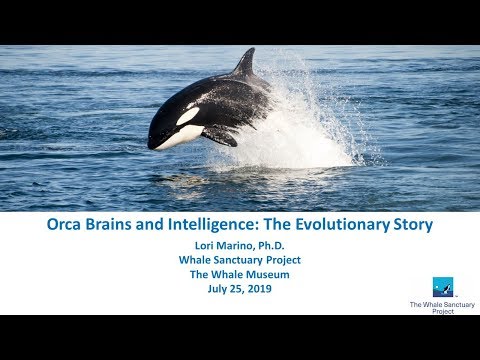
Dr. Lori Marino, neuroscientist and President of the Whale Sanctuary Project, gives an illustrated talk about the evolution and ...

Lori Marino is a neuroscientist and expert in animal behavior and intelligence, formerly on the faculty of Emory University, where ...

I will present current knowledge about who dolphins, whales and porpoises are: research on cetacean brains, self-awareness ...

View full lesson: http://ed.ted.com/lessons/how-smart-are-dolphins-lori-marino Dolphins are one of the smartest animal species on ...
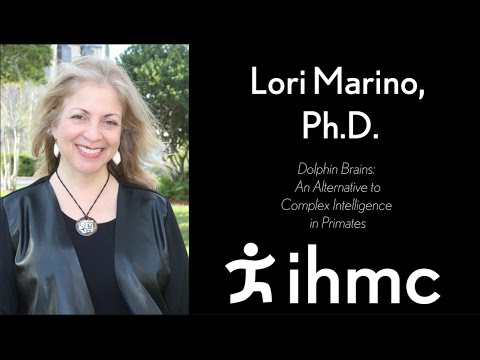
In the past three decades, new research has revealed that dolphin brains are not only large but are extremely complex in their ...

On December 7, 2013 Lori Marino spoke on "The Science of the Nonhuman Rights Project" at the Personhood Beyond the Human conference at Yale University. Lori Marino is a neuroscientist and expert in animal behavior and intelligence who is the Founder and Executive Director of The Kimmela Center for Animal Advocacy and Science Director for The Nonhuman Rights Project. She has also been on the faculty of Emory University for over 18 years. She is internationally known for her work on the evolution of brain and intelligence in dolphins and whales and comparisons to primates. She has published an…
Sign in to search the full transcript archive, filter by topic, and access every quote from Lori Marino.
The summary and quote tags on this profile are produced with AI assistance from verified, first-person interview transcripts, then checked by our team to confirm the speaker's identity and the accuracy of every quote. See how we verify →