
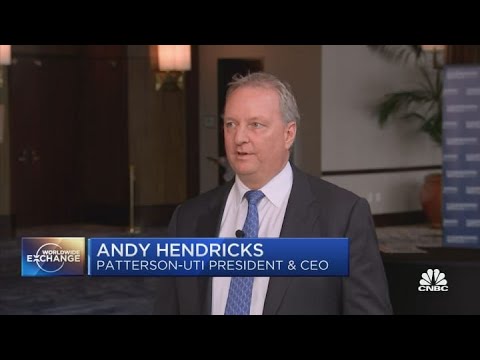
Patterson-UTI CEO Andy Hendricks on oil rig operations over the past year
Andy Hendricks, CEO of oil rig operator Patterson-UTI, joins Worldwide Exchange to discuss his company's operations during theΒ ...
President, Chief Executive Officer & Director, Patterson-uti
Search every verified William Hendricks interview, podcast appearance, and on-the-record quote β each transcript cross-checked by AI and human review to confirm speaker identity. William Hendricks, CEO of Patterson-UTI, has discussed the company's operations and industry outlook in several CNBC interviews. In September 2021, he noted that during the COVID-19 downturn the company's operating rigs fell from 126 to 34, and had since recovered to 73, with expectations to reach 80 by July. Hendricks stated that even if WTI oil prices pulled back from $70 to the mid-to-low $60s, activity growth would continue, and he expressed encouragement from discussions with customers. He said the company could provide new engines that burn 100% natural gas and battery storage solutions to reduce emissions, and described sustainability and ESG as watchwords in the industry. Hendricks also said that capital discipline remained important to investors, with room to grow activity relative to budgets set at lower oil prices. In earlier appearances, Hendricks addressed the severe down cycle in oil and gas during 2020, stating that lower oil prices eventually cure low oil prices as customers shut in wells. He said that coordinating production throttling across states would be difficult and likely ineffective given the rapid drop in global demand. Hendricks emphasized that Patterson-UTI had strong liquidity, a good balance sheet, and low debt, positioning the company to survive the cycle and potentially gain market share. In 2018, Executive Chairman Mark Siegel discussed the company's acquisition of MMS Energy, a directional drilling firm, and noted that the U.S. had become the world's marginal producer of oil and gas. Siegel said the company emphasized a strong balance sheet and that fewer rigs could achieve more due to efficiency gains.
“During the COVID downturn, we went down to 34 operating rigs from 126, and now we're up to 73, showing a projection of growth with expectations to reach 80 by July.”
“Even if you see a pullback in WTI prices from 70 to mid to low 60s due to volatility, that's still okay; we're still going to see activity growth.”
“We can provide new engines that burn 100% natural gas to reduce emissions, and we have a battery storage solution to reduce emissions as well.”
“Sustainability is the watchword; ESG is the investing watchword. Everybody here is talking about ESG at the conference, and while some say we are an oil rig company, somebody has to drill, and we want to do it more responsibly.”
“Capital discipline is key; investors want positive cash flow and a balanced approach, not just 'drill, drill, drill.' There is room to grow activity, but it is still showing capital discipline relative to budgets set at a lower WTI price.”
“The old saying is the cure for high prices is over-drilling and over-producing, which then collapses the market. Are we smarter this time? I'll paraphrase Mark Twain: the numbers are greatly exaggerated.”
“We still need energy; as countries get vaccinated, there will be demand for energy, and I see demand for oil and gas remaining fairly strong.”
“We're going through a severe down cycle in the oil and gas industry, but the positive is that lower oil prices eventually cure low oil prices as customers shut in their wells, which will bring down production in the US.”
“Shutting in wells requires many precautions and preparation for eventual restart; different customers have different economics influencing their decisions, with some shutting in all wells and others continuing production due to pipeline agreements.”
“Coordinating production throttling across states is very difficult and likely ineffective given the rapid drop in global demand; even if Texas oil production went to zero, oil prices would barely recover due to the magnitude of the demand hit.”
“At Patterson-UTI Energy, we have strong liquidity, a good balance sheet, and low debt, positioning us to be one of the survivors in this down cycle and likely to gain market share as the cycle bottoms.”
“We've consistently been a company that emphasized having a strong balance sheet. I've called it before a fortress-like balance sheet. We think that's really important; there's no business with better operational leverage. We think in this business you don't need to put financial leverage on top of it.”
“We are so excited about this new acquisition of MMS Energy. Directional drilling frankly has been part of our strategic plan for more than 10 years but it was finding the right opportunity. MS is actually the number two ranked directional driller in the United States.”
“The United States has become the marginal producer in the world and so we're very excited about our prospects. Just plenty of oil for you to be able to drill it, plenty of oil and plenty of natural gas.”
“Natural gas is incredibly cheap. A lot of the natural gas is being used for manufacturing and for particular uses where it's already set in motion or for electrical generation. Natural gas has displaced coal this year and that's really a long-term trend we think in the United States. It's environmentally sound and it's...”
Andy Hendricks, CEO of oil rig operator Patterson-UTI, joins Worldwide Exchange to discuss his company's operations during theΒ ...
Andy Hendricks, Patterson-UTI Energy CEO joins 'Power Lunch' to discuss the company's quarterly earnings and the state of theΒ ...
With oil prices rising on news that OPEC may reach a deal, what should you do with your energy investments? Jim Cramer took aΒ ...
Sign in to search the full transcript archive, filter by topic, and access every quote from William Hendricks.
The summary and quote tags on this profile are produced with AI assistance from verified, first-person interview transcripts, then checked by our team to confirm the speaker's identity and the accuracy of every quote. See how we verify →