
What's good for economy generally good for banks, says BankUnited CEO
BankUnited CEO Rajinder Singh joins CNBC's "Closing Bell" team to talk about the bank, earnings and his economic outlook.
Chairman, President & Chief Executive Officer, BANKUNITED INC
Search every verified Rajinder Singh interview, podcast appearance, and on-the-record quote — each transcript cross-checked by AI and human review to confirm speaker identity. Rajinder Singh, Chairman, President and CEO of BankUnited, discussed the bank's 10-year anniversary and its growth since its founding in 2009, which he described as "the perfect time to start a bank." He stated that "what's good for the economy is generally good for banks" but expressed uncertainty about the business cycle's duration. Singh noted conflicting signals, saying that while the bank's loan book and clients appear healthy, market indicators give "some pause." He assessed that trade disruption would have some impact on South Florida and New York economies but called it "more noise at this point than real trouble." Singh commented on the banking industry's structure, predicting a "barbell" evolution with very large universal banks and highly specialized banks like BankUnited. He noted that the U.S. has roughly 6,000 banks, a number he called "unique," and said consolidation is likely to continue. Regarding M&A, Singh described it as a "secondary strategy" for BankUnited, with the primary focus on organic growth. He observed that recent large acquisitions have not been "rewarded by shareholders," though he noted that two recent "mergers of equals" saw positive stock performance, while cautioning that such deals are "especially hard to pull off." On regulation, Singh said there has been no major deregulation of Dodd-Frank but that the "attitude of regulatory bodies" toward businesses has become "much more reasonable."
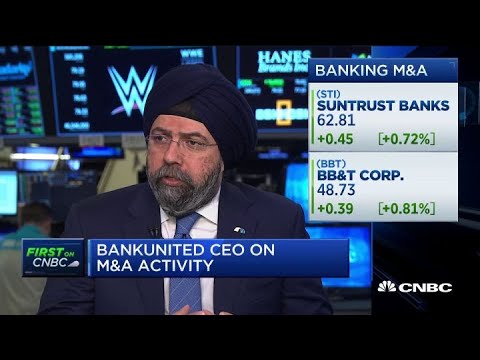
BankUnited CEO Rajinder Singh joins CNBC's "Closing Bell" team to talk about the bank, earnings and his economic outlook.
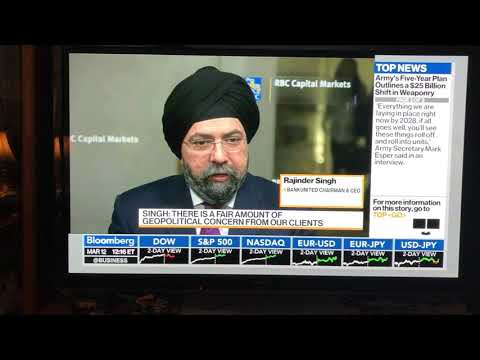

Though BankUnited has more than doubled deposits in the past eight years, it’s committed to maintaining the local, community feel. “We’re a country bank,” President Raj Singh joked, the cows across the street visible from his office. BankUnited hasn’t been around long, but Mr. Singh is making sure it will be. His customer-based mission has attracted bankers from all over, and he is committed to growing organically. “We don’t take a single customer for granted,” Mr. Singh said. Mr. Singh is perfectly content growing BankUnited within its two markets of Miami and Manhattan for now. Being a s…
Sign in to search the full transcript archive, filter by topic, and access every quote from Rajinder Singh.
The summary and quote tags on this profile are produced with AI assistance from verified, first-person interview transcripts, then checked by our team to confirm the speaker's identity and the accuracy of every quote. See how we verify →
Pro unlocks every transcript in full, plus unlimited search across every executive and company we cover.
50% off appliedPulling data at scale? The Data API gives you 30,000 transcripts a month over REST, MCP and JSON.
Compare all plans