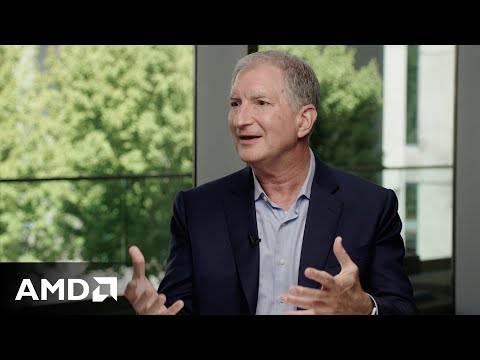
AI Compute: Rebuilt for the Agentic Era | Mark Papermaster, AMD | RAISE Summit 2026
Mark Papermaster, CTO and EVP of AMD, joins Karim Jalbout (Konstellation Advisory) to explore how AI compute is being rebuilt ...
Chief Technology Officer and Executive Vice President of Technology & Engineering, Advanced Micro Devices
Search every verified Mark Papermaster interview, podcast appearance, and on-the-record quote — each transcript cross-checked by AI and human review to confirm speaker identity. Mark Papermaster, Chief Technology Officer and Executive Vice President of Technology & Engineering at AMD, spoke at the RAISE Summit 2026 in July, discussing the company's strategy for AI compute and system-level optimization. He described a shift toward agentic AI workflows, stating that AMD is using such workflows to "shave months off of our chip design schedule" and bring new features to market in "weeks and days." Papermaster attributed AMD's competitive position to a culture he described as "a scrappy underdog, a fighter" combined with "a culture of execution." He also said that "the days of the homogeneous data center" are over, and that enterprises can no longer rely on a single vendor for computing engines. Papermaster highlighted AMD's acquisition of ZT Systems and its focus on optimizing entire clusters of CPU, GPU, and networking hardware at the rack level. He noted that the company is working to make AI more economical for enterprises by offering solutions that span from cloud data centers to edge devices, including embedded neural processors in PCs. He also previewed AMD's upcoming "Advancing AI" event, where he said the company would provide details on its Helios rack and new 2-nanometer "Venice" CPUs.
“We're going from productivity gains that we had prior to the last 6 months of, you know, 10% kind of gains to now dramatic improvements in productivity. And just in our own chip design at AMD, uh we're shaving months off time of market. We're taking new features that we needed that would take many, many months and we'r...”
“It's actually our secret weapon. It's our secret sauce is our culture. We have that culture of being a scrappy underdog, a fighter. It's always been part of AMD. Uh I I joined with Lisa Sue almost 15 years ago to AMD and and we didn't lose that scrainess, that underdog. But what we've added is a culture of execution, g...”
“The days of the homogeneous data center or and homogeneous computer or CIO could just say, 'I'm going to just populate my computer with one engine, you know, one vendor.' That's gone.”
“What we've seen is agentic AI is transforming how we, even at AMD, how we're running engineering. And it's going to transform every enterprise. So, we're looking at every process we have. We're saying, 'Look, we can create agentic workflows. We can tag these together. We're shaving months off of our chip design schedul...”
“If we can't lower the cost to make AI more accessible, we're going to create tremendous divisions in society because that's how powerful this capability is. It's going to be the halves and halves nots.”
“We have a built-in encryption capabilities. So, you can it can all be encrypted. Someone walked away with your laptop and they don't have your codes and your passwords. It's useless to them. Uh, we actually do the same on the cloud. Uh, we have encryption capabilities that can be run there. It's called confidential com...”
“This year this we launched what will be a just a topflight AI computer which uh can mass together 72 GPUs and then be connected horizontally through Ethernet connectivity to just massive clusters. So we've extended our competitive reach uh to be from thousands of GPUs to uh CPU these are all heterogeneous CPU and GCPU...”
“I see it vividly. Uh it it's just a dramatic change of of increase of capability of AI. And you know, one of the things that uh I'm urging our uh engineers at AMD um and our non-engineers at AMD uh is to embrace it because a change of that nature in a short time, it can be scary. It is scary. And you what do what do yo...”
“And if we do it the right way uh and we really communicate and people can understand uh I think we can have great outcomes uh if not you're going to see people rejecting it. Uh and uh the problem is if certain countries reject it and others don't, it's going to create an imbalance of capability and frankly that leads t...”
“It is going to be a $1 trillion market by 2030.”
“A number of 78 million new jobs that will be created by AI, but I'll caution you that as well as creating the number of jobs it will also displace existing roles.”
“We set out to be a very agile competitor offering not only CPUs and GPUs but other key hardware and software IPs to be a solution provider that could listen to customers, take their input, react quickly and help provide very optimized solutions and therefore provide customers value.”
“Investment in what became our Infinity Fabric — our network-on-chip and link technology, started in 2012 — was gamechanging for AMD; at the time people thought it was the wrong way to go and some top leaders even got up and left the company.”
“AMD's focus is on allowing computing to make a difference in people's lives. AMD powers the number one and the number two supercomputer in the world, and we aim to democratize high-performance computing across data centers, the edge, and PCs.”
“Since I joined the company 14 years ago we've grown our India population of engineering from under 1,000 to over 10,000 — it's grown 10x and now spans everything we do in the company.”
Mark Papermaster, CTO and EVP of AMD, joins Karim Jalbout (Konstellation Advisory) to explore how AI compute is being rebuilt ...
This session examines agentic artificial intelligence and system-level optimization for data center and edge infrastructure. Chief Technology Officer and Executive Vice President Mark Papermaster of AMD draws on four decades of engineering leadership to explain how agentic AI drives a shift from component-level tuning to holistic system optimization. Papermaster describes heterogeneous workloads and the need for low-latency memory and efficient data movement across CPU, GPU, networking and storage and outlines AMD's modular infrastructure strategy and expanded portfolio. They emphasize priorit…
This week on GAEA Talks, Graeme Scott sits down with Mark Papermaster - Chief Technology Officer and Executive Vice President of AMD, former Apple Senior Vice President of iPhone and iPod Hardware Engineering, four-decade semiconductor industry veteran, and newly elected member of the National Academy of Engineering. Mark's career reads like a history of modern computing itself. Beginning at IBM in 1982, he spent twenty-six years driving microprocessor and server technology development before being hired by Steve Jobs to lead iPhone and iPod hardware engineering at Apple. He went on to lead s…
“Unleash Your Potential with AI” Abstract: AI is transforming computing at unprecedented speed—accelerating science, reinventing industries, and changing how engineers build systems. Mark Papermaster (CTO and EVP, AMD) will explain why AI’s growth is driving explosive demand for compute, memory, and networking, and why progress now depends on holistic, full-stack co-optimization from silicon to software. Bio: Mark Papermaster is chief technology officer and executive vice president, responsible for driving the company’s end-to-end technology vision, strategy and product roadmap. He led the r…
In this interview, I sit down with Mark Papermaster, CTO and Executive Vice President at AMD, to discuss his illustrious career and the company's relentless drive toward innovation. From his early days at IBM and senior roles at Apple and Cisco to spearheading the turnaround of AMD with the Zen architecture, Mark shares firsthand insights into "pedal to the floor" engineering. We dive deep into the future of high-performance computing, exploring the upcoming Zen 7 microarchitecture, the new ACE (Advanced Matrix Extensions) engine, and why Mark believes that in the face of technical barriers, "…
Episode 3 of Road to IIT2026 and Beyond is now live In this full episode, Mark Papermaster, CTO and EVP of AMD, gives an inside-view into where the computing world is heading and why the next decade will demand a complete shift in how builders, operators, and technologists think about scale. You will hear directly from one of the industry’s most influential technology leaders on: 👉 Why global computing demand is moving toward an infinite curve 👉 How AI adoption will reshape industries that choose to build instead of wait 👉 What pressures, risks, and breakthroughs are shaping the next wave of i…
The Carreker Distinguished Lecture Series presentation "Engineering Your Future with AI" by Mark Papermaster, Chief ...
In the latest episode of Young Turks: Voices From The Valley, Shereen Bhan sits down with Mark Papermaster, CTO of AMD, to unpack the company’s bold AI playbook. Fresh off a blockbuster year with nearly $26 billion in revenue, AMD is doubling down on AI. From the launch of the MI350 GPU and deep partnerships with Meta, Microsoft, and OpenAI, to a $400 million India investment and joint venture with Humane in Saudi Arabia - Mark shares how AMD is scaling innovation, expanding global capacity, and pushing for open ecosystems. He weighs in on sovereign AI, cost concerns, and the race toward ‘AI…
Bryan Madden, Global Head Of AI And Embedded Marketing at AMD, is joined by Mark Papermaster, Chief Technology Officer ...
Sign in to search the full transcript archive, filter by topic, and access every quote from Mark Papermaster.
The summary and quote tags on this profile are produced with AI assistance from verified, first-person interview transcripts, then checked by our team to confirm the speaker's identity and the accuracy of every quote. See how we verify →