
CEOInterviews.AI
Start App
Try: AI strategy tariffs earnings guidance layoffs interest rates growth

Reed Hastings

Co-Founder & Former Chairman, Netflix

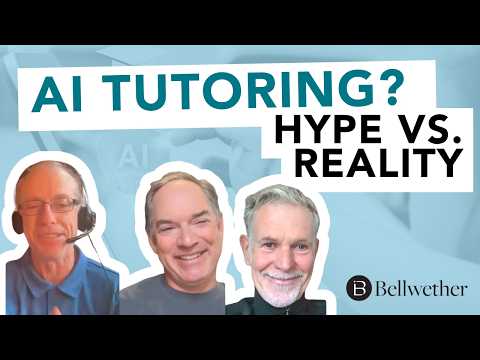
Search every verified Reed Hastings interview, podcast appearance, and on-the-record quote — each transcript cross-checked by AI and human review to confirm speaker identity. Reed Hastings, co-founder and former CEO of Netflix and a board member at Anthropic, has recently discussed the potential of artificial intelligence in education and the economy. In an August 2026 debate with tutoring pioneer Michael Goldstein, Hastings argued that AI is improving exponentially, roughly doubling in quality each year, and suggested that AI tutors could offer personalized learning by allowing students to progress at their own pace. He also acknowledged challenges, including students' reluctance to reveal misunderstandings to an AI. In a separate podcast interview, Hastings described AI as a driver of "creative destruction," stating that companies could use AI's capabilities to expand against competitors or reduce their workforce, and he cautioned that many people underestimate the pace of AI improvement. At TED2026, Hastings discussed his work in education philanthropy and his role on the Anthropic board, describing the company's mission as focused on safely navigating the "age of AI" rather than maximizing profits. He predicted that successful AI development could lead to high productivity, GDP growth, and stock market gains alongside high unemployment, and he suggested that governments might consider sovereign wealth funds, similar to Alaska's or Norway's, to distribute the benefits of AI-driven tax revenues. He also noted that after 25 years and a billion dollars in education philanthropy, US school outcomes had not improved as hoped, calling it a hard problem.

Recent appearances

Notable quotes

“The promise of AI is really each kid goes at their own pace and that all 12y olds are learning different things and therefore they're much more engaging. Why is it hard to motivate kids? Well, it might be because there's 30 of them in a classroom learning something at the same time and you know a third of them already know it, a third of them are interested and a third, you know, are really bored and behind and alien”

“I think most humans are underestimating what doubling every year that's an exponential rate of improvement is going to do. So we don't have many. I mean cars didn't get better at that pace. Computer chips did but they were sort of buried a little bit as one part of the economy but it's very rare for things to be improving exponentially and there's no guarantee that it will continue to do that. It certainly looks like”

“For the last decade, AI has been getting roughly twice as good every year. If that continues, which looks pretty likely, then in five years the AI will be 32 times smarter, more effective than it is today. Then you asked, what do CEOs have to do? It's like doubling your workforce. So suddenly, boom, you've got double your workforce. Now, you could either cut your workforce in half and stay in the same business lines,”

“This time if AI is successful in the way we think it will, I think we're going to see high productivity, high GDP growth, um, high stock market, and high unemployment. So, we'll have money to do things. And so, think of it like the Alaska Fund, which is oil, or the Norwegian sovereign fund. We need some ideas like that. What are we going to do with all these huge tax revenues that are going to be able to come in with”

“This time if AI is successful in the way we think it will, I think we're going to see high productivity, high GDP growth, high stock market, and high unemployment. So, we'll have money to do things. And so, think of it like the Alaska Fund, which is oil, or the Norwegian sovereign fund. We need some ideas like that. What are we going to do with all these huge tax revenues that are going to be able to come in with big”

“I don't think there's that much hope for doubling the number of physical schools and teachers in Africa, which is a bare minimum of what we need given the population growth. But what there is possibility is one tablet per child. And so, technology's costs are coming down, whether that's Starlink, whether that's inexpensive tablets from China. The significance of that is that the AI learning applications in the develo”

Other executives at Netflix

The summary and quote tags on this profile are produced with AI assistance from verified, first-person interview transcripts, then checked by our team to confirm the speaker's identity and the accuracy of every quote. See how we verify →