Tariff uncertainty has created an arbitrage opportunity for base metals: LME CEO
Matthew Chamberlain, CEO of LME, shares his view on looming tariffs, competition between exchanges, and the outlook for base metals.
Chief Executive Officer, London Metal Exchange, The London Metal Exchange
Search every verified Matthew Chamberlain interview, podcast appearance, and on-the-record quote — each transcript cross-checked by AI and human review to confirm speaker identity. Matthew Chamberlain, CEO of the London Metal Exchange, stated in May 2025 that uncertainty over potential US tariffs on copper has created an arbitrage opportunity, with traders buying untaxed metal in Asia and shipping it to the United States before tariffs are imposed. He noted that this activity has led to some de-stocking in Asia and trans-Pacific shipments, describing the LME’s global network as enabling such trades. Regarding competition, Chamberlain said that while exchanges compete, initiatives like the Shanghai Futures Exchange opening to foreign investors are positive for the global industry, as they create more arbitrage opportunities. Chamberlain has previously emphasized the LME’s role in promoting responsible sourcing. He said the exchange has introduced requirements that metals must be ethically sound, not just metallurgically sound, and has implemented rules barring metal linked to child labor or conflict finance. On sustainability, he stated that metals must be sourced responsibly to be part of the solution for the energy transition, and the LME has partnered with Metalshub to bring transparency to the carbon footprint of traded metals.
“In the past few years and really starting officially from the beginning of 2024 we've said in addition the metal needs to be of sufficient ethical quality in the sense of meeting the responsible sourcing requirements and this although it's been a quiet revolution has been an absolute revolution in terms of for the firs...”
“Sustainability actually unlocks a huge amount of investment particularly in newer mining jurisdictions because it gives the people who are committing that funding and committing that effort a visible path that they'll be getting a fair price for metal which has been sustainably produced.”
“The broad consensus is that as well as these materials having an output benefit they themselves have to have a sustainable input they have to be sourced in a sustainable way it's not good enough to say I'm going to use this copper for a good purpose and hence I can turn a blind eye to the conditions in which it was ext...”
“We're a physically delivered market and therefore we maintain a list of the brands of metal that you can deliver to satisfy an LME contract and over time that brand list is become incredibly valuable because people want to be on that brand list because it is kind of the list of good metals in a broader context.”
“we did decide that we were going to embed the oecd principles for responsible mineral sourcing into our brand listing report requirements so for 140 years we've said you can list your copper on the lme as good delivery as long as it meets these metallurgical tests and frankly we didn't care where it came from and for t...”
“I think it's going to be very much a democratization of capital markets I think actually what we've seen during the pandemic as people wanted to have things to do and got a lot more involved in capital markets whether that was trading meme stocks or in some cases we saw trading commodities I do think that democratizati...”
“There's a lot of interest in base metals. People still trying to figure out where it's going to go. These macro economic geopolitical questions which would weigh on both side of pricing. But in many, many ways that's a good place to be because it means people want to hedge, they want to express an opinion. And that's o...”
“I think people do need to expect that margins are going to be higher because we really want to demonstrate to the whole market that from a risk management perspective, that volatility that we saw is baked into margin levels.”
“it very quickly became apparent that the pricing had disconnected from the fundamental physical realities of our market and it was therefore necessary to step in and take action because otherwise we believe there would have been very significant systemic risks to our market into the broader physical industry if we were...”
“we don't take decisions based on the nationality of our members or our participants in the market. The fact is that we take decisions based on what is right for the market... we didn't take any of these decisions because of the nationality of any of the participants involved we took the decisions because of the size an...”
“I think the scale of our action, the importance of that action demonstrates just how important we felt this was and had we not done that, had we not closed the market and canceled trades we felt there would of been very systemic problems in terms of reducing a price disconnected from physical reality which would have b...”
“The nickel situation is a technical situation driven by a particular client in the OTC market who got themselves into a position that threatened the systemic stability of the market. So I think it's important to separate the two.”
“I think it's going to be very much a democratization of capital markets. I think actually what we've seen during the pandemic as people wanted to have things to do got a lot more involved in in capital markets whether that was trading meme stocks or you know in some cases we saw trading trading commodities. I do think...”
“Launching new physically delivered contracts is tough and the reason for that is you end up with this this sort of wheel of inertia as i describe it that the pricing is only really relevant if the delivery is working but delivery's only going to happen if people are trading it and people are only going to trade it if t...”
“Metals can't expect to be part of the solution unless we can show that metals themselves are sourced in a responsible and a sustainable manner.”

Matthew Chamberlain, CEO of LME, shares his view on looming tariffs, competition between exchanges, and the outlook for base metals.


Join Andrea Hotter, special correspondent at Fastmarkets, in the sixth episode of Fastmarkets' Fast Forward podcast as the discuss how the LME is shaping the future of metals markets, explore the intersection of global trade and sustainable energy, plus hear some discussion around the use of block limits.
Welcome to IPO-VID Livestream Episode #040 by Patrick L Young with Matthew Chamberlain. London Metal Exchange (LME) CEO Matthew Chamberlain is responsible for the stewardship of the global base metals trading market having overseen several significant initiatives, including the delivery of integration and build-out following the acquisition of LME by HKEX, re-tooling of the LME’s physical network delivery, and a market-wide discussion on the strategic direction of the Exchange. Having joined LME in 2012, Chamberlain has a track record of using corporate platforms to promote inclusivity…

“There’s a lot of interest in base metals.” Matthew Chamberlain, chief executive officer at London Metals Exchange, discusses the demand for base metals and his outlook for the nickel market. He speaks on Bloomberg Television from the sidelines of the “LME Asia Metals Seminar” in Hong Kong. -------- Follow Bloomberg for business news & analysis, up-to-the-minute market data, features, profiles and more: http://www.bloomberg.com Connect with us on... Twitter: / business Facebook: / bloombergbusiness Instagram: / bloombergbusiness

Matthew Chamberlain, CEO of the London Metal Exchange, says there's a lot of untapped demand in those hours, but "we have to do that in a way that means all of our stakeholders are comfortable with the risk profile" and "we're not quite there yet, but I am really, really hopeful that we will get there soon."
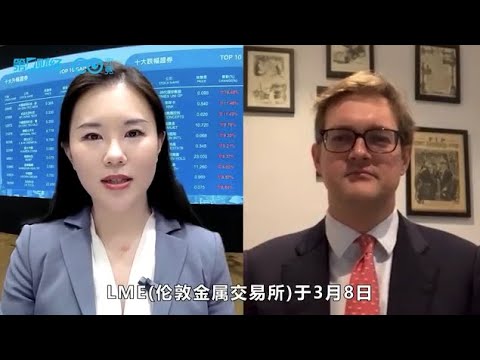
Matthew Chamberlain: short squeeze of tsingshan originated in the OTC market. There should be a greater disclosure around the otc market.Intend to keep the daily limit permanently.

London Metal Exchange CEO Matthew Chamberlain talks nickel's surge in the face of economic turmoil in Russia.Matthew chamberlain, chief executive of the London metal exchange to discuss these unprecedented move. You know, chaos ...

London Metal Exchange (LME) CEO Matthew Chamberlain has been responsible for the stewardship of the global base metals trading market having overseen several significant initiatives, including the delivery of integration and build-out following the acquisition of LME by HKEX, re-tooling of the LME’s physical network delivery, and a market-wide discussion on the strategic direction of the Exchange. Having joined LME in 2012, Chamberlain has a track record of using corporate platforms to promote inclusivity, responsible supply chains, and environmental standards through a multi-stakeholder appr…

Oct.11 -- The London Metal Exchange is working with Metalshub to develop a spot trading platform for base metals, with the first product set to be launched in early 2022. London Metal Exchange CEO Matthew Chamberlain discusses the partnership, outlook for metals price and demand, and aluminum production on “Bloomberg Markets: European Close."
Sign in to search the full transcript archive, filter by topic, and access every quote from Matthew Chamberlain.
The summary and quote tags on this profile are produced with AI assistance from verified, first-person interview transcripts, then checked by our team to confirm the speaker's identity and the accuracy of every quote. See how we verify →