CEOInterviews.AI
Start App
Try: AI strategy tariffs earnings guidance layoffs interest rates growth

Martin Casado

General Partner, Andreessen Horowitz

Search every verified Martin Casado interview, podcast appearance, and on-the-record quote — each transcript cross-checked by AI and human review to confirm speaker identity. Martin Casado, a general partner at Andreessen Horowitz, has been active in discussions on AI's role in software development, infrastructure, and investment. In podcast appearances, he discussed the limitations of AI in operating production systems, arguing that while AI can generate code, debugging and managing real-world systems remains a harder challenge. He also explored the concept of recursive self-improvement (RSI), distinguishing it from simpler automation and discussing its potential implications for AI capability growth. Casado has also been involved in conversations about AI infrastructure investment, including the launch of a16z's Machine Age Fund, where he noted that the AI industry has shifted from an engineering-bound problem to a capital problem. He discussed the strategic value of investments in companies like Cursor and OpenRouter, emphasizing that these firms hold independent value in the evolving AI stack. Additionally, he participated in debates on AI regulation and safety, arguing that premature regulation may not effectively address risks and that the security community and labs need better alignment on reporting practices.

Recent appearances

  • Why AI Can Write Code But Can’t Keep It Running (Yet)

    AI can write production code in minutes. But can it debug and operate that code when something goes wrong? Grepr CEO Jad Naous argues that running real-world systems is a fundamentally harder challenge, with unpredictable workloads, failures, and countless possible states. Jad joins a16z General Partner Martin Casado to discuss how coding agents have transformed engineering inside his 10-person team, including projects that once took six months and now take roughly 10 days. They also explore whether AI can troubleshoot production systems by detecting changes, forming hypotheses, and running…

    Read the verified transcript → Watch on YouTube ↗

  • The State of Recursive Self-Improvement in AI Research

    a16z General Partner Martin Casado sits down with MakerMaker.AI co-founders Dhaval Adjodah and Owen He to unpack recursive self-improvement, or RSI, and separate the increasingly popular term from what it would actually mean for an AI system to improve itself. Dhaval and Owen distinguish true RSI from simply using AI to automate pieces of AI development. Their goal is a closed loop where the system being improved is also doing the improving, across components including models, harnesses, and eventually more of the AI stack. They explain why closing that loop still doesn’t guarantee runaway “t…

    Read the verified transcript → Watch on YouTube ↗

  • How Jev Turns AI Into Software That Gets Things Done

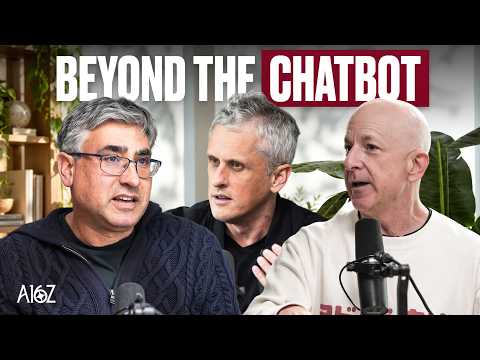
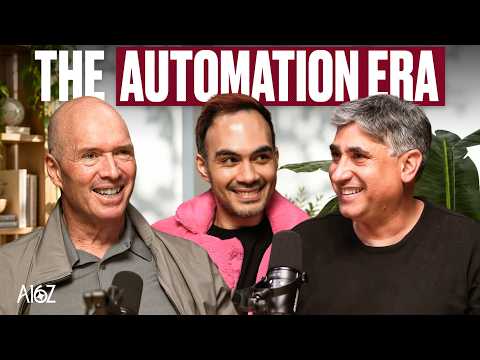
    a16z’s Ben Horowitz and Martin Casado sit down with TypeSafe AI founder Diogo Almeida to ask a simple question: AI has become remarkably capable, so where is all the automation? Diogo argues that coding agents may help us write software faster, but the software they produce still largely works the way software always has. TypeSafe is taking a different approach with Jev: putting intelligence inside software itself, so developers can build programs that reason about intent and make probabilistic decisions rather than simply generate text for a human to interpret. They discuss why reliability…

    Watch on YouTube ↗

  • The Next Chapter of AI Is Inside Our Software

    Erik Torenberg sits down with Box CEO Aaron Levie, and a16z’s Martin Casado, and Steven Sinofsky to debate how the AI industry should think about safety, security, and regulation as increasingly capable agents move into the real world. They argue that much of today’s conversation is happening before we have clearly defined the risks we’re trying to regulate. Drawing on earlier waves of computing, from computer viruses and the early internet to aviation and automobiles, they ask what AI can learn from industries that developed safety standards only after understanding how their technologies ac…

    Read the verified transcript → Watch on YouTube ↗

  • Why Fei-Fei Li Is Betting on Spatial Intelligence

    World Labs co-founders Fei-Fei Li, Justin Johnson, and Ben Mildenhall join a16z General Partner Martin Casado to discuss Atlas, their latest world model, and what it reveals about the pursuit of spatial intelligence. At the center of Atlas is what the team calls “new view prediction”: given images or views of a scene, the model predicts what that environment should look like from a different position in space and time. This brings generation and 3D reconstruction into the same model, and raises a broader question about whether predicting views could become a useful primitive for understanding…

    Read the verified transcript → Watch on YouTube ↗

  • Why Top Founders Are Racing Into AI Infrastructure

    Ben Horowitz, Martin Casado, Raghu Raghuram, and Erik Torenberg discuss the launch of a16z's new Machine Age Fund and the infrastructure buildout behind AI, from chips, memory, and networking to power, cooling, and data centers. Why a dedicated fund now? The group argues that the bottleneck in AI is increasingly shifting from the models themselves to everything beneath them. Hyperscaler CapEx is surging, critical components are booked years in advance, and each new generation of reasoning and agents requires dramatically more compute. They unpack why this cycle looks different from previous i…

    Read the verified transcript → Watch on YouTube ↗

  • How Cursor Built One of AI’s Fastest-Growing Companies

    a16z General Partners Martin Casado, Sarah Wang, and Matt Bornstein unpack the story of Cursor: how a small, product-obsessed team entered one of the most competitive markets in technology, took on incumbents with seemingly unbeatable advantages, and repeatedly made decisions that ran against conventional startup wisdom. They revisit the early bet that the interface between humans and AI would matter more than building a coding-specific foundation model, why Cursor built its own product rather than a VS Code plugin, and how the founders' ability to say "no" became one of the company's definin…

    Read the verified transcript → Watch on YouTube ↗

  • How AI Changes the Economics of Innovation

    a16z General Partners Martin Casado and Erik Torenberg are joined by Board Partner Steven Sinofsky to explore what recent breakthroughs in AI and mathematics tell us about where the technology is headed, and whether some of the basic assumptions that have governed computing for decades are starting to break. Martin and Steven debate whether AI's progress in mathematics represents a genuine leap in reasoning or simply a new tool for solving problems at a higher level of abstraction. From the four-color theorem and early computers to graphing calculators and today's models, they trace how new t…

    Watch on YouTube ↗

  • Cursor, OpenRouter, and Where the Money Went | Martin Casado

    FULL INTERVIEW: Martin Casado says AI is the first technology where you can put in $10 and reliably get something back. Everything before it was engineer, wait two years, cross your fingers. @martin_casado is the @a16z GP behind the firm's investments in both Cursor and OpenRouter. Days after SpaceX closed the $60B Cursor deal and Stripe agreed to buy OpenRouter, he sat down with @theojaffee and @sophiadew to cover whether the labs win everything, when the subsidies stop, and why RSI is the wrong term: 02:24 whether decades of experience still matter in AI 03:48 what you would have done with…

    Read the verified transcript → Watch on YouTube ↗

  • Fei-Fei Li is Solving the Hardest Problem in Robotics | World Labs with a16z

    Last week, World Labs announced its acquisition of SceniX, bringing together two teams working on one of AI's biggest unsolved problems: how to give machines a true understanding of the physical world. Martin Casado sits down with Fei-Fei Li, co-founder and CEO of World Labs, creator of ImageNet, and pioneer of spatial intelligence, alongside Yunzhu Li, co-founder of SceniX and assistant professor at Columbia University. They discuss why World Labs acquired SceniX, how simulation can unlock the next generation of robotics, and why training robots may require a fundamentally different approach…

    Read the verified transcript → Watch on YouTube ↗

  • The Future of Compute: Pat Gelsinger & Martin Casado

    Playground hosted a fireside chat with Pat Gelsinger and Martin Casado where they discussed: What is going to unlock the next wave of physical AI–not just better models, but the ability to generate and train on realistic 3D environments, with enough scale and diversity to reflect the real world Why good founders won’t listen to you Why AI is no longer just an engineering problem, but a capital and supply chain problem. Subscribe for more conversations at the frontier of deep tech, AI, and venture capital.

    Read the verified transcript → Watch on YouTube ↗

  • Aaron Levie on AI Adoption and Enterprise Workflows | The a16z Show

    Steven Sinofsky, board partner at a16z, Aaron Levie, CEO of Box, and Martin Casado, general partner at a16z, discuss the reality of AI inside enterprises. They cover the gap between Silicon Valley and the rest of the world, why most AI initiatives fail in large organizations, and how agents, infrastructure, and workflows are evolving beyond the hype. Timestamps: 00:00 - Trailer 01:05 - Introductions & The Silicon Valley vs Enterprise Gap 04:30 - Why Enterprise AI Efforts Keep Failing 09:16 - The Architectural Shift: Treating AI as a User, Not Software 14:38 - The Integration Wall Agents Can't…

    Read the verified transcript → Watch on YouTube ↗

Verified interview transcripts

Notable quotes

“So if you think of capability, what we're trying to do here is we're trying to improve the rate of improvement of capability, right? So like the first derivative of capability with respect to time is the thing that everybody is trying to improve. Right. And now you can put that to be equal driven by two things. The numerator and the denominator. The numerator would be performance. Which is what everybody is trying to”

“I think pacing is the wrong way to describe this. For one, yes, it is orthogonal to security. Right. So like you can very slowly build a nuclear weapon and that doesn't make anybody feel better that it's slow versus fast. So that's one. The second one, it just feels like a capitulation to the pause folks without actually, you know, addressing it. So, you're saying, well, we're not going to pause. We're going to pace ”

“So, this is look, the one thing we all knew within startup world is that if I have a two-year lead on you and you try and catch me by hiring a thousand engineers, you're going to wreck your company. Like, that never works. It's a mythical man month. Nine women can't have a baby in a month. That like that's it. Like, that never works. Okay, now that works. But it's not hiring a hundred thousand engineers. It's taking ”

“Well, I mean, the obvious is like you know the demand for AI is basically infinite and as a result of that every part of the supply chain is under duress. I mean everything including like materials used to make things like memory. It's also very interesting whether there's something unique about AI. Because the demand is infinite and growth is infinite, what you tend to worry about is the margin of companies which is”

“I think that when it's all said and done and we look back on this, um, you know, this wave, I think the biggest change is the fact that you can actually put a lot of money to good use. Like, you'd never be able to like, so what would have happened 10 years ago if I gave you a billion dollars, what would you do? Yeah. Hire a ton of people and then you would blow up the whole thing would be like a total mess, right? An”

“So much of the general shot and Freud and criticism on X and the socials are around business quality metrics. Um and often they're wrong by the way like ours was a great business and it was doing great. Um, but it misses the point of like we're in a transformative wave where new pieces of the stack are being developed and they have strategic independent value that will have a tremendous amount of optionality going fo”

Other executives at Andreessen Horowitz

The summary and quote tags on this profile are produced with AI assistance from verified, first-person interview transcripts, then checked by our team to confirm the speaker's identity and the accuracy of every quote. See how we verify →