CEOInterviews.AI
Start App
Try: AI strategy tariffs earnings guidance layoffs interest rates growth

Mark Zandi

Chief Economist, Moody's Corporation

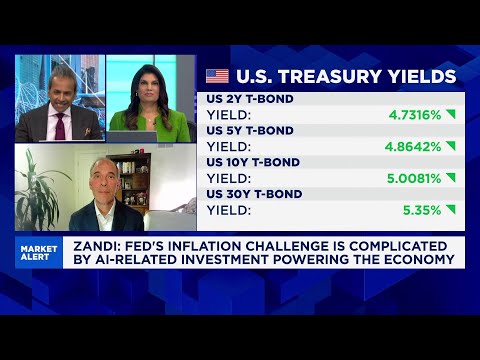
Search every verified Mark Zandi interview, podcast appearance, and on-the-record quote — each transcript cross-checked by AI and human review to confirm speaker identity. Mark Zandi, chief economist at Moody's Analytics, has made multiple media appearances in the weeks ahead of the 2026 U.S. midterm elections, discussing the state of the economy and its political implications. In an October 16 conversation hosted by Dialogue Vanderbilt, Zandi and Doug Holtz-Eakin discussed economic issues facing Americans. Zandi has described the U.S. economy as experiencing significant headwinds from what he calls "deglobalization," citing tariffs, restrictive immigration policies, and the Iran war as factors raising inflation and interest rates. He has also repeatedly stated that the economy is split between a strong performance for high-income households and struggles for lower-income Americans, noting that the bottom 80% of income earners face falling real wages and that housing has become "completely unaffordable," with typical monthly mortgage payments roughly doubling since 2019. Zandi has been a vocal critic of current monetary policy, arguing that the Federal Reserve should hold interest rates steady rather than raise them, saying that higher borrowing costs will not solve inflation driven by supply-side shocks such as the Iran war, tariffs, and immigration restrictions. He has stated that the August jobs report, while strong on the surface, "overstates the case" and that the job market is creating fewer jobs than data suggest. Zandi has also said he believes the AI-driven sector is a key tailwind boosting the economy, and he has expressed confidence that "never bet against the American economy," while warning that without guardrails, the AI tailwind could become a headwind.

Recent appearances

Verified interview transcripts

Notable quotes

“I mean, when we talk about the economy and answering that 1st question, that's the aggregate. That's, that's kind of down the middle of the distribution, not looking at the distribution. It's, uh, you know, what is going on for the kind of the typical, uh, part of the economy, the kind of the mean and the median. But it, but what's happening is that, uh, there are parts of the economy that are doing quite well, and p”

“Well, 3 years ago is a long time. I'm not even sure I remember back 3 years ago, uh, but a lot has changed. I mean, uh, forces that are both headwinds and tailwinds to the economy's growth and performance. I mean, with regard to the headwinds, uh, that goes to policy, economic policy. So I throw into that mix, things like much higher broad-based tariffs, uh, highly restrictive immigration policy, uh, and of course, m”

“The deglobalization is weighing on the economy by raising inflation and now resulting in much higher interest rates. And obviously this has very significant implications for any business industry that needs a lot of capital. Particularly if you go to the sustainability industry, there's a lot of capital that's necessary to drive that and it's now become much more costly to invest because of the higher interest rates.”

“The headwind is deglobalization. The US economy is pulling away from the rest of the world very rapidly. Lots of different ways that's happening. Tariffs being a good example of that. Highly restrictive immigration policy. Another the Iran war. Kind of the marginalization of different global institutions that are key to the globalization process. Everything from the World Trade Organization to the World Health Organi”

“Well, they're okay too. And this goes back to the K shape, right? I mean the consumer that's driving the train are is the wealth to do the folks that owns the stocks, right? I mean AI stock prices is going stock market is going straight north or at least it has been. It all goes back to AI artificial intelligence and AI stocks they you know since chat GPT was put on the planet four years ago they've gone straight up.”

“Yeah, not good, Ed. I mean, inflation is uncomfortably high and, you know, you can the Iran war's fingerprints are all over all over it. Obviously, the higher energy fuel costs go directly to the war and there's a lot of pass through going on into the rest of the economy and adding to the inflationary pressures. Tariffs don't help and immigration policy also an issue, but that war is really causing juicing up inflati”

The summary and quote tags on this profile are produced with AI assistance from verified, first-person interview transcripts, then checked by our team to confirm the speaker's identity and the accuracy of every quote. See how we verify →