President, Chief Executive Officer and Managing Director, PMET Resources
Search every verified Ken Brinsden interview, podcast appearance, and on-the-record quote — each transcript cross-checked by AI and human review to confirm speaker identity. Ken Brinsden, President, Chief Executive Officer and Managing Director of PMET Resources, spoke at the Resources Rising Stars conference on the Gold Coast in September 2026, providing updates on the company's lithium, cesium, and tantalum project. He described the geology at the Shah Ghojauna site as having scale and grade across all three minerals, noting a lithium resource of 240 million tons with portions comparable to Greenbushes, and described the cesium discovery as the world's largest hard rock cesium resource. Brinsden stated that the company is targeting a final investment decision for the latter part of 2027, coinciding with the completion of the mine authorization process, and mentioned that updated feasibility and scoping studies are expected in the coming months to capture the value of co-product credits. Brinsden also discussed the company's strategy around co-products, emphasizing that cesium and tantalum are critical minerals with industrial applications such as in defense, aerospace, and electronics. He compared the proposed scale of the project to Pilbara Minerals' operations, suggesting a production rate of approximately 800,000 tons per annum of concentrate, which he said would place it among the top five globally in hard rock lithium. He noted that the company is building commercial relationships and expects to form a consortium to support the project's development, drawing on his prior experience with Pilbara Minerals.

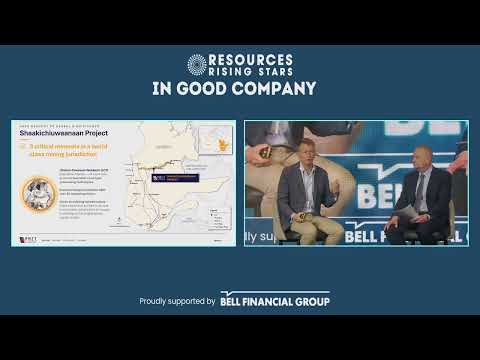

During our recent German / European road show with PMET Resources Inc. (TSX: PMET/ ASX: PMET / WKN: A41JA8) beginning of July 2026, CEO, President & Director Ken Brinsden explains the future of PMET`s Shaakichiuwaanaan project in the north-central region of Quebec, a key, large-scale rare type of Lithium-Caesium-Tantalum (LCT) pegmatite deposit, critical minerals of big demand globally. Ken Brinsden further talks about about PMET`s world-class partners and near-term significant potential catalysts still in 2026. PMET`s project should be on of the more important critical mineral developments in…

Ken Brinsden, Chief Executive Officer of PMET Resources, is closing in on a key economic assessment for a massive lithium project in Canada. The project is on track to become the fifth largest hard rock lithium producer in the world, meaning it is ideally placed to be a key supplier to North American and European markets looking to diversify away from China.

Tune in to a replay of the Renmark Virtual Non-Deal Roadshow featuring Ken Brinsden, CEO, President and Director of PMET Resources Inc., presented on April 27, 2026 for investors across Europe. During this presentation, viewers will gain insight into PMET’s exploration and development strategy, recent project advancements, and the company’s vision for creating long-term shareholder value within the critical minerals sector. The discussion also highlights market opportunities, operational progress, and upcoming milestones as PMET continues to advance its portfolio. Learn more about Renmark Fi…

A major permitting milestone, a strategic partner in Volkswagen, and a possible valuation re-rating. PMET Resources CEO Ken Brinsden joins Kitco Mining to break down the company’s newly filed ESIA for the Shaakichiuwaanaan project in Quebec, the path toward mine authorization, and why investors are paying closer attention to the story. Jeremy Szafron and Brinsden discuss the 2025 feasibility study, lithium price sensitivity, the potential impact of tantalum and caesium by-products, cost pressures, financing, and the key milestones that could shape how the market values PMET from here. This v…

Ken Brinsden, CEO of PMET Resources, joins BNN Bloomberg to discuss the potential of critical minerals and the company's Northern Quebec project. +++ Subscribe to BNN Bloomberg to watch more videos: / bnnbloomberg Connect with BNN Bloomberg: For the latest news visit: https://www.bnnbloomberg.ca For a full video offering visit BNN Bloomberg: https://www.bnnbloomberg.ca/video BNN Bloomberg on Twitter: / bnnbloomberg BNN Bloomberg on LinkedIn: / bnn-bloomberg -- BNN Bloomberg is Canada’s only TV service devoted exclusively to business, finance and the markets. #BNNBloomberg #C…

PMET Resources President and CEO, Ken Brinsden hosted an investor teleconference and webcast to discuss the results of the lithium-only Feasibility Study for the Shaakichiuwaanaan Project.

PMET Resources is a paying client of Resource Stock Digest. This creates a conflict of interest and you should not rely on the information as personal investment advice. Resource Stock Digest, as a publisher, is not a broker, investment advisor, or financial advisor in any jurisdiction. Resource Stock Digest, and its owners, directors, employees, and members of their households may own shares of some all companies/equities discussed. Resource Stock Digest does not make stock recommendations. Nothing in this content constitutes an offer to buy or sell the referenced securities. The securities…

Ken Brinsden, CEO of Patriot Battery Metals, talks building teams, scaling hard rock projects, and what North America must do to catch up in critical minerals. He reflects on transforming Pilbara Minerals, the importance of resilient leadership, and why energy storage is an underestimated growth driver. Recorded live at the Fastmarkets Lithium Supply and Battery Raw Materials Conference 2025. Follow us on social media to get the latest commodity pricing news, as well as updates on all of our events: LinkedIn: @Fastmarkets X: @Fastmarkets

Patriot Battery Metals is a paying client of Resource Stock Digest. This creates a conflict of interest and you should not rely on the information as personal investment advice. Resource Stock Digest, as a publisher, is not a broker, investment advisor, or financial advisor in any jurisdiction. Resource Stock Digest, and its owners, directors, employees, and members of their households may own shares of some all companies/equities discussed. Resource Stock Digest does not make stock recommendations. Nothing in this content constitutes an offer to buy or sell the referenced securities. The sec…
“The scale that's proposed at Shaka Jawan I can make the Pilbur minerals comparison. It's roughly the same as Pilgora today. Approximately 800,000 tons per annum mine concentrate. So it's a big project in the world of hard rock lithium. That would make us today top five globally. In cesium, we are going to break the record books because we've made what is now clearly easily the world's largest cesium discovery ever. W”
“The lithium story is a massive demand story. As lithium ion cells get cheaper and cheaper and cheaper, which is pretty much the phenomenon underway today, as it has been in the last decade, the addressable market for lithium batteries grows in a way that most people haven't been able to anticipate. So really up until two years ago, we're talking about lithium-ion batteries as being an EV story. I want to take you bac”
“What was required to grow lithium raw material supply in the face of that emerging demand I've just described is a lot more raw material supply. Now, what that means is that every player in the market has to go to all four corners of the globe to support supply growth that's easily 30% plus. You know, last year battery growth was 49%. The implication is that you pretty much needed 45% plus growth in lithium raw mater”
“We were shouting from the rooftops about the changes that were emerging in the market and stationary energy storage was a big source of demand and we could see that unfolding. We could see the behavior changing from key suppliers and those demand subsets starting to emerge. And yeah, thankfully that's what's come to pass. It's meant that the market has rebalanced much, much faster than most analysts were expecting. A”
“Our cesium resource is already approaching 2.4 million tons of pollucite at approximately 3 and 1/2% contained cesium, subsets of which are very high grade plus 10% cesium, which in itself would be direct shipping cesium concentrate. You wouldn't even need to process it. At 2.4 million tons, the resource is already... We haven't finished drilling. Our expectation is it will continue to grow as we keep drilling. It's ”
“In supply terms, there has been issues. When the market was fully supplied, lots of discussion about, and especially from China, the significance of their lepidolite production in Western China, and new African supply. But, I want to suggest to you that not much of that was really sustainable through the cycle. It's not typically low-cost production. You only have to look at the evidence and the stability in supply f”
Sign in to search the full transcript archive, filter by topic, and access every quote from Ken Brinsden.
The summary and quote tags on this profile are produced with AI assistance from verified, first-person interview transcripts, then checked by our team to confirm the speaker's identity and the accuracy of every quote. See how we verify →
Pro unlocks every transcript in full, plus unlimited search across every executive and company we cover.
50% off appliedPulling data at scale? The Data API gives you 30,000 transcripts a month over REST, MCP and JSON.
Compare all plans