Co-Founder & Director, Square
Search every verified James Mckelvey interview, podcast appearance, and on-the-record quote — each transcript cross-checked by AI and human review to confirm speaker identity. Jim McKelvey, co-founder of Square (now Block, Inc.), has been speaking publicly about his concept of the "Innovation Stack" and the early challenges of building Square. In a March 2026 podcast, he recounted that Square started after he lost a sale at his glass studio because he could not accept an American Express card, and that in the first week of operation he found 17 laws or rules Square was violating. He described Amazon's later attempt to copy Square with Amazon Register and said the threat led him to write a book about how innovation forces a company to invent rather than copy. McKelvey also discussed the emotional difficulty of innovation, noting that "the first time any human does anything, that person is unqualified" and that meaningful innovation is rarely comfortable or cool. In April and May 2026 appearances, McKelvey reflected on his personal history, including his mother's suicide and his experience as an outsider. He said that being unpopular as a child gave him an advantage in not caring what others think, and that he has "been kicked out of everything I've started" because he gets bored once a venture is built. He also described his approach to layoffs at Square, stating that the company avoided small, repeated cuts and instead conducted a single org-wide reduction with six months' severance plus a week per year of service. McKelvey continues to promote the idea that true innovation arises when copying is impossible, and that entrepreneurs should embrace the demoralizing, failure-laden process that comes with building something new.
“A small merchant is 45 times as profitable if you call the fees profit as a large merchant. That's where the money comes from. It comes from very See? That guy's upset.”
“When I went to close the account, we did use the account for a couple of months to test the rails out, and then I went to close it cuz we didn't need it anymore. And I called them up, and I said, 'Hey, we need to close the account.' And said, 'You can't do that.' ... And this was what they sent. And I I will zoom in he...”
“If you're not able to copy then you're left with the last resort, which is to invent, to innovate. And I think we do a real disservice talking about innovation as something that's cool. ... If you've got something you can copy that works, start with that. But if you can't then you're forced to innovate.”
“PayPal should have realized that there was still an unserved market out there and they were asleep at the wheel. ... I think that left. So, I think culturally the organization got to a point where they really couldn't do much but copy.”
“We didn't want to go through like a little layoff here, a little layoff there. That's just culture killer. So, what we did was we they really serious about it, went through the whole org, top to bottom, and then said, 'This is what we need.' We paid them 6 months, we gave them a year for a week, you know, week for ever...”
“I know what we got to do. I want to turn my phone into a credit card machine so I don't lose further sales.”
“If you're really doing meaningful innovation, you will not be qualified. Don't think that qualification is your excuse for quitting because if you're really doing meaningful innovation, you will not be qualified.”
“If she'd held on a couple more years, we would have had antidepressants that are now wonderful and could have cured her. Like if I had just had the tenacity and the arrogance that I have now back then, my mom might still be alive today.”
“I became dependent on the chaos. That I became used to getting my energy up sort of artificially through this level of problem and emergency that was necessary for me to get into my top performing state. And that led me to create chaos unnecessarily.”
“The motivation for the book was that Amazon copied Square when we were a startup — and when Amazon copies you as a startup, you die.”
“It was illegal when we started; in the first week I found 17 rules or laws we were violating — OFAC, KYC, the card networks — and getting compliant took us a long time.”
“St. Louis was a phenomenal city a 100 years ago. It's been in decline my entire life. It gets worse every year. And there are a bunch of reasons for that, but primarily because we never learned how to integrate. St. Louis didn't deal with racism very well and we ended up going the segregation route and it was a disaste...”
“I was trying to sell a piece of glass. I lost a sale and I was very frustrated and I knew how abused I felt as a small merchant. So that was the impetus for Square. In other words, I wanted to build something for myself so that I could get paid. And that was the founding spark behind that company.”
“It's going to keep getting better and people are going to get more access, more products, and the AI is going to make it possible for you to get the advice that a rich person used to be able to only get and now everybody can get it. So, hopefully it will lead to a greater democratization of access to financial tools.”
“If your job is compiling information, it's already gone or very soon will be. If your job is using information and building new things, it's probably safe.”
What if the very thing that made you feel like an outsider was actually your greatest advantage? Jim McKelvey, cofounder of ...
Jim McKelvey Co-Founded Square with Jack Dorsey and built it into a billion dollar company. Then Amazon came after them. They somehow survived. In this episode of The Bigger Why, Jim McKelvey breaks down the Innovation Stack — the counterintuitive strategy that allowed Square to do what no one thought possible, and why even the world’s most powerful company couldn’t copy it. What we cover: ∙ What the Innovation Stack actually is and how it works ∙ How Square was built from a single problem nobody else was solving ∙ The moment Amazon tried to destroy Square — and why they failed ∙ Why innovat…
Jim McKelvey talks about how AI will keep growing but says engineering and actually building things still matter a lot. He also ...
In this episode of Fast Forward STL, host Keith Alper sits down with St. Louis native Jim McKelvey, co-founder of Block (formerly Square), to talk about the lessons he’s learned from building a global company and how those ideas apply beyond business. From launching Mira and co-founding Third Degree Glass Factory, to growing a global fintech company, McKelvey reflects on curiosity, creativity, and the value of learning by doing. He explains why understanding emerging technology, such as artificial intelligence, matters far beyond the tech world, and how innovation can help make cities like St.…
What does it actually take to build something that has never existed before? In this episode, Jim McKelvey, co-founder of Square (now Block), breaks down the real story behind building Square from scratch, not with a perfect plan, but through necessity, invention, and relentless problem-solving. Jim introduces the concept of the Innovation Stack, why innovation is rarely chosen willingly, and why copying “what worked before” fails when you’re solving a problem no one else has solved. He shares the moment Square felt real, the panic of Amazon launching a competing product, and the counteri…
Jim McKelvey did the impossible. He beat Amazon. The tech giant launched a product similar to Square's, undercut their pricing, ...
What do glassblowing, fintech, and plastic-free diapers have in common? One brilliant disruptor: Jim McKelvey. I had the privilege of interviewing Jim McKelvey, the award-winning, Amazon-beating polymath who co-founded Square (now Block) with Jack Dorsey. But calling him just a fintech entrepreneur or a computer scientist would be like calling Leonardo da Vinci just a painter. This man defies categorization in the most fascinating way possible. “I’m a guy that’s had no focus for 30 years,” Jim told me with characteristic humility. “I am a transport category pilot. I’m a professional glass…
E.B. Moss Interviews Jim McKelvey on predicting business disasters and brand matches, practical inventions, media innovations, ...
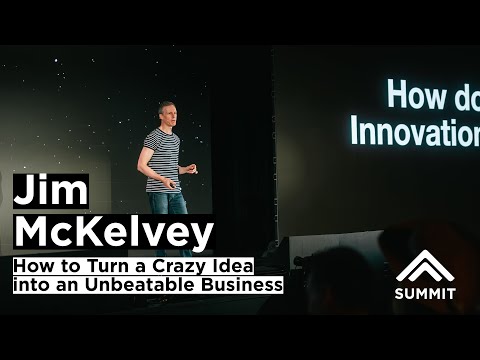
Jim McKelvey partnered with Jack Dorsey to revolutionize digital payments through Square. Now he's setting his sights on upending the broken drug development system. Leveraging his extensive experience and success, Jim has crafted a set of innovative principles that can transform any industry. From managing change to striking deals, discover the unique strategic insights of one of the boldest entrepreneurs of our era. This talk was recorded at Summit Baja in November 2024. Interested in joining Summit Membership or attending a Summit flagship event? Apply at https://bit.ly/421X3Fa. Connect…
Sign in to search the full transcript archive, filter by topic, and access every quote from James Mckelvey.
The summary and quote tags on this profile are produced with AI assistance from verified, first-person interview transcripts, then checked by our team to confirm the speaker's identity and the accuracy of every quote. See how we verify →