CEOInterviews.AI
Start App
Try: AI strategy tariffs earnings guidance layoffs interest rates growth

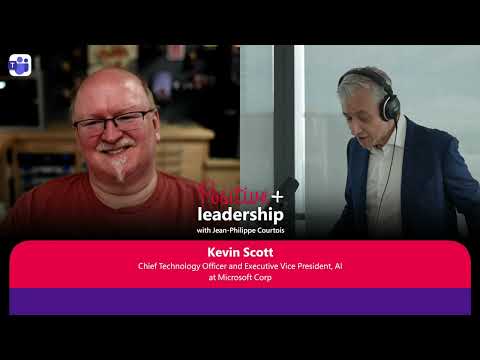
Kevin Scott

Executive Vice President of AI & Chief Technology Officer, Microsoft

Search every verified Kevin Scott interview, podcast appearance, and on-the-record quote — each transcript cross-checked by AI and human review to confirm speaker identity. Kevin Scott, Executive Vice President of AI and Chief Technology Officer at Microsoft, appeared on the AI & I podcast in May 2025, where he discussed his belief that the agentic web would be the next major development in AI. He argued that for AI agents to be genuinely useful, they need the ability to take action on behalf of users, which requires access to the same broad range of tools, data, and systems that compose the internet. Scott stated that the foundational infrastructure for this agentic web is currently being built and that an ecosystem resembling the internet is necessary for agents to function effectively, while also suggesting that some existing "middle layers" in the current web contribute little value. He also expressed optimism about the potential for AI to improve security, citing a personal example involving a two-factor authentication attempt on his wife's account. In earlier appearances from 2019, Scott voiced views on AI's role as a platform for broad innovation and addressed industry challenges. He was quoted as saying that AI must be a platform that others use to build businesses and fulfill creative objectives, rather than being controlled by a small number of companies. He also discussed the need for industry-wide efforts to close the gap between model capabilities and user delivery, and on the topic of face recognition, he noted that Microsoft had articulated a point of view calling for government regulation to define appropriate uses.

Recent appearances

Verified interview transcripts

Notable quotes

“I think it might be a false dichotomy. There is a thing that you have in these open systems where they are permissionless. And there's a real advantage in having permissionless innovation. So, the thing that as an individual that excites me most about what's happening right now is the extent to which you can go innovate and build things without having to seek someone's permission.”

“We have technology that is progressing at the fastest rate that it ever has. And you've got some really big social problems, like society scale problems that we have to tackle. And so I think we're going to rise to the challenge and figure out how to intersect all of the power of this technology with all of the big challenges that are facing us. Whether it's global warming, whether it's the biggest remainder of the p”

“I think we have to think about AI that way. Like it has to be a platform that other people can use to build businesses, to fulfill their creative objectives, to be entrepreneurs, to solve problems that they have in their work and in their lives. It can't be a thing where there are a handful of companies sitting in a very small handful of cities geographically who are making all the decisions about what goes into the ”

“These demographic changes in the world will mean that you just don't have a big enough workforce to go do the work of the world, unless you have major breakthroughs in productivity and major breakthroughs in productivity, meaning technology. AI is currently the best shot on goal for productivity that we have.”

“One of the struggles that folks in my community have is the internet just doesn't work well. So you can't leverage AI if you can't connect to AI.”

“I like a world where the capabilities of these platforms are out in the open — where it's not just one Silicon Valley company building this thing on their infrastructure with their smart people and then they decide what is going to get done with it, but it's out there for anyone who can go sign up for an API key and start building; that democratization of powerful AI capability is something I'm proud of.”

Other executives at Microsoft

The summary and quote tags on this profile are produced with AI assistance from verified, first-person interview transcripts, then checked by our team to confirm the speaker's identity and the accuracy of every quote. See how we verify →