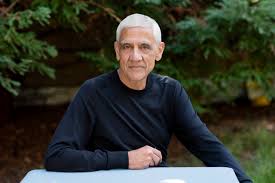
It's over for human doctors. They are just going to be better. Took an MRI, took it to three different surgeons. Each one recommended something different off the same MRI. I'm getting opinions, not facts. The node Kosla is one of Silicon Valley's most influential venture capitalists. A visionary who bets on radical technologies before the world believes in them, including OpenAI, Stripe, and DoorDash. He also co-founded Sun Microsystems, powering the early internet. Human accuracy was 73%. AI 88%. Then they gave the AI to the human doctors. They improved to 76% but degraded the AI from 88% because they introduced their biases.
Uh, you spoke about the idea of that Tesla in healthcare.
Globally make mental health almost free. Globally make primary care free. Globally make chronic disease free. All these things should cost $2 an hour. A trillion dollars of it is expertise and expertise should be free.
Okay guys, just a show of hands. How many of you are students? Uh, how many of you are not students? And then how many of you want to start a startup? Out of all of you who wants to raise from bino?
Well, the other interesting question is how many want to do something in health versus non-health? Health and non-health audience indeed.
Um, given that you know everyone is here for the YC Startup School, I think it's fitting to have the contrarian question around it. Um, YC always preaches to do what users want. I think you are very well known about saying that the customer is not always right. So what philosophy should people follow and maybe what is also your philosophy around company building?
Yeah, look, with transformational technology and I'm mostly like really transformational, new possibilities emerge. And when you're asking people, they know what you incrementally need. In fact, Steve Jobs was famous for that. People would say I need a bigger disc drive, but he was more thinking what's the experience I want to deliver that's completely different. If you ask any customer today, when we invested in OpenAI, there was no demand for AI. There was no such thing. I mean, surprisingly, in 2018, there was nobody interested in AI other than academics. Uh, we invested the same year in fusion. There wasn't a single customer asking for fusion. So if your goal is to change the planet, you develop fusion and a fusion startup. If your goal is to serve a market, that's perfectly reasonable too. I love transformation. I love using technology to change the world for the better. But it's not the only reason you should be an entrepreneur. You could perfectly do it. Yeah, I always say that there's a talk on our website that I first actually wrote up in 1986. It's called the Entrepreneurial Roller Coaster. And many of you will learn when the highs are high and the lows are really low. How many have been entrepreneurs before? So you know about the lows too. Um, in it, I say it's perfectly reasonable to say I want to do a startup because I want to be rich. Perfectly reasonable to say I want to do a startup because I want to change the world in some way. Perfectly reasonable to say I want to do a startup because I want to be my own boss. I want to be famous. Uh, perfectly reasonable to say I want to just work with a few friends. All of those are really valid reasons. And don't let somebody tell you what their reasons are. You should have your own reasons. So, um, there are lots of reasons. Uh, but it's not always listening to a customer. You know, there's no customer asking for fusion doesn't mean you shouldn't do a startup. No customer asking for AI doesn't mean you shouldn't do something. Um, and so it's really fun. One of the really interesting things I suspect a lot of you are interested in AI. About three or four years ago when we looked at what customers were asking for, this is after the ChatGPT moment after everybody was excited, they wanted a tool for humans to use. If you're a software programmer, you want Cursor to help you in your IDE. We decided we wouldn't do anything that was a tool for humans. We decided we do workers, not tools for workers. Now, that's a fundamental decision because I thought that was much more revolutionary and humans would get in the way of AI. So whether it's chip design or software design or a doctor or an oncologist, humans can get in the way and they want to apply the old habits to this new technology. So you use 20-30% of the technology, not 80% of it. And so we decided at Khosla Ventures, we just do workers. An AI accountant, not a tool for accountants. An AI we did Cognition, which was essentially a software engineer, not Cursor. Um, so we applied this uniformly. And so you know, different people will do different things. Usually a tool is a lower risk but much smaller opportunity that utilizes the technology much less in most areas. And now there's so many exciting possibilities. Uh, so it depends on what you're trying to do. So I always say go back to your objectives. Be clear what your objectives are. I just want to work with friends. I love that idea, by the way, and I know lots of people who just do that and don't let others convince you that you should be building the biggest company or something else. But it's perfectly okay to say I want to build the biggest company. I want to be the richest person. I want to be the next Larry Page. But Larry Page had a very much mission orientation when he started. We invested in him very, very early. Um, I was just talking to somebody from Google today and I said I spent time with Larry when he was in Margaret Jack Hall at Stanford University as a PhD student. So, but he had very clear objectives and financial wasn't his biggest objective. Anyway, sorry.
I think earlier we were also discussing about uh a lot of investors tell you what you want. A lot of investors are good to you. And then the question is whose opinion should you take? Which person should you listen to? Are my favorite topics.
So the single most important decision any entrepreneur makes is whose opinion to trust on what topic. And on different topics, you want to trust the opinion of different people. Don't ask your friends. They'll have an opinion. The question you should ask is, are they qualified to have an opinion? And just because somebody's in a position of authority, they're a vice president of marketing at Cisco or IBM, doesn't qualify them to advise an entrepreneur in a new market. If you're doing incremental things, maybe they'll have some good ideas. If you're trying to introduce radically new things, their opinions are more likely to be wrong than right. I personally find, and so if you Google, uh, most investors add no value and 70% of investors add negative value. I really, really believe that. Why? Because they haven't built a company. Just because you get a job at a VC firm or get an MBA doesn't qualify you to advise an entrepreneur. You have very little empathy for how hard entrepreneurship is. I mean, all of you thinking about entrepreneurship, be prepared. The press makes it very sexy, very glorious. It is hard and you have lonely down days all the time. But you have to persist through that. So whose opinion you trust becomes a very nuanced thing. You really have to evaluate first. Are they qualified to have an opinion on your topic? What have they done? Even the junior partners at Khosla Ventures, I tell them all the time, you have not earned the right to advise an entrepreneur. And you should think about that. And I think most VCs have not. If you have, that's sort of one topic. Whose opinion to trust? The other part, and this is really bad for entrepreneurs, everybody wants great references from their entrepreneurs. That's a bad thing because then they're nice to you. I always say a good VC should treat a great entrepreneur like they treat their children. You don't always say yes. You don't always tell them they're doing great. You tell them what is best for them in the long term. And you give them the good news and the bad news. So one of the things when we started Khosla Ventures in 2004, I put a phrase there saying we prefer brutal honesty to hypocritical politeness. I had just gone through an entrepreneur who had a lot of money in the bank. None of the VCs would tell him the truth that they were doing the wrong thing. So this team of 50 people and I told them but when they asked the other VCs they say polite thanks. So this team of 50 people wasted three and a half, four years, took a lot of money, eventually sold for $3 million. Why? Because nobody was honest with them. And so I decided I'd never be hypocritically polite, which is what 90% of people do even if they know what is the right advice to give you. You know, if you have a founding team, I'll give you my favorite example. I've done this a few times. If one of the people is the wrong person on the team, I will tell you before we invest because you're good at one thing that you know really well and mostly you're in learning mode. So you don't know how to judge people. And so you want people who will be really honest, uh, as if they're talking to their people, their children. I use that analogy because you always want what's best for your children. But the right answer isn't always yes or you're doing great. Sometimes it's think about this hard, you may be on the wrong path or I don't agree with your strategy. Uh, don't say it so politely because entrepreneurs have a lot of confirmation bias. So whatever you say, they hear it as confirming their opinion. By the way, I was just talking to Sam Altman. He was here earlier today, uh, this week. We were having dinner. I said, Sam, your hardest problem is nobody's going to be brutally honest with you, tell you you're screwed up in X or Y. Like literally I told him that and he said, "Yeah, nobody says that to me. Like where am I screwing up?" And there's a great book uh by a woman called Margaret Heffernan. I said to him, you should invite her to come speak to your senior management team and she's given a TED talk which is the easy way to look at it called Dare to Disagree. And she talks about where people don't disagree even if they know something's wrong. And then very often you don't know something's wrong, but you have a hunch. So you're not even sure of your own opinion, but if you don't bring it up in a group meeting, you can't discuss it. And there may be three other people in the room that are worried about the same thing. And very often when startups go wrong, people say, you know, I thought that two years or three years ago and somebody else will say, I thought that too, but they never surfaced it for discussion. Discussion is always a good thing. Disagreement is always a good thing. As Jobs says, you want to have that discussion, then you want to have the team agree and commit or disagree and commit, but you want one strategy and that's what the founder does or the CEO does. So be very, very careful. Margaret Heffernan has written a number of books along this thesis. She even talks about why did with child molestation among priests. Why did nobody speak up? Everybody knew it was wrong. There was just this don't want to be disagreeable or don't want to cause chaos. Uh, lots of big issues have happened in war decisions, in lots of big decisions, small decisions. So I would suggest you read Margaret Heffernan's book on the right culture for a company. I have very long answers to everything.
I love all of the answers. Um, I think you mentioned speaking of OpenAI and Sam Altman, you mentioned that you saw a very interesting data point before investing in OpenAI which was that a lot of young people and a lot of researchers were ending up in AI. Is this the secret source? Is this the way that you judge most of the investments or maybe what's the best way to know the right data point to predict the future?
You know, every situation is a little bit different and also depends on the kind of startup you're building. If you're building an insurtech startup, then it's really market oriented. It's not technology oriented. Mostly in the case of OpenAI, the most important factors. When I went to MIT or Stanford to speak, what were people interested in? And I realized the best talent was going into AI and talent's a pretty good thing because that says research will progress well. Then you look at what is the rate of progress and there's two ways to look at it. Uh, I remember giving a talk to the National Bureau of Economic Research on the impact of AI. Now I'm not an economist but they invited me to be the lunchtime speaker and I said here's the curves of progress. If you look at the curve, it's at a silly level to human performance. Human performance is up here. The curve is down here. So you'll have, take a medical example. I remember vividly somebody joked that an AI asked an 80-year-old man if they were pregnant. Yes, AI was doing silly things. But you look at the exponential of the curve, you'd say, well, it's only a matter of a couple years before performance catches up to human performance. So do you look at the data or do you look at uh what everybody believes are accidental examples? Uh, no technology is perfect when it starts and you can't let that distract you. You have to look at the fundamentals. Now same was true. 1996 I invested in Juniper. It's one of the largest returns in venture capital. $3 million turned into $7.5 billion. 2500x. That's pretty nice. But you know, nobody believed because the telcos at all decided TCP/IP would not be the protocol of the internet. Think about it today. 1996, Cisco had said they would adapt ATM as the protocol because the AT&Ts, the telcos, were asking for ATM, which used to stand for, for those of you who were around, uh, not many, asynchronous transfer mode, a particular way where every packet is engineered, not randomly routed as is the internet. But you look at the data and TCP/IP was growing exponentially. It didn't care. I didn't care what the telcos were saying. This is going to win. And so we bet on that and that's why we got such a huge return and that's why the world is in the right place. ATM would never have scaled. It would have scaled for a year or two. AT&T had a view um that ISDN or 64 kilobits was all any home would ever need. They actually said that in comments with the FCC in their filings to respond to my comments about. They thought HDTV would be 480 VGA resolution. Lots of silly things. So you can look at today and look at the incremental thing or say let me see where technology can take us, which is much more exciting, much more fun, results in much larger companies. I've asked uh, Vasco from Sword Health, uh, that you invested very early on in his company for a question for you. And um, his question was how much your contrarian mindset comes from your upbringing in India versus your understanding that it produces returns?
I don't know. You know, India is a pretty traditional place. Even when I was growing up, risk-taking wasn't encouraged.
I just met earlier this afternoon with the president of Korea and he was talking about what it takes to encourage innovation in Korea. And I said, encourage risk-taking. Make it okay, not embarrassing, to fail. There's a Harvard Business School case where the first line of the case is a quote from me saying, "My willingness to fail allows me to succeed. Otherwise, you're not going to take risks, which means you'll do what everybody else has done because it's established." So, it's almost like a self-fulfilling prophecy and each of you has to decide how much risk and how much innovation you want. They're correlated. How big a company? If you want a really big company, you want to take more risk and be more ambitious but your probability of success goes down but your consequences of success go up dramatically. And most people in business, especially VCs in a country like India, want to avoid risk and so they are okay with a higher probability of success and lower consequences of success, which I personally find unexciting. But different things for different folks.
Look, Vasco is a healthcare entrepreneur, one of the most successful digital health companies. He was a PhD out of university in Portugal, was trying to do this thing. He had been turned down for 9 months um because everybody was judging him on the then-current thing, not how they imagined where he could go. I looked only at Vasco's learning. How fast was he learning? Not where he was. And I said, "You'll get to your goals." So, you know, he'd been looking for money for 9 months, mostly among European investors. European investors have a great habit. Uh, I won't insult them too much, of turning every great idea into a decent one with lower risk. Uh, any Europeans here? Uh, it's really true. They take every large, big, ambitious idea and turn it into a low-risk, lower-consequence idea. Still successful, but that's not what entrepreneurs should be mostly doing. So I met with Vasco. It literally took one meeting to say we will invest and he was surprised because he maybe talked to 100 people the last previous nine months and now it's one of the most successful digital health companies. He's just a great entrepreneur.