The Bloomberg Terminal Bros are in full control. 30 minutes until the start of trading. I am Dani Burger.
Coming up, a global bond sell-off sends the 30-year yield to its highest level since 2004. Buying time, the U.S. and China extend their trade truce ahead of today's summit between Trump and Xi. An exclusive conversation with tech billionaire Vinod Khosla on the A.I. boom and where he is investing next. Some of the stocks we are watching, Oracle taking steps to limit its financial exposure to a huge New Mexico data center that's already run into setbacks. Declaring a force majeure if the site fails to come online as planned. Shares fall 4%. Blue Owl a big lender into this project. We thought 10-year rental payments from a -- were a sure thing. Do we need to rethink that?
Yesterday Mark Zuckerberg unveiled a pipeline of new products including a handheld gadget for Muse, its A.I. assistant. So that's the story in equities. But perhaps the bigger signal today and yesterday is coming from this bond market, where Treasury yields are moving as investors reassess the path for growth, inflation, and Fed policy. Mike, I am really struck by this idea that this most recent hike was on P.M.I.'s. The something we have discussed, how sensitive this bond market feels whether it be from speech or P.M.I. data we usually don't care about.
They've come up now more and more because we are looking for more to get this sense. There is this insecurity. Every data point matters more because we don't have Warsh's guidance yet. We don't have his policy parameter set. Even though we have gotten more things. Yesterday we had oil rising from overnight. We then got the better data than expected broadly better with labor market being much stronger than expected as far as the readings. Of course we got Barr speaking who doesn't come out hawkish. They're voters next year. The five-year auction which was a sad tragic tale at one of the worst and unfortunately again indirect which often they gain a demand way weaker than expected. It's worst reading since 2021.
That leads us to a five, 10 and 30-year yield and it feels like broad disappointment that the House and Bessent suspect doing more. It feels like this market has pushed against action from this government.
The flattening of the curve has something to do with this buyback. It seems open-ended. He is like I am the house, I will challenge you. He drew a line in the sand. We are past that line in the sand as far as 30-year yields. The action is in the front where we are seeing Fed expectations rise. We have 3 1/2 hikes into the end of next year. That is higher than the dot plot. That's removing and beyond the Powell safety cuts. Here we go. We got a perfect storm for a bear sort of flattening that now today is taking a pause. We will see how it goes.
The stock market doesn't even sell off 1%.
Yesterday we did have a little bit of reaction, the five-year did see it. Everyone is hiding out in A.I. and we have a lot to talk about there.
We do. Let's start with oil because that is impacting yields. Prices are climbing with Iran threatening to expand the Middle East war into the Indian Ocean. Let's get more now with our Bloomberg oil reporter. The price keeps climbing. It feels like any respite was limited. What is the latest?
This morning we are seeing prices climb higher, up to above $106 after a report from Iran's official news agency quoted a senior military advisor to the leader threatening to expand the war in the Middle East to the Indian Ocean in retaliation for any potential U.S. or Israeli attacks. What makes that unique now is not necessarily the threat of expanding the conflict. Iranian officials have in the past threatened to do as much in retaliation for strikes on the Islamic Republic, but it's really undermining any kind of progress that we have seen traders hoping for from the U.N. General Assembly in New York. In conversations on the sidelines of that summit between U.S. and Iranian officials, we have seen hope that there could be some kind of respite that might help to stabilize energy through the vital Strait of Hormuz and the president himself, U.S. President Donald Trump, had described the possibility of any kind of resolution from those talks favorably and this kind of undercutting that hope right now. You are seeing prices rise as a result.
Charles, I thought coming out of the weekends, we had too much hope and it was interesting to see sort of the futures markets really based on long position maybe overstretched. When we think about spot what if I am Malaysia and I want something delivered, any sense of where the barrel is for delivery today versus what we are seeing in the futures market?
It's important to qualify we are not seeing prices as high as we have seen earlier in this past month or even, you know, over the trajectory of the conflict. We are seeing barrels getting through Hormuz, a big reason for the higher prices earlier this month has been disruptions to Saudi Arabia's east-west pipeline that has helped the kingdom to get barrels to the Red Sea coast circumventing the Strait of Hormuz and that was damaged about two weeks ago following drone attacks. We are seeing progress being reported on that pipeline being restored and we are also seeing the kingdom exporting far more barrels through the Hormuz itself, even as we continue to see ongoing risks to shipping there. We are seeing more barrels getting out and that is helping to ease prices a little bit right now despite the tenuous diplomacy but what really is concerning I think at the broader level is the oil products market and we are seeing U.S. diesel at record highs. We are seeing European diesel also hitting highs and that is where we are seeing a lot of the acute stress.
Talk of an export ban in the United States not helping. Charles, thank you so much. Let's turn now more in D.C., President Trump greeting Chinese President Xi Jinping at the tarmac at Joint Base Andrews. The U.S. and China are agreeing to maintain a truce through early 2027, even as tensions persist. Bloomberg Washington correspondent Tyler Kendall back at the White House joins us now. Tyler, what so far do we know about what these leaders have agreed to ahead of meeting?
It appears that stability in the U.S.-China relationship is the theme for Chinese President Xi Jinping's first state visit to Washington since 2015. You mentioned that we did get confirmation of the expected trade truce. It comes in at two months which brings the deadline to January 10th though it is worth noting that this comes in below expectations that we were going to see a three to six-month extension and well below what Beijing was pushing for, a two-year extension to bring this to the end of President Trump's term that goes to underscore how the relationship is fragile even underneath this stability. Including that we have seen this public dismay by U.S. officials regarding Chinese export controls on rare earths. That is something that we are going to be watching closely as new Chinese customs data published right before this visit shows a 21% drop in shipments to the U.S. of magnets from the month prior. We also know that the U.S. is pushing Beijing to up its agriculture purchase commitments. China is halfway through its commitments for soybeans for the rest of the year. We are waiting to get any sort of update when it comes to progress for an additional commitment of purchasing $17 billion of non-security related goods. Dana, that only hits the trade stuff. There is more on the agenda.
No demand to fight now, I get that from our administration. It's an interesting flex of two months versus what we wanted on our side, a three to six. We had it from Bessent again highlighting this underdelivery amount. Is there something on the ground holding that up or do you think this is part of the tactics? Can we have security or really think about it that way or it's unknown?
In terms of the -- the fact they're missing their numbers what we were expecting to be delivered for rare earth. That is the leverage they have on us. I am curious, if there isn't rare earth supply or is it being purposely held up? At this point the administration would be alleging that this is an area where China is going to be flexing its leverage. We have heard from the trade representative, as well as Treasury Secretary Bessent, that this is an area where they have repeatedly been pushing China to try to live up to agreements that had been reached the last time that the two leaders had met back in May in Beijing. That's factoring into some of the administration's calculus including whether or not to bring up a national security review which found that Chinese A.I. firms are essentially stealing American I.P. It also factors into the decision on whether or not Washington is going to push Beijing when it comes to its purchases of Iranian crude. That is how critical these export licenses related to critical minerals has become to this conversation. Also of course dovetails into the conversation about artificial intelligence, with President Trump saying earlier today that it's going to be a top focus, but essentially the two sides are going to leave it as it is, saying that they're going to put competition first ahead of those guardrails.
Tyler, thank you so much. Tyler Kendall reporting from the White House. We should be hearing more as President Xi and President Trump meet in about an hour's time. Elsewhere, Oracle is trying to give itself some financial breathing room amid a massive New Mexico data center project that's already hit regulatory roadblocks planning to delay payments if the site isn't completed in time, issuing a force majeure because of those delayed permits. Let's discuss this with Bloomberg Tech host Ed Ludlow. We have heard so many times from big lenders, Blue Owl saying that we don't care, we are not making a directional bet on A.I. All that matters is the credit risk of the borrowers and the fact they'll be making lease payments. The latter come into question. What has gone wrong with Oracle that's made us rethink what did feel like a near certainty previously?
In this case, the force majeure is being issued to a unit or portfolio company of Blue Owl Capital which is Stack. They're the developer on the project. Oracle's official response to our reporting is that Project Jupiter in New Mexico, critical piece of the Stargate plan is -- they're committed to it and it's going ahead but what they want is to protect themselves from having to make payments if permitting, construction, other imponderables delay the project and it raises the question quite clearly, like who picks up the bill and make the payments? When that happens because this is a specific project where there's an $18 billion loan backed by multiple banks. In this case it's a unit of Blue Owl that's the developer and it is a site that has already experienced some kind of like delays in issues. So the market is paying attention and the lenders are posing questions.
Switching gears here to this Muse charm news, I have to be careful because I am very worried we are going into the Minority Report world where everything is recorded even if I am not wearing the devices. And I mean this is also something I think we will be talking about in the future, regulatory pushback. But look, this is Apple's country. This is where they're really good at as far as the physical world. What are you thinking here as far as trying to take a piece of the pie and once we get past the hurrah, is it going to stick? What is your thoughts there?
There it is in Mark's hand the charm. It is a puck, it has a two-inch screen, it's not beholden to Wi-Fi. Front-facing camera. The whole point of it is a new form factor device to interact with Meta's A.I. agent Muse. There was lots of enthusiasm for it on the internet, a big reaction to it, but a lot of skepticism as well because the question people pose is I have a smartphone. I have an iPhone or Android smartphone like do I really need this? The cautionary tale is in the Humane A.I. pin, the device, those were busts big flops. Big, big flops. And Zuckerberg's argument -- and again what he is holding in his hand is like the Tamagotchi for the agent. By the way fingerprint identification in the corner to interact with A.I. and quicker than it is for your smartphone. At the end of the day in this age of A.I. that's the question.
It doesn't matter, your smartphone is always listening. Thank you so much for joining us, Ed Ludlow on the latest on this tech news. We will see you at Bloomberg Tech in just under two hours' time. A check on markets this morning. Equity markets falling for a third consecutive day. Still within 1% of all-time highs. The Nasdaq only a few days ago hitting its own all-time high, 30-year yields stay above 5.4%. Superlatives abound across the curve from the five on out. Near its highest since 2007 or more. Brent crude back above $105, up 2% this morning. Take a look at some other movers this morning. With that is Norah Mulinda.
First up, M.G.M. getting hit this morning. That's after Barry Diller's IAC walked away from its takeover bid from the company. IAC already owns 27% of M.G.M. and says it is still open to other options but for now M.G.M. staying on its own. Shares of the company down by about 10% in the premarket trade. Next up over to restaurants. Darden coming up short on first quarter sales growth with Olive Garden seeing much lower growth and the steak house proving to be the standout. The company keeping its full year outlook unchanged. Shares of Darden down about 1.7%. Finally, Viking Therapeutics tumbling after offering $200 million in common shares and another $200 million in convertible notes to help fund clinical development. This comes just after the huge move that we saw earlier this week on experimental weight loss drug results. Those are your morning movers. Dani?
Norah, thank you very much. Coming up on the show, we talk A.I. oversight, energy use and its impact on the labor market with billionaire venture capitalist Vinod Khosla right after this break. This is Open Interest.
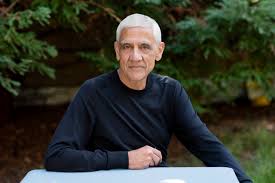
OpenAI's Sam Altman speaking at the United Nations yesterday. This morning President Trump posting A.I. will be a big topic of conversation with China and that both countries want to 'leave it exactly where it is.' Let's bring in an early investor of OpenAI, Vinod Khosla, founder of Khosla Ventures, a veteran in all things tech and investing. Great to have you in. Look, we have so much to discuss today, but if we could start with that, you have been really prescient on this, as early as 2023 you were saying the U.S. can't slow down because we have this concern what is happening in China. Your man Sam Altman has said he is open to maybe slowing things down for the name of safety. I wonder what conversations you've had with him.
Without going into specific conversations, I might divulge a little, I think much more dangerous than A.I. is A.I. in the hands of our nation-state adversaries. So we should be very clear. That's way more dangerous when there's bad intent behind it than if it's on its own.
Can I jump in on that? This seems to be where the problem will be. We are off to a good start with the model front but the power problem here, now China put up five times as much power as we did in 2025. 60 gigawatt dam coming in. Are we going to win on the models and maybe governance but lose in the power story eventually?
Permitting and other delays are clearly slowing us down. But I do think it doesn't hurt that -- the rate of model development. It hurts for inferencing. I am less concerned about power in the 30s, early 30s and beyond, than I am today. The power demand was growing very, very slowly. In fact, slightly less than G.D.P. the last 20 years, and it surprised everybody. It shouldn't have been a surprise. We invested in Commonwealth Fusion in 2018. The same year we invested in OpenAI. That was 2018. But it takes 10 years to develop a technology and I am pretty certain it will be -- fusion will come out very well and we have new sources. Geothermal will come out very quickly. My bet is by 2028. So there are alternatives. We have new investment in a company called Subcritical you will hear more about soon. So there are alternatives coming, but power plants take a while to build, and they respond slowly. So there is a short-term problem. That will be solved with pricing.
Does that short-term problem make us all the more vulnerable for adversaries to speed up ahead of us if what's growing in the United States at least for now is this pushback to data centers getting constructed?
Well, this is one of the places I agree with President Trump on is we need to push ahead for development of A.I. and power. I think in the end it will help the country tremendously, but there is a short-term mismatch.
What do you do about that?
I think some states can take the lead here and not be subject to as much NIMBYism. I think the data center providers should subsidize rates where they are, so that's very easy to do because they have room in the economics to do that.
So I am a big fan of this fourth turning concept, so every 60 years you get a big pivot in politics. You have been talking about taxing capital. That's important with A.I. taking many jobs, disrupting industry. Maybe there is a transition period. Can you talk about how the political argument can be made to the populace that this is an important thing? We had tax cuts that are popular on one side of the aisle and more extreme views on the other.
There are two entirely different questions. One is deployment and I just talked about many sources of power Commonwealth Fusion, we are doing Mazama for bio-geothermal energy, a new source of power coming online we will hear soon about. I can't talk about it yet. So -- on the jobs side is where the real concern with A.I. is, not so much data center, I believe. I think we need to make sure people are protected. I think there is a fundamental difference. Some people think we should protect jobs. I think that's the wrong approach. We should protect the people who are impacted by jobs. That's a very different question, and since long time we have been favoring capital over labor. Labor has a high tax rate compared to capital, which gets preferential capital gains treatment. So we are redistributing money upwards, and people always talk about not redistributing money downwards but we are doing it the other way and I think leveling all tax rates would be a really good idea. No different than capital gains income or ordinary income. That would be beautiful.
When you wrote about this in The Information I believe in our op-ed one line stood out. Capitalism is by permission of democracy. I prefer that capitalism not be revoked by the socialist tendencies emerging in our society among voters. These two things are happening at the same time. This great anxiety, just generally, plus A.I. creating more anxiety. How fearful are you that we could undergo a structural shift that impacts the very project of capitalism itself?
Well, that's why I wrote my piece. I do think it can be impacted, and there is a claim to socialism among the younger set that's well understood in all surveys. But it can be reversed. If we do something about it. It's pretty easy to take a $400 billion that I talked about in my op-ed per year and be deficit neutral. I think that deficit neutral is key, and the money is key to help people who are displaced and tell them they will be taken care of. I think we will have the ability in the next 10 years to provide a great safety net behind people and that's how we protect people, without saying you can't change jobs or displace jobs.
You are speaking this well and laying it out factually. Do you see the rest of the venture capital world getting this because I think it was a fumble here to not get ahead of this NIMBYism we are seeing and angst we are seeing. We don't understand how it works or how it will impact us. What else is going on with the guys you talk to on your level?
I do think there is a fumble here and I think we didn't lead with the benefits of A.I. For $1 or $2 a month we could provide every American with free primary care. We could provide every kid for $1 or $2 a month with A.I. tutors for their children, personalized tutors. All this is trivial and will reduce downstream costs that we see in our society from lack of enough access to primary care, higher downstream health care costs. So there's lots of things to lead with that benefit people and they see the benefit without being mostly scared about their jobs. So I do think there's a fumble but there is a way to address it. I suspect, just like President Trump took up the immigration platform last time and played it to the hilt, even with sort of pretty ridiculous pitches like immigrants are eating your pets, we can and some presidential candidate I hope takes up a platform like this, radically reinventing the tax bases.
This political environment already is moving at a glacial pace. Do you see any political leaders who are willing to take under the mantle?
I didn't think anybody would take up the immigration platform in the same way. So I think to be a differentiated candidate you have to have something unique to offer and I think what I propose is a unique thing. I hope somebody takes it up for 2028.
I wonder if it was a mistake to this point you are talking about, to really communicate what A.I. does. If it was a mistake to have these A.I. leaders from Dario to Sam to Elon say maybe there is a safety issue and we need to slow down, was that the wrong message to be sending to the public?
I do think that's the wrong message. I do think we have to focus on our competition with China. Whoever wins in A.I. -- I talked about this for a long, long time -- is going to win the economic race and hence the influence race globally. What Southeast Asia, Latin America, Africa adopt will be the political philosophy, will be a function of who wins the A.I. race. Economic power will reside with whoever wins the A.I. race. That's why it's so important and that's why I think President Trump has it right. So I do hope we get behind this.
Can I throw you a curveball? You gave me hope with energy. Quantum computing. That's the next unknown, another concept very hard for Main Street to understand. We can say partner with A.I., do all kinds of things. I have read the books. You see things others don't. This is super-national security stuff. Where are you on quantum computing?
I have looked at every quantum computing effort in this country for the last 10 years, turned down every single one except only this year I changed my mind, and so we made our first quantum computing investment after looking at a dozen of them and I do think there is a radical breakthrough. Previously the question was, which is the best quantum computing company? I have always looked at what is a good enough quantum computing company to solve what's technically called an algorithm which is very disruptive. I think that happens in 2030, which is disruptive and an area we can beat China in, but there are other areas we can beat China in. We are very dependent on minerals and materials. I think there is huge effort in this country to do that, to reintroduce those industries. We have seen A.I. really help in refining, in mining. Lots of hope in the minerals. We have minerals in that area. I am very excited about what they can do. They are opening up shut down copper mines. This is climate week. Other things we have that produces cement cheaper than high carbon emissions cement. We have one that produces steel cheaper than high carbon emissions steel. You don't have to worry about the climate benefit. If the climate technologies are cheaper than their fossil competitors, that is the way to approach it.
We are just about out of time but I would be remiss if I did not ask you quickly about another one of your investments, and I am sure we will talk about it later. You are a multi-decade veteran of this industry. Reports are you are also in the middle of raising a fund. You have been doing this for a while. Why add NFL to the portfolio? Why buy the Seahawks among the other things you do?
How often do you get to buy a Super Bowl winning team?
It is a hedge to the A.I. world. I think live events, especially live sports will not be impacted by A.I. It is one of the areas that will not be impacted.
Thank you for joining us. Been an absolute pleasure. Whenever in New York, please stop by. Let's get a quick check on your markets. The opening bell just passing through about two minutes ago, and we are declining on the S&P, down by half of 1%. The Nasdaq falling 0.8%. The pressure from this bond market on the long end of the curve ebbing at least for this morning. Little changed on the 30-year yield at 5.4%. The 10-year yield and 5% at the highest level since about 2007. Some of the stocks we are looking at at the open, Oracle taking steps to limit its financial exposure to a huge New Mexico data center project. That has run into setbacks. It wants to delay payments if the site fails to come online as planned. A huge lender into that project also down by 1%. Meta shares are down with the broader market. Yesterday, Mark Zuckerberg unveiled new devices including lightweight VR glasses and a handheld gadget for its new A.I. assistant. Stocks sold off as bond yields start to come down after a day of a somewhat of a meltdown in bonds.
One of the remarkable things of yesterday, Mike and I talked about this briefly, as you are in this moment where bond markets were selling off a more than 10 basis point move and equities were just kind of like, whatever, we will not sell off 1%. VIX does barely anything. Is there a disconnect or is this a higher yield regime can survive?
It is like what happened with that pricing as it relates to the forward group. That is not to say yesterday was not a very big move. It was a very big move, but equities know we are in this higher rate regime that also entails higher rate volatility. I think there is this element of understanding. Also, you have to think about the components of what drove the move yesterday. It was predicated on better growth. That is not a bad thing for equities. That is why it was not an over 1% sell-off yesterday.
We are all taught a flat to curve is a negative. We will over tighten and have to have a payback on growth. To your point, we are in this blissful Goldilocks scenario where earnings can still grow. Let me ask you this. I know we all saw it. There is a better breadth of earnings. We have seen leadership now get more concentrated. Is this now into the new earnings season that needs to be reevaluated?
I think we will have these ebbs and flows. Q2 was all about semiconductors and hardware, and then you saw the broadening out to banks and health care. Now you are seeing this gravitation back to the Mag Seven. I think there is an element of there is a price for everything and when something underperforms, because everything is solid from a fundamental standpoint, you can pick and choose where you want to be at different times and that is what is happening. And that speaks to how, yes, at the index level the volatility is not that high but if you look at a single stock level, it is quite high and creating a lot of interesting opportunities.
I wonder how much of this is driven by how much what is being created right now. I was looking at a J.P. Morgan statistic saying withdrawal from investment accounts almost doubled from April last year to April this year. I am sure you are seeing something similar in the private bank as well. How is there so much money being put to work now because of A.I., because of the wealth created in this economy?
Yeah, and it is important to keep in mind a lot of investors missed this rally. There has been a lot of cash on the sidelines that has not gotten involved. There is an element of, my gosh, this is real. Q2 showed there is a real thing on this investment. If you like we are about to get new models released that will speak to the innovation and pace of A.I. I don't want to miss this. You pair that with specifically talking about the Mag Seven leading the charge from an R.O.I. perspective. They are viewed as defensive. You have the two things working for them and that is what you are seeing money flow back.
5% on the 10-year is getting a lot of attention. For your clients, is that what caught their attention or are they honing in on levels? In my mind it is rate of change.
I agree with you the most part nothing is rate of change and the volatility with it, how quickly it happens and the magnitude of that. I think within our client conversations, it is mostly 5%, is this where I think about adding to fixed income? But I think the risk/reward conversation around that is different from five or six years ago. We are in a higher rate and higher rate volatility environment so you really have to think, OK, with the S&P 500 at 19 times, the 10-year at five, what is the risk profile of each of those are the risk/reward profile of each of those that makes me think of how to allocate from a portfolio construction standpoint? A different conversation at 5%.
What does that conversation look like now? Are people nibbling?
I don't think the natural conversion is I will sell equities and buy bonds. I have a ton of cash, which is a true thing that came out from J.P. Morgan this morning. We do very much see that cash transfer going to fixed income, particularly thinking about where there can be tax advantage. I think that is the conversation. I don't know that people are selling their equities to buy bonds.
With the curve flatter, you don't have to take a duration risk so it is attractive if you think this will be transitory as far as what we are seeing with the Fed and the worries there.
That is another conversation. There has been single stock volatility within equities. You don't have to take a ton of duration risk to get the yield you want to generate. That is a much more nuanced conversation and why we are not going all in on duration because you can think about the short end of the curve and think you are getting a nice coupon and an extended credit.
Fantastic. Thank you. Let's get a check on your equity markets about nine minutes into your trading day, and we are trending lower. We are down 0.4%, 30 points or so. On the plus, Meta is leading the charge at its highest price in about a year. Susie has him over Muse in the premarket. Will people buy something that is listening to you powered by A.I.? Abby mentioned the health care trade being a popular one amid the volatility. Certainly popular this morning. Eli Lilly and Johnson & Johnson both up. Big oil, Exxon doing well, up 1.5%. Nvidia, Microsoft, Broadcom, those are lower. Oracle maybe having an impact, saying there is a possibility they cannot make rent payments if some of the permitting does not get up to speed. Is that what is denting some of the highly indebted hyperscalers too? Looking at some of the sector action, energy will be doing well. Communications because of Meta doing well too. Health care staples. Darden Restaurants had earnings saying people are coming back to malls and spending. Consumer discretionary still at the bottom of the pile alongside infotech as Oracle falls. Coming up, we will get more into that story. Oracle is putting a shield around a massive New Mexico data center already facing setbacks. That is next right here.
Let's get some top calls here with what the sell side has to say this morning.
I have three positive calls for you this morning. First let's start with J.P. Morgan upgrading CoreWeave and saying the demand for A.I. compute remains strong and that is exactly what has given the company more room to keep prices high. From A.I. to Dollar General, HSBC upgrading the stock from hold to buy saying that your ground is moving from promised actual delivery. Sales coming in at the high-end of guidance and the stock looks pretty cheap. Shares now higher by 2.4%. Finally, Piper Sandler started Carlyle at overweight. Pretty blunt on this one saying that shares are too cheap to ignore. Growth is actually starting to improve. You are seeing the stock lower by 1.7% in the premarket trade. Those are your top calls.
Thank you very much. Oracle trying to protect itself from costs tied to a massive New Mexico data center by invoking force majeure. Let's get more now by Sri. I know you have been tracking this data center closely. What has gone wrong that they are saying there is a chance we might not make our lease payments?
It is a classic case of the friction between the grand ambitions of all the A.I. leaders in the A.I. business economy and local realities. The data center we are talking about is this massive 1400-acre campus built in southern New Mexico. Beautiful part of the country right next to White Sands National, bordering Mexico. But it is also a rural county, and there has been a tremendous amount of local pushback, regulatory challenges. People are worried about the water consumption, greenhouse emissions, whether there are sufficient financial returns to New Mexico. Yes, everyone involved with the data center project says this is a good thing for the state, this will bring local benefits to the economy. But what all of the friction has meant is and has thrown into uncertainty whether the project can truly go online as previously planned. Blue Owl, which owns the product developer Stack Infrastructure and Oracle which will be the tenant, which will be leasing the compute from the data center facility believe everything is on track, so why are we talking about the force majeure notice? It is purely a defensive shield. Oracle is not saying they want to walk away from the project, tired of the infrastructure, going away, but it wants to make sure it is not racking up expenses, not on the hook for certain financial commitments and obligations if there are delays, if there are certain overruns and if things don't go according to schedule, which as of today, they are hoping remains the case. There is no denying there is a lot of NIMBYism going on.
It is the canary in the coal mine, is this something we should expect from a more legal posturing? Are we not going to have smaller data centers, instead of the larger one, and then you have a different marginal cost for compute?
I will take you up on the canary in the coal mine question because in some ways this data center has become a poster child for all the issues of data centers across the country facing. You are seeing a lot of action in the price, CDS market, other stocks. That doesn't mean that it is all tied to this one project, but investors are trying to analyze what does it truly mean for everything else? Whether it is Silicon Valley or Northern Virginia or other parts of the country, data centers are coming up in the battleground states heading into the midterm elections. We have seen problems everywhere. Did we think a year or two ago the data centers would be the campaigning rhetoric heading into the elections? That is what it has turned into, and that is why, even if this is just a fresh wrinkle in a project that has already been massively controversial, everyone is trying to tease out what is the next step, what does this mean for every other project? A lot of capital is being allocated into this project, and that a challenge for investors. Is this a revolution that will bring an abundance or lead to extinction?
The first thing I thought about when I saw the story was the many conversations I've had with private capital players saying we are not making a directional bet on A.I. The only thing we are betting on is the credit worthiness of our tenants. Basically rental payments for these leases were treated as a sure thing. I wonder what happens if all of a sudden this throws that into question? Does the cost of capital get higher? Presumably bond yields will go higher for these projects and there will be less appetite, pushback. Does this add a wrinkle into the conversation of how fast we can build if our assumptions are on the safety of these projects change?
You can see certain private markets trading. When Project Jupiter was rolled out, there was an $18 billion loan commitment put forward by 20 banks. There has been some amount tied to those loans, and that is now trading below $.90 on the dollar. Not the stress levels but stress levels. It is not a level where you want to see trading at. When you see something like this, which is a bit of a spanner in the works, there is concern out there. That is being expressed in the markets. Meanwhile, it is important to say that Blue Owl has said this notice does not change the multiyear financial commitments. We are trying to signal to the market that the payments it expects will be coming in as planned.
I really worry about this, because not only the bottom line, the top line, it is the actual execution, where the rubber hits the road. This company, this world does not have a capital shortage. It has an execution problem. We are going to lose the race to countries that can execute better, China, and overall, once we get through the political cycle, I don't think this is going to fade.
This idea that China doesn't have this problem because they don't have the NIMBYism. I don't know if we can know this for certain because we don't get our hands on these contracts, is there any sort of language, idea out there that these contracts contain language of what happens if you don't get your permitting for various things, isn't that a factor or is this Project Jupiter so new that he didn't have this pushback yet?