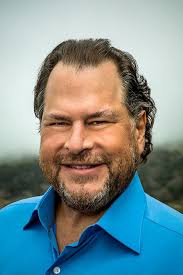
We are in Honolulu, Hawaii, on the island of Oahu, and we are up in the Botanical Gardens. On my right, the amazing, the extraordinary Marc Benioff.
Hi, I'm Marc Benioff. I am the chairman and CEO of Salesforce. What I look for most in an entrepreneur is a mindset that is flexible, that is open, or as the Japanese say, a beginner's mind. In the beginner's mind, you have every possibility. In the expert's mind, you have few. The best founders are the ones who have shoshin, the beginner's mind.
Marc is the founder and CEO and chairman of Salesforce, and Salesforce has become one of the greatest companies in the world today.
And not only is it an extraordinary company itself, but all the companies that run off of Salesforce are much more efficient because of it. Anyway, Marc has also started his business in the Silicon Valley and moved to Hawaii.
He has figured out—turns out people are willing to come visit you here.
Yeah, no, it's exciting to work and live here in Hawaii. And to everybody here, aloha. And thank you for inviting me over here to the neighbor island. We're happy to come over and visit you. We are building some new healthcare here in Hawaii, and one of the new hospitals is actually a big investment in a new hospital right in downtown Waikiki with Straub. So we're very excited with Hawaii Pacific Health. That's going to be a $100 million investment that we're making to improve healthcare right downtown here.
Fantastic. And you also funded some helicopters so you could go back and forth.
We have helicopters going back and forth because we don't have the same great healthcare on the big island, even though we do have a new hospital in Hilo. So we do bring a lot of folks over here for all kinds of advanced work at Straub and also at Queen's Punchbowl and so forth.
So tell us a couple of things. First, I'll start with just Salesforce. How did that get started? What made you do it? And what was the vision when you were just getting started?
Yeah, I was spending actually a lot of time here in Hawaii, and I've been coming here since 1974. I have always been very attracted to the Aloha spirit and the values of the Hawaiian people. And I was actually doing something that we're not really allowed to do anymore. Everyone here knows we're not allowed to go swim with the dolphins anymore in the ocean. But back in the day, we used to kind of go out and the dolphins would come and they would swim around and they'd say something to us, like *dolphin noises*. And so then—
Wow! That's a good dolphin!
Thank you. Thank you. I do a variety of animal sounds and I am available for birthdays and also bar mitzvahs. Yeah. So we were out there swimming with the dolphins, which we'd be doing. And there's a lot of very kind of people who are extremely interested in the spirituality of Hawaii. So they're in there doing their dolphin thing. And then I just had a vision that the world was going to change in technology, like it's changing now. And that I wanted to leave the company that I was at. I was at Oracle for 13 years, so I started my own company called Salesforce. And today Salesforce will do—we have about 83,000 people all over the world. And we were the number one supplier of enterprise software. And a lot of it came from the visions that are available here in Hawaii. So we encourage everyone to come here to Hawaii.
So all of you out there and all of you in TV land, learn to speak dolphin.
I do other sounds too. I'll do a variety of them during the—
Good. I'm counting on it.
Whatever you want. I know you do a couple sounds, don't you? What's your best animal sound?
I think it's elephant. *Elephant noises*
Yep. We're two elephants, so we're happy to do more sounds as it's going to—
As time goes on, well, that's what the show is all about.
That's it. This could just be—
That's the social media moment right there. All right.
Okay, so we got the sounds down. Okay, now, you built this incredible company and you decide you move your family, your world, everything to Hawaii. Tell us about that move and tell us about how you separate... I mean, when I'm here, it's like vacation, right? And then occasionally it's like, "Oh, I got some work to do." How do you do that? How do you have like a—
Well, I've just been coming here for decades and then decided not to go back.
Okay. I asked you something and you gave me a good answer. How you separate the work from the family and the play and all that stuff. And you said, "Well, we put up an office and you go to that office and then you bring your board over, you bring your management over, and you do regular meetings with them." And then the rest of it, it's just Zoom calls, right?
I'm working 24/7. I think that once you actually decide to start a company, you're working 24/7, especially today. But you're living 24/7 wherever you are, and then you can decide to be wherever you are. And of course, I'm still going all over the world. I love traveling, and we have offices all over the world, customers all over the world, employees all over the world. So I need to be all over the world. So it's all fine, but I always get to come home here to my ohana. That's the Hawaiian word for family.
Right. Yeah, absolutely. I'll tell you though, Marc does work 24/7 because when I send him a text or an email, it's almost immediate that he gets back to me. So if you really want to be a huge success, you move quickly, efficiently, effectively like Marc Benioff. Okay. One pretty serious question.
Thank you. Like one serious question is AI. This is sort of an interesting factoid. We have a company that just did a press release that said, "Our AI has just copied every one of the YC companies." 400 portfolio companies all, and he's created the exact same software 400 times just with AI within about a week from when they were all launched. So that's going to change some things. So how's Salesforce going to change? What's going to happen there?
Well, I think to that point, we're kind of entering a new world of AI. AI, of course, as you know, Tim, because you've been in the industry for decades—this is not your first rodeo. It's not your first paniolo Hawaiian rodeo either. I would say that over the decades of AI, we've seen these incredible models and we've seen them do unbelievable things. But now there's one specific thing that's happening that's really pretty awesome, which is kind of the idea that we have the ability to code, that these are now coding agents. And that is really exciting because I think up to that point, like what you just said, if you didn't have an engineer, you weren't coding. And I think now if you have an AI model, you are coding.
The second point is it's an agent revolution. It's incredible what is happening. Software is really becoming not just software, but agentic-ware—the idea that it's about humans and agents working together. The models are only so accurate, so it's still very important that the humans are in the loop. But in all cases, agents can make things so much better. So it's customer service: yes, it's your customer service humans, but also these AI agents that are working in tandem with them. Your sales folks: yes, it's your salespeople, but it's also AI agents who are out there doing qualification and prospecting for you, maybe even closing deals.
And I think in all cases, it's going to be agents supporting you and helping you. All of us have had the experience of working with a ChatGPT or an Anthropic or a Gemini at home, and that's kind of our agent kind of helping us along. These agents are going to be a little bit more loose, a little bit more autonomous. They're kind of supporting us in the wild. It's a very exciting moment in software, something that we haven't really seen this kind of revolution in quite a few years.