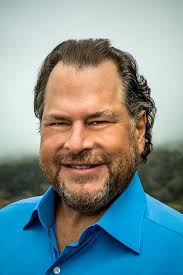
And now our CEO and chair, Mr. Marc Benioff.
All right. Thank you so much everybody. Really excited. How's everybody doing today? Did you all have a good time at the concert last night? And is Dreamforce going well? All right. Fantastic. Well, we have a fantastic entrepreneur here and a great leader of our industry who I've known for a tremendous amount of time and I'm thrilled that he's back at Dreamforce. So, welcome Travis Kalanick.
Good to see you, too, Mark. All right. I want to get Matthew McConaughey pitching my stuff. That was awesome. I'll buy whatever he's selling. This is going to be a very easy interview. So, you know, we've known each other for 21 years.
Do you remember where we met?
I do. Should I tell or you?
Davos? Yeah, we met right when you were discovering the concept for Uber itself.
You were like in Davos trying to get a car and you did not.
Yeah, that's fair enough. That's fair enough. That's funny. Well, I'm sure there's a lot of Marc Benioff fans in the audience.
Why don't you actually just tell us the vision? What happened? Actually, there you are. It's two decades ago. You're in this little ski town. You're having all these thoughts. Whoa, why can I not just get a car on my phone?
I mean, look, here's the thing. So, I'll make it quick on the Davos thing. They allow sort of young entrepreneurs to come. They call them tech pioneers and it's we're just there for like entertainment and just sort of like we're the crazy weirdos and they let a few of us through every year. And I was watching you hold court at Davos and I was like, "Okay, that's that's a thing." And basically Mark runs Davos. Um, the idea for Uber and it's crazy. I mean, I don't know what it's like today cuz I don't go anymore, but the idea for Uber was actually was originally in Paris. Uh, we were at a conference, me and my buddy. It was sort of in between in between things. It was uh the end of 2008. And my buddy was my buddy Garrett uh was like, "I wish we could push a button and get a ride." It was December. It was snowing and before Uber in Paris, if you went out to a restaurant, had dinner, you're walking home. Doesn't matter how much how far. That's just what it was. The metro shuts down and taxis won't pick you up. So, we were on a three-mile walk back. He said, "I wish we could push a button and get a ride." And I'm like, "Damn, that's pretty good." He was like, "Let's go buy 20 S-Classes, hire 40 drivers, and get a parking garage." And I'm like, "No." I'm like, "There's enough cars out there. Let's use them better." And so the way we started Uber was, you know, my co-founder Garrett, he brought the classy and I brought the efficiency and it was off to the races. Yeah.
You mentioned Paris and I mean that was a memorable moment. You rolled Uber out in Paris. Were you shocked to see the reaction and kind of the tension that started to develop in that kind of a you know unique moment versus San Francisco?
Oh, look, I you know I we we saw we saw tension everywhere we went. I, you know, my line back then was I, you know, sort of scratch my head and I'd be like, I really don't know how one citizen taking another citizen across town became so damn controversial. And it's kind of interesting when you think about it that way because that's all it is. Um, we started in San Francisco and three months after we launched, there was a cease and desist by the city of San Francisco and the state of California and all we were doing was black cars. So, the black cars in California, you see it has a TCP license on it. They're all licensed, commercially licensed, commercially insured. Instead of picking up their phone and taking an order, it was picking up your phone and taking an order. And they decided they're going to send us a cease and desist that threatened me with 90 days in jail for every ride that had happened. That was the beginning of Uber. So, like like 3 months after we launched and we weren't launch time right now, huh? Well, at that time it was 20,000 years in jail.
Today, I don't know. It'd be like a hundred billion years in jail. Um, so yeah, it was a little weird. Um, and it's but it goes to show you like we weren't doing anything wrong. That's why I'm not in jail. Um, it's funny. Okay. But it goes to show you when you're disrupting something, what can come back at you, especially if it's an industry that at its very core outlaws competition, which is pretty wild situation. That's the taxi world. Happy to get into it if we want or we could use our time in another way.
It's up to you, Mark. I mean, the world has transformed now from that that moment. I mean, looking back over two decades, you completely transformed how we all get around.
Well, we you now can push a button and get a ride. Um, and so, you know, there's like a fun trajectory or sorts. You could sort of look at the different companies I did. The thing I did before Uber was called Red Swoosh, and it was networking software to move data around networks really efficiently, like a super geeky networking thing. And the way I think about it is like um there's you know a lot of times I talk about bits and atoms and digitizing the physical world which is really and I'll get into what that means. It's really treating atoms like bits. We know the bits world is a computer. CPU manipulates the bits. Storage stores bits. Network moves bits from point A to point B. If you're digitizing the physical world treating atoms like bits you're like okay CPU manipulates bits. What manipulates atoms? Manufacturing. Storage stores bits. What stores atoms? That's real estate. Network moves bits from point A to point B. What moves atoms? That's transport or logistics. So you have these three core computing resources in what I refer to as a atoms-based computer. And I did networking software before Uber. Then I did Uber. So I went from networking software, networking bits to networking atoms. And after Uber, I was like, I want to go after the computer as a whole. And you know, there's a ton of things to do in digitizing real estate. And there's a ton of things to do in digitizing manufacturing CPU and storage for the physical world. And so the first thing we rolled out was a food computer. We are automating an entire industry known as the food industry with manufacturing real estate.
That's how this started. Cloud Kitchens.
That's right. Cloud Kitchens. We don't call it Cloud Kitchens anymore.
Well, it's still called Cloud Kitchens.
We just do a lot of things besides that. So the overall company's called Atoms and we automate industries. Some people might call it physical AI, industrial AI, but it's more than that. It's just we take an industry and we automate the whole damn thing, but they're physical, gritty, atoms-based industries. Food is one of them. Started as cloud kitchens. We're also doing mining. We're also doing transport. There's a lot of cool things in there. Like a couple months ago, I was in a mine in the middle of the Amazon. There's nothing there but that mine and there's a truck fully loaded that's two million pounds going 35 miles an hour autonomously. And so there's a lot of really cool stuff.
This is the company that you bought this company. Is that right?
So there So so what happened is I Okay. So you Okay. So we're catch me up on this. Mark's keeping me Mark's keeping me honest here. Okay. So we have that relationship, don't we?
Yeah. Yeah. Oh yeah, you should see us. It's good. It's good. I like it.
Okay, so on the So we're like, okay, let's The first thing I did was called Cloud Kitchens, and we're like, we're going to digitize food. We're going to make a computer, a food computer. And the overall idea is, can you make a meal that's prepared and delivered to you so efficient that it approaches the cost of going to the grocery store? I mean, if you can do that, you've done some really cool stuff. What you do is you you're basically giving people their time back, which is often what happens in the let's call it the atoms-based computer. You're giving people their time back. The most important luxury in life. And so you go, cool story, but how do you do it? It's one, you need you need to automate the production of the food. So that's food robotics. Two, you need to automate the movement of the food. Whether it be inbound logistics, trucks, freight, midsize commercial, all the way to the end user, a vehicle that brings the food to you autonomously. So think of like you see the Waymos out there, but what what about something that keeps food at temperature that's going towards you 35 45 miles an hour but safely and high quality meal at the end of that. Um but then the third thing you got to do is industrial real estate because online delivery is essentially online delivery of food is you know when you do Dash Uber Eats that is e-commerce and so you need industrial warehouses to do the logistics from because food has a 30-minute half-life after it's made every 30 minutes it's like just getting less valuable the manufacturing i.e. The production of the food has to happen in the same place the logistics do and it has to be close to you. So we have facilities in this industrial e-commerce real estate for manufacturing and logistics in every major city in 30 countries around the world many of them. So like here in the Bay Area probably like 20 facilities that is the digitized real estate robotics that makes the food and we're getting into the courier piece of it now. The minute I went into Courier, I had to get my band back together because at Uber, we had an autonomy program that was catching up to Waymo. When I left Uber, the team that came in divested autonomy.
We don't have to go there.
It's not that interview. I agree.
But we got the band back together because we're getting back to autonomy.
But we do want to know the origin story on cloud kitchens. That is important.
I was at Uber Eats. We were building Uber Eats. We were making it awesome. And we started seeing kitchens, restaurants that were on Uber Eats that were just in kitchens. There was no restaurant as you know it. It was a regulated kitchen. It had the little letter grade and all that, but it wasn't a restaurant as you know it. It was a commissary. We started the first ones we saw were actually in Melbourne and the idea around cloud kitchens was how like can you do this in a much more efficient way. So 30 30 kitchens in a single facility. We buy the land we do the construction and then we lease the kitchens these delivery only locations to restaurants restaurant groups.
How many of those locations are there now?
Oh, I mean high hundreds.
Yeah. So you have basically that's like restaurants and then and then who's picking those up? Is it Uber Eats and DoorDash and coming to get them?
So first of all the high hundreds that's but multiply by 30 or 40 because there's 30 kitchens in each. So tens of thousands of restaurants. Um and so what happens is they'll list in Uber Eats and DoorDash the same way you normally would. You push a button and order. The courier comes to our facility as if they were coming to a restaurant, but they wave the phone in front of a camera and the locker pops open that has the food they're supposed to pick up. Behind the scenes when you order the restaurant starts making the food an AGV comes picks the food up when it's done brings it to front of house it gets put in a locker and then of course the courier waves his phone in front of a camera locker pops open he gets it and you're saving minutes everywhere those minutes mean that the distribution of the food gets cheaper and cheaper and cheaper because people are waiting around less and your food is higher and higher quality because you're getting it faster.
Now in the facility is it robotic? Is it humans? What is going on? How do you make that happen so quickly?
So, it starts, everything starts, you know, sort of very manual. It's a normal kitchen and little by little you automate it. We just rolled out food robotics. Uh like we rolled out a bit ago, we have restaurants using it. Think of it as like if you walk into a Chipotle, the front line of Chipotle is just automated. What that means is your meal to the gram has everything it's supposed to have. There's far fewer mistakes. You get it faster. You get it at a higher quality and it's cheaper. So the meal, we talk about the cost of meals these days, etc. The cost comes down. And what's interesting is like you know look in AI there's a lot of discussion about jobs and labor and things like this but what's so interesting when you're talking about home meals these are meals you have at home the labor that we're taking away is yours right so this is not labor in a restaurant this is labor for e-commerce essentially so that you don't have to do it yourself.
Yeah. And this has gone very well, right? Because how how many years have you been at this now?
So we started this eight years ago.
And it's turned into an incredible business almost overnight.
So we're having so we're Yeah. We're having a lot of fun. I think the thing to keep in mind and you see this with folks who really go after atoms heavy industry is the atoms take longer than the bits, right? I think it was like the other night Mark, you introduced me to an entrepreneur. He was like 24 years old or something who he's like got a two-year-old business, three-year-old business that's doing like $4 billion in revenue or something wild like this. And I'm like, and he's like, "Yeah, we went from like, you know, a hundred million last year to four billion this year." And that's cool. It's cool. Okay. But the atoms-based world works slower. So like, think about this. Like Elon with Tesla, like how many years did it take before he was doing 100,000 vehicles a year? I mean, it was probably like 15 years. It took 15 years to get the rocket that's going up to come down and land. But once you get it, oh wow. And so we're starting to get to that oh wow now. Because I have a robotics division that's pushing out a lot of robotics that helps with the production. We're about to get the courier thing going. And now the food computer's working. Now you can, you know, and I'd say in a short period of time, some in some short period of time, you're going to start seeing the cost of a meal that's prepared and delivered to you starting to come down dramatically. And when that happens, it's a big deal. Right now, online delivery, which is thought of as a huge category, it's 2% of all meals in the US, just 2%. E-commerce on the other hand, retail is 25%. So when that cost comes down to par, you're going to see a huge multiplication in sort of the quality like the number of meals of course that are coming across the quality and sort of variety and selection you get. And the you know and the time that you get back because of it.
So you're in this post Uber moment. You have this vision for cloud kitchens. You have this idea that you're gonna have these hubs. You can have multiple restaurants in every hub. The hubs are kind of hybrid robots and humans and automation and all that's going along. And now this is working after, you know, eight years. But then all of a sudden this year, you all of a sudden said, "Wow, this is a really cool company. I could acquire this and now turn this into another industry." Is that is that is that a fair characterization?