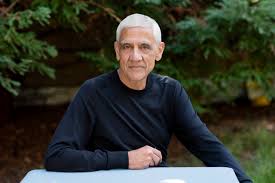
Well, good morning, everybody. I think I want to first start with my wife. We've been together for 55 years or so, almost. Yeah. So watch out, we're here to stay. My son Neil, we've been together for 33 years—32 years. My daughter Nina—Nina's an entrepreneur by herself. Two fashion brands she's started, FOUM and OSU, so feel free to talk to her later. And my other daughter is feeding the baby. You'll meet the newest 12.
And our fourth daughter is just landing from Amsterdam.
No, no, no. Third daughter and a son.
Or the fourth child, the third daughter. Nina's the eldest. Anu with the baby is second. Our daughter who's landing is the third, and she'll be here at the game. And my son Neil is the youngest, the baby in the family. So he's an entrepreneur. Anu mostly works on nonprofit causes, and our daughter who's landing from Amsterdam is a competitive equestrian, so she was competing, and so she's back here for the game.
Hello. Brian Nemhauser with Hawk Blogger. Welcome to Seattle, first of all.
Excited to be here, really excited.
Excited to have you. So when the team was last sold in '97, Paul Allen recognized that accessibility was important, made $10 tickets available, and committed to have some percentage of tickets always at the lowest average in the NFL. Since then, ticket prices have gone up 1100%, median household income's only up 125%, and I'm curious what your perspective is on keeping accessibility for the average fan to keep the home-field advantage what it's been in Seattle.
So we do respect what Paul Allen and Jody did. I suspect, without going into specifics, our policies won't be much different than whatever they are following, done in conjunction with management. So I don't expect we'll change a lot from Paul's philosophy or Jody's philosophy.
Congratulations again. Chris Daniels from KOMO News in Seattle. The question that has lingered for a lot of people through the last few months with the change in ownership is what your future plans are, not only for this building that we're sitting in right now, Lumen Field, but for the area around the stadium as now the official owners of the franchise. What can you say about the future of Lumen Field and the stadium district?
Yeah, first I'd say we are owners for five days. A little early to formulate specific plans. The broad thing I can say is I don't expect too many changes. So our philosophy will probably be similar to what the Allens did, and rely a lot on management to recommend what they want to do.
Hi, Bob Condotta with the Seattle Times. I understand you guys were here for the playoff game against the 49ers last year and obviously, I guess, rooting for the 49ers at the time, but I was just wondering if you could tell me what you remember of that game and your thoughts on kind of sitting in the stands for that game.
Well, that game really brought home to us the power of the 12 brand, literally how passionate a fan base it is. I never realized how popular a brand the 12s are, and so that's very exciting. I would say that was the big takeaway, other than being on the losing side of that—thankfully now being on the losing side, we're excited for Seattle. And so I would say the biggest impression was Lumen Field as an iconic venue, the loudness, how exciting and energetic it was, and of course the 12s.
I might just add, you know, my dad and I came to that game, Bob, and we had never been to Lumen before. I think obviously the Seahawks had a very good game, and we're kind of sitting there in the fourth quarter and it was still so loud. Kind of one of my reflections coming out of that was like, I don't know that I've ever been in a venue this loud and this passionate, and it's a 30-point game in the fourth quarter, and you see how special the fan base is. I think we walked away going, "Oh my god, this is built different." That was kind of the first cue to us that this franchise has something really special in how it's connected to the community and what the fan base is, and how they show up for games and ultimately how that helps the team on the field.
Hello, I'm Brady Henderson from ESPN. Welcome. So we know your respective titles. Can you help us understand what that's going to mean, who's in charge of what, what that looks like on a day-to-day basis?
I would say the following: We are a super close-knit family, so if you want to know us, we're very close and we will probably operate relatively interchangeably as an office of the chairman and not have any specific things. Now, Neeru is very passionate about education. She's had a nonprofit in education for—
—for 20 years, which by the way serves 30 to 40 million children worldwide every year, and millions of students are using her AI tutor every single month. So she'll be more focused in the community efforts and some of the foundation efforts for the Seahawks Foundation. Neil and I will probably operate relatively interchangeably. We stay in close touch. We talk every single day practically. We hang out a lot together, so you'll see us operate as if we are one entity.
And one follow-up to that: Will any of you or all of you be stationed in Seattle or in this area?
We will be here often. We won't be moving to Seattle. Just like we've been together for 55 years, we tend to be pretty stable. We've been in the same house since 1986, so—
So, but we'll be here a lot.
Just so you know, we take commitment seriously.
Dave Mahler, KJR Seattle. First of all, welcome to town. A couple of questions. Can you guys just talk about—
Great weather. Welcome to us.
It's always like this, by the way, just so you know. Can you talk a little bit more about your management style? You mentioned letting the people in charge make recommendations. And then I think the question everybody here wants to know, really the reason why we're all here: You've had and you've seen the blue throwback uniforms. Are we going to see the white throwback uniforms brought back at any point in time, maybe this season?
You want to talk about—oh no.
So to the first question, the management style, I think our approach will be to have great management. We do have great management. They got us to the Super Bowl. And by the way, how lucky is it? How often do you get to buy a team that just won the Super Bowl? So the best thing we can do is not mess with a lot. I think we will be working closely with management. I don't think our approach is going to be telling them what to do. Our approach will be lots of discussions and then leave it to management to decide whether they agree with us or not. So I'm very much a fan of handing them the baton, let them do their thing, and take responsibility for the results, which hopefully is a Super Bowl very soon this year. I don't know if I can tell you much more other than lots of dialogue, lots of discussion, then let them make decisions.
Yeah, the throwbacks. That's one I can—we will bring those back for 2027, the white throwbacks.
Gregg Bell of the News Tribune. Could all of you address how you'd like to incorporate artificial intelligence in the football operations of the Seahawks?
Well, I don't know if there's a specific plan. We've talked a bunch about it. I won't say there's a specific plan on the field. That'll be left to Mike Macdonald and John Schneider to do. AI has a lot of roles to play. I just mentioned AI tutors in the community, so there's definitely uses for that. And no, I don't think there's any labor displacement going to happen with robots. I suspect AI will be an important part of entertainment and enhancing the experience, but no specific plans today.
Yeah, I would just add that I think one of the great things about John and Mike is they're always chasing edges. They're always looking for what they can do to gain advantages. And if we can be helpful, we'd love to bring those perspectives. But as my dad said, I think it's: How do we have discussions? How do we push each other? And then they have to make decisions. We're not here to make decisions about how AI is used in football. I think we're here to have those conversations and hopefully bring some new ideas, and that's kind of the extent of that.
Yeah. And let me just elaborate on that a little more. You always want to have lots of discussions, lots of ideas, lots of debate, but then the people in charge of executing should have the baton to make the decision, because if they haven't made the decision, they won't be as committed to it. That's a very important management philosophy. The person responsible for executing should buy into the decision, make the decision after plenty of debate and ideas and interaction.
Of all professional sports franchises in the world, why did you choose—
Well, they just won the Super Bowl. We're very fortunate. I've had lots of connections to Seattle because of the tech community here, and when it became available, we both got super excited about it. I'd say it's the best sport in the world, and it's the best fan base in the sport and in the world, like that simple.
Can I just add, because for me, most important is to kind of bring the youth into the world they're going to live in, and the best way to do that is through education. Help them understand what they can do. A lot of what we built has been—and by the way, we offer it free so we can educate, we can kind of help them be, if they truly want to be in sports, which they should, we want them to be there with deeper understandings. So that's my commitment to the youth of Seattle: to help them get where they want to get through what we've built with technology and now AI on top of that. So lots of potential.