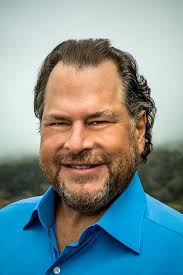
And now our CEO and chair, Mr. Marc Benioff.
All right. All right. Good afternoon, everybody. How are you doing? Are you having a good day? Are you having a good Dreamforce? All right. Please welcome His Excellency Omar Al Olama all the way from Dubai, the UAE.
Great to have you. We are so thrilled to have you. It has been many years we've been waiting for this interview. We're so thrilled. And I'll tell you a little inside thing, which is we've known each other for many years. We were serving on some incredible commissions together and discussions of AI in the future. But one of the things I think a lot of people don't realize is you were the minister of AI way before there was AI. Like you had the vision that this was going to happen quite a few years ago. So when did you become the minister for artificial intelligence in the future in the UAE?
Thank you for having me, Mark. And I've been meaning to come here for many years as you said, but you did your magic this year and you made it happen. I was appointed minister of artificial intelligence in the year 3 BC. So three years... quite a while ago. Three years before COVID. So that was in 2017.
2017. Yeah. It was quite amazing because we would sit in these meetings and you were telling me about these visions. In fact, right here we remember, I remember we were at a meeting in the Presidio here in San Francisco and you had a very clear view of everything that was going to happen and how governments were going to have to adapt, but especially how the Middle East was going to adapt. And where did that come from? How did you have that incredible insight so far away?
So, I get zero credit for this. One thing that our leadership in the UAE has is they are voracious readers of history. They understand historical trends. They understand what happens when nations grow and what happens when nations fall, and it's usually linked to technological innovation and disruption and embracing that disruption. So in 2017 when I was appointed minister of artificial intelligence, I remember coming to His Highness the Prime Minister and saying what's the job description and he said you're about to find out. I said okay. He said travel east and west, see what the frontier of artificial intelligence looks like and come back and report back to me. So I remember in 2017, I think it was either end of 2017 or the beginning of 2018, there was a gathering in LA with the founders of OpenAI, Sam Altman was there, Elon Musk was there, Dario was there and many others, and they were talking about building what today we call LLMs and what we call ChatGPT and you know the other systems that we're looking at right now. And then I remember going east and seeing what's happening in China and they were talking about real world AI with robotics and they were so fixated on creating humanoids, on creating systems that can be used to take care of their aging population. So I came back to the Prime Minister, I said Your Highness this is what's happening in the west, this is what's happening in the east, and he said we need to be somewhere in the middle and we need to make sure that if there's a conversation on the table with people from the west or people from the east that we need to be a value-add partner for both and that they will bring us to the table because we are either the fastest to implement or we have the experience that they need. And that's I think where this whole thing came from.
Well, take us back to that moment. You know, you've had this appointment, you're having these meetings. Was it clear to you that these things were really going to happen or were you not completely sure when you looked into the eyes of these founders of these companies? What was your own insight?
So, the honest answer is I was actually very scared. When you hear them talking about what this can become, the first instinct that hits you is fear because there's a fear of the unknown. And I just need to give you a little bit of a background of the region that I come from. Some of you might have visited the UAE and the Middle East, and you might know what I'm talking about, but you know, not so long ago, my region, the Middle East, was the most advanced region when it came to technology, economy, culture in the world, right? It was where most people would send their kids to be educated. This was between the year 813 AD to the year 1515 AD. And it was a long period of time that we were ahead. Now the question that we always ask ourselves is if we were ahead why are we backwards now or why are we behind and the answer is technology. There was a technology that was created called the Gutenberg printing press. It had the opportunity to democratize information, to educate people. Before it, you had to get on a camel or a donkey or a horse or on foot and you'd have to ride for weeks to access one piece of literature, try to memorize it and hope that you don't die on your way back to your village or your city to give it to others. And then there was this machine that could just copy the scriptures and the books. And every civilization in the world embraced it. The Middle East, however, banned it for 200 years. Before it, the Middle East, you know, depending on the historical accounts that you read, was ahead of the rest of the world somewhere between 600 years or 60 years, right? So still ahead and after it, we are behind now on many different domains. We're catching up. We're using the grit, the perseverance, the focus that we have to catch up. Now, I remember when I first heard of all the calls to regulate AI, you think about the printing press and you think about AI and there are so many similarities. The printing press was banned in the Middle East for three reasons. The first was that there is going to be misinformation that is being spread. We know who is authoring what scriptures or what books and if you let people copy content and distribute it, we don't know who wrote that content, right? The fear of misinformation. The second was the religious clerks said that there's going to be people that are going to spread anarchy by changing the holy scriptures and making copies and spreading them. And the third, the fear of the unknown were the advisers to the Sultan or the Khalif or the king at the time said to him that we don't know what the effect of this is going to be. Let the others implement it and we'll see what results they get and then we're going to follow suit. It took them 200 years to catch up and then say it's worth us actually allowing it. So, we can't afford to make that mistake again. And even if you fear certain things, you have to put your head down and focus on the things that you know are going to change people's lives. And if you don't mind, I'll give you a few examples. Everyone talks about AI being dangerous. And I know that there are calls right now and conversations in Washington, other places talking about restricting AI. And it's because these new models are dangerous. Whether it's Fable or Astra or others, what I always say is we don't need to look at these new models. Let's look at the previous models that were very capable, still very capable. Not a single government has used those models that are not dangerous to implement them in ways that improve people's lives. In the UAE, we try to do that. So, most government services today have LLMs, and they're not the Astra or the Fable. They're actually the older models answering customer inquiries. You have an agent that answers all your questions. There's an app called TAMM that I urge you all to try if you come to the UAE and go to Abu Dhabi where you can get every single government service without having to jump through hoops or clicking on 10,000 clicks. You just speak to an agent, tell the agent what you need, it will do the full process for you. And the quality of life improvement is incredible. That's what we should focus on.
You know, how many people here have been to the UAE or Dubai or to Abu Dhabi? Oh, so only about a third of the audience, maybe 25%. So you're giving them a good introduction. You know, one of the things that's amazing when you go to this amazing country is there are so many insights and visions into what the future is all about. And I think you are a great personification of that. That's why I really wanted to start out that you had this incredible position so early on and that you were very much in the beginning of this history being made. And I do want to come back to the west versus east because we've had that conversation many times. But now that I see that show of hands, you know, one of the great things that you can do as well is go to see the Museum of the Future. And there's many examples of that that you've created in the country. You know, just give us an insight to why that is so important to you and what is happening in the UAE in regards to preparing it for the future.
The world doesn't lack challenges. The world doesn't lack problems. The problem is the world lacks inspiration. Many times I speak to people and they are driven either by very personal issues or they are driven to hope to reach a point someday to do something that's bigger than themselves. And there's nothing bigger than building a nation and building a nation collectively. Not building a nation as Omar or as Mark, but really everyone collectively seeing a similar vision and working day in day out to achieve that vision. That's what we try to do in the UAE. We live in a very tough neighborhood. I'm sure and I'm going to address the elephant in the room. You guys know what's happening in our region. It's a very tough region to be in. It's a very tough region to be in and to talk about AI and agents and all of that, especially with the circumstances that are looming over us. But if you come to the UAE right now in this current situation, you're going to see that businesses are thriving. People wake up every single day trying to make a difference. And they're creating incredible things out of this nation. We are a medium power. We are not a large country and we are not a small country. We know that every single moment counts especially if you want to make up for lost time and we have a lot of time to make up for. The other interesting thing is at a certain point in the past we were asked myself and another minister from the government to go and meet with Pope Francis. Because he had a few questions and in that meeting he asked, he said how can a country in the Middle East have 200 nationalities people thriving and coexisting without problems. He said, in most places, these people are going to be at each other's necks, but you know, you walk in the streets in the UAE and they're friends. And he said, I just want to know how we're able to take this model and implement it across different countries around the world and make it a global system. And the answer of the minister that was with me, who actually was the one that was leading that conversation, he said to him, if people are treated equally, if people believe that they're able to create a better tomorrow for themselves, their kids, their families, or their groups, they're not going to worry about the other person. They're not going to try to belittle him or be bigots or be racists or in any way, shape, or form create tribes. And it's a very tough thing to achieve. We don't think we've achieved it yet. We're constantly trying to achieve it. I want to go back to the AI conversation. The AI conversation is a very interesting one because if you implement AI, and I know that most government officials try to not talk about job loss, and I actually want to address that head on if you don't mind. The AI conversation is a very sensitive one because of job loss and because the challenge isn't a uniform challenge. The challenge for the US is very different to the challenge for the UAE. So the way that we tackled this is we said we don't want to wait for job loss to come. We don't want to let people decide on what to do after the fact. We went on an initiative to train 80,000 people to become experts on agentic AI. Before that we trained a million people how to become super prompters on AI. So they actually are able to prompt, you know, the best prompts for the different models. For the 80,000 people, that's every single government employee in the federal government of the UAE. And why we wanted to do that, it doesn't matter if you're an entry-level worker or you're a minister. It doesn't matter if you're doing a specific process-oriented job or you're doing consulting or whatever else. You need to understand what agents can do for you and for your government if you're going to be part of the future. Now, if anything happens and they lose their jobs, we actually think that jobs are going to be created and not lost because of this. But let's assume that someone is going to lose their job. If they are empowered with the knowledge of agentic AI, they'll be able to create a lot more outside the government job than someone who isn't empowered and able to understand what AI can do for them. So I really do believe that the train is leaving the station. Governments need to move very, very quickly. We can't wait to reactively react to this. We need to be proactive about this.
Well, can you give us a global assessment of that? You opened up this kind of with a very provocative thought about the west versus the east and the humanoid, you know, kind of efficiency robots versus, you know, what the west is building these models. You know, when we talk about governments, different governments have taken different positions in regards to safety, regulation. You know, what do you think the correct policy should be? How do you think the government should be interacting with these different technology companies, whether they're the model companies here or the robotic companies of the east? How do you see the correct motion playing out?
That's a great question. So, let me start by saying this. There's always the dilemma, the innovator's dilemma and the regulator's dilemma. The innovator wants to break the rules to create something that doesn't exist. That in his or her opinion is going to change the world. The regulator's dilemma is I need to safeguard against them breaking something that's going to hurt people. The challenge is there's always silos. So the innovator's working in a silo and the regulator's working in a silo. The first thing I think that should be done, and you know we've done it in the UAE and it works, bring the innovator in the role of the regulator, actually have cross-fertilization. So hire people in government that either were previously innovators or have that innovator mindset. You've done that in the US. So you know you've hired people like Elon Musk and many others to work in government in certain roles. But these roles were, you know, extremely time-bound. So 6 months or a year, I'm not sure how that works there. And the authority that that person is given, they're given that authority, but they don't work in cohesion with the other government departments. They need to work as one team. So you need to get, and I'm not vouching for one specific person, but you need to get innovators in government because government needs to change the way that it reacts to technology. It needs to be at the forefront. It can't be a laggard especially in the era of artificial intelligence. The second thing is unfortunately when it comes to the east versus west conversation today it's a race. I know that people don't like to see this but it is a race and if everyone isn't on board there is very little we can do. So if you go and ban artificial intelligence in the US it will mean that you're at a disadvantage. Unless you can convince China to do that as well then this isn't an option that's on the table. What I would do is I would actually seek ideas from all the innovators that I know, the different players, and I'd work with them to create the rules but at the same time bring civil society, bring different people to allow for my regulations to be fit for purpose. I'll give you a simple example of what we did in the UAE. So we saw GDPR and some people in the government said we need to emulate the GDPR in the UAE. And one of the arguments for why we needed to do that was we have a small market. So if we did a completely different law, the cost of compliance is going to be very high for the companies that will need to comply. So for them, it'll be a market that they're just going to ignore. So they said, let's just copy GDPR. The Europeans know what they're doing. Let's just do it. And I was part of that conversation. I said, I actually have a different opinion. Let's build this in a different way. Let's bring all the companies that work on data collection. So all the names that you guys know, let them draft the law for us. So let them assume the role of government officials. Let them draft the law for us. So we sat with them. We told them to draft the law as if they're doing it for themselves. Then what we did was we brought in government and civil society to take it apart wherever needed and to fix it. And what we saw there is usually what happens is if you tell government officials to draft the law from scratch, it tends to overregulate. If you bring the private sector to do it for you, they tend to underregulate, but you can bring in the government to fill the gaps and then add regulation wherever it's needed to ensure that you really have a stronghold on the issue. And when you do that process, you'll also educate everyone that's around you to understand, okay, this is done in this way because these are the ramifications or because this is the logic. So if I'm going to do it in a specific country, that's what I'll do. The third thing I'll do, and maybe if you allow me, I want to do a quick shout out. We have 56 of our chief AI officers of the UAE government here with us. If you guys can raise your hands. So what I would say is if you guys, if you really want to work on AI in the right way, you need to have informed government officials that understand what this technology is. Ignorance is the biggest enemy to governments. So, find people that are experts in the domain. Give them a role. So we have these chief AI officers who today are the decision makers when it comes to AI in their government department. I work with them. So we are an orchestra. I'm the conductor. One of them plays the violin. The other plays the trumpet. One of them plays the triangle. So each one has a role. But I think governments need to do that.
Well, first of all, welcome to everybody from the UAE. It's fantastic to have everybody here. We're so thrilled to have you. Thank you so much for being here with us. And let's kind of come back to that point because I think you opened this very well to talk about here you are, you're quite prescient. You see the AI phenomenon is happening. You're in China. You're here. You're with the founders of these companies. I'm sure you're an early investor in all the companies as well.
Unfortunately, that's the only mistake I made. I didn't invest on the record.