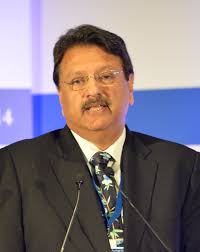
Namaste, Jai Hind, Vande Mataram. In conversation with someone who's not just an industry leader, a very senior voice, but he's also a philanthropist and a thought leader. And I look up to him a lot, and it's a pleasure to be in conversation with him when Bharat is on the cusp of becoming a really big nation as a developed nation, and also a big player in the world. Ajay Piramalji, Namaste, and thank you very, very much for your time again. My first question to you: a nation like Bharat, if it has to rise, should it work harder, or should it work smarter?
The aspirations that we have for Bharat are very high. We want to be the third largest economy in the world by 2030. And therefore, it's not a question of working harder or smarter. I think it's a question of working both harder and smarter. I think we have the potential to do that. We have the youngest population which is there in any country in the world. 65% of our people, as we know, are below the age of 35, and they are all rearing to go. I think this is a and when I see the energy in the youth, and if it is channeled in the right direction, I'm sure that we would be able to do that. And it is both. We have to do both. With technology coming in, how can we become smarter? It's also a fact that today our productivity per capita is much lower than that of any of the advanced countries, or even of the middle, not such advanced countries. And if we have to be there as the third largest economy, we need to do both.
So, how do we do that if I may press you a little bit? You're saying that we need to work harder, we need to work smarter. Productivity per capita has to grow. At a time when the Pradhan Mantri has said 2047 as Viksit Bharat, it's incumbent on every Bharatiya to pitch in. So, how do we do it? Should it be sector-wise, service means or certain industries work smarter, certain industries where manufacturing etc. work harder, longer hours? How does it work?
It first of all means that each one of us, the 1.4 billion today and going up to whatever that number does, we all need to work harder and smarter. One of the things that we also need to do is to carry the whole country with us. There are different parts of the country where productivity is higher, where the per capita income is much lower than others. For instance, I mean the eastern states where we are looking at it, I find that their per capita income is much lower than that of a Maharashtra and Tamil Nadu. So, if we raise all their incomes, I think our per capita will also go up. It also means that we need to focus on certain industries which for some time we'd forgotten. I think manufacturing for one is an area where we can create much more. Today, manufacturing as a proportion of the GDP is just about 15-16%. It used to be 25% just a few decades ago. So, can we bring that up? Which means there'll be more employment, which means there's more technology, that means there's more output per capita.
Do you see the current generation in Bharatiya overall as someone who are entrepreneurial in nature? Do they have the and do we have the appetite for risk?
By and large, I think Indians are by nature entrepreneurial. If you look at it from actually centuries ago, we have been really entrepreneurial and much more I find that entrepreneurship in India than in the rest of the world. As we educate people, as we broaden their horizon, I think they will be more entrepreneurship. I mean, sometimes I find that because and this generation actually has by and large has been more wealthy than what their previous generation was because of how wealth has come. They are more educated than their previous generation and therefore they are willing to take risks. If you look at the number of unicorns that are coming in in India. And these are people in the days when we started work several decades ago, it was that you had to have some capital. Your family had to have some capital to start business. Today I find people from, you know, just with nothing and have created very successful enterprises. So, I believe that we have the entrepreneurship.
What is going to nurture it? What needs to be done to nurture the ability to take risk? Is it a thing of upbringing within families or is it policy, governance, education? How does it?
I think it's a combination of all, but some people come with families who do not have that but if environment outside as we celebrate success of people who have come from very modest backgrounds being successful, that's one thing. The other thing is that availability of capital. If we can give more risk capital to people for young entrepreneurs, I think that is very important. For instance, I'll just tell you the MSMEs in India, there are about six crore MSMEs. These are the registered ones. I think there are several more who are unregistered. Now, almost 40% of these people don't have access to capital. Can we see that they get loans there? Can we see that they have some money which is at a reasonable rate of interest? Can we see that they can get some more capital? Then I think you'll find that there will be many more people who are willing to take risk. Attempts are being made for several of the Atal Innovation and other labs. I think more needs to be done.
My question here is on Prime Minister Narendra Modi. 25 years in governance, 12 years as Prime Minister. What's your impression about PM Modi?
I think let's look at the facts of what has happened in the 12 years that the Prime Minister has taken office. First of all, after several more than three decades, we've had a stable government for this is a third term, which itself is quite an achievement in India. Otherwise, for so many decades, we had every time a coalition government. So, that's one. But, look at it. In the 12 years, we've seen that 400 million people have been moved out of poverty. That is not nowhere else in the world have you seen this. The economy today is the fifth largest, poised to become the third largest in the world. During this period, we've now today the fastest growing large economy. Inflation is under control. And if I see the improvements in the infrastructure, whether it's the roads when he came in, there were only 91,000 km of highways. Today, there are 146,000 km of highways. Airports from 74 have doubled. Everywhere, ports have increased. So, infrastructure has gone up. Look at the way we managed the crisis. If you would recollect, during COVID, everybody was saying that India is now pushed back by several, you know, years. The economy, there will be bodies floating. What happened? Nothing happened. We had the most successful program for vaccination in the world. We could give it not only to India, but to the rest of the world. We had the direct benefit transfer, which was the most successful one. I would say you had the grains which were given. I mean, and the economy actually look at the condition of the banks. They came out stronger. So, we had an economy which really came back. So, that's a big thing. During crisis, again, look at the recent crisis. I mean, you remember once a few months ago when the Iran war broke out, people said, 'What will happen to the economy? There will be diesel shortage. There will be LPG shortage.' At least I don't think people for the first few days all the media brought up, you know, pictures of people carrying cylinders and all, but that's gone. Then look at the whole thing on the Jan Dhan 50 crore new.
Correct. So, these are all policies. So, you've said that there have been policies that set Bharat on the right path and that have come under his leadership. But I want to understand your assessment because you are also six decades into leadership as more than nearly six decades. 2028, I think, you'll complete that, sir, if I can. 2023, yeah. So, you've completed six decades. So, what was your impression when he first came on? And your own assessment of his style of leadership.
I think his style of leadership is one that he is the most grounded politician. He's aware of what's happening on the ground because of the fact that he spent several years in this country going around the country and being in touch. Also, he comes from a very very modest background. So, he knows what it is which the majority of the Indian population goes through and therefore he's sensitive to that. I think and I mean the Prime Minister's observation and his ability to think with the same issue differently and innovation in his own thought process is something that's admirable. Third fact is that his whole memory and his understanding is at least I haven't seen anybody else who has such a memory and such a connect with different people. Also, I think he is fearless. He's willing to take risk. I mean, you've seen what happened. We would never have done an Operation Sindhu or we would never have done a surgical strike for so many years. I mean, we were looking at the abolition of 370 for decades. What happened? He did it. Maoists to catch hold of the Naxalites and eliminate. I mean, these are all big things which require a lot of courage. And he's been able to do that.
No, but when you interact with him from industry, has he been able to understand what your needs are as corporate? And I'm sure when you meet, you go with a certain set of needs and requirements. Do you see him receptive or do you see him already there knowing what? And if you could share any.
Even if the Prime Minister knows, he's still receptive. He will give respect to the other person's view. Whether he may not always agree, but I have seen him to be very attentive because he always respects somebody else's views, which is important for a person as a senior as a Prime Minister of the country. You know, and the thing that he's really done, which is important, I think, for all of us Bharatiya is to get the self-confidence. I mean, when else would you have got this? Today, when I travel abroad and I see this with everybody, there's a respect which an Indian gets, which he or she never got before. These are the things.
10 things or a few things, not 10 things, two or three things which you would like to see Bharat do on a mission mode over the next 10 years.
What I would like Bharat to do in the mission mode is one is that we must. There are lots of people today who are with multi-dimensional poverty. What do I mean by multi-dimensional poverty? I mean that people for generations have had poverty. How do we get them out of poverty? Just as we've done the 400 million, I think in 10 years we should see that all of these people get out of multi-dimensional poverty. That means people who are in the aspirational districts, which again the Prime Minister highlighted, and the tribal districts, and so many of the other districts which are suffering. How do we get that? That's one. Similarly, on the thing, I believe that we need to do much more on education. If you want a really good, strong India, education, and when we see today a fifth-standard child, by and large, on an average, can only do reading of a second standard. So, how do we bring our school learning levels up to a standard? I'm not even saying best in class, but up to at least an average global standard. So, whether it's health, whether it's education, these are some of the things. And then thirdly, I would really like that how Indian industry is encouraged and actually does it themselves to make global brands. Today, we are a large economy but we still don't have any really reputable global brand. So, I think these are some of the things that I would say.
Yeah, so if you're building brand Bharat, build brands from Bharat also. So, that is a fantastic vision along with, of course, social welfare or alleviating humanity in Bharat. Now, coming to social welfare, are you a votary of social welfare, social benefits by the government? And where do you draw the line between revdies or freebies and welfare?