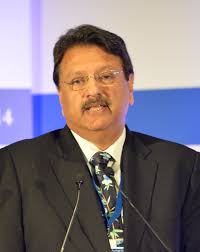
They say the greatest stories are written not in what is built but what it has transformed, and few stories reflect such profound depth as the one that we have for you today. Ajay Piramal.
In the 1970s, a young man was thrust into leadership far earlier than planned. Faced with the untimely death of his father and brother and the family business in flux. From those defining years emerged not just resilience but the ability to see opportunity where others saw uncertainty. That instinct would soon take shape. First with the acquisition of Gujarat Glass, then Nicholas Laboratories, transforming it into Nicholas Piramal and from there there was no turning back. Over the years he would go on to orchestrate more than 100 deals across glass, manufacturing, pharmaceuticals and financial services, earning him the reputation of the Warren Buffett of India. Today in his 70s, Ajay Piramal continues to build not just enterprises but ecosystems of impact with a grounded dharma of doing well by doing good. Let's dive right into this conversation and hear from the man himself, Ajay Piramal.
Thank you very much, Mr. Ajay Piramal, for joining us on this episode of Future.
Let's dive straight into this conversation with the first question that I have. Piramal Foundation has become a powerful pillar of the group's purpose-driven vision. How exactly do you envision the foundation's role evolving in the context of India's social transformation journey?
If you look at India's social transformation journey today, we have become the fourth largest economy in the world in terms of GDP and the way we are growing, I think, and that's what all the estimates show that by 2030 we should be the third largest economy in this part. But what is unfortunate is that there are some parts of the country and some people who have not prospered as much as the others have. Yes, we've in the last 10 years have lifted 400 million people out of poverty, but still there are some people who are left behind. And my concern is that the gap between the people who are the haves and the have-nots is only increasing. So look at India. If I was to separate out the eastern part of India and look at the per capita income of people in the east and that in the rest of India, the difference today is 2.2 times. The per capita income is higher in the rest of India compared to the east India, and this was 10 years ago this difference was only 1.6 times. So as we are progressing, as we're getting more and more technology and people are becoming better in terms of education and skills, some parts of India are being left behind and that's where we as a foundation want to play a role so that these people, which is the eastern states of Jharkhand, Assam, Chhattisgarh, Odisha, Bihar, how can we lift these people who have got multi-dimensional poverty out of that in the next few years and that's what the foundation is doing with an alliance.
That's actually quite powerful. The force having a global alliance to actually lift the socially backward states and the financially backward states out of poverty and bring them to a level playing field in the entire country is a beautiful aspiration. To zoom into that aspiration, India also aspires to become a $10 trillion economy with equitable access to education and healthcare. Well, that remains a foundational challenge when we say that we want to become that economy. How is Piramal Foundation leveraging all agents of transformation, whether it's technology, policy partnerships, or community networks, to drive impact across these sectors?
To drive the impact, I think we have to recognize that actually in the field of all the social functions that are there, like education, health, whether it is sanitation, water and all, the government is spending a lot of money and the funds are only increasing every year by 12, 13 percent. Almost if I look at it in terms of $500 billion is the budget which the government has on social schemes and increasing significantly, but still we are finding that there are gaps and I think it's because we have to work to see that how we can also work with government to see how we can make the systems more effective. And that's what our foundation has been doing, is to see how to improve the systems. And this is the alliance that we have. This alliance is with government, it's with the social, with other NGOs, it is with other philanthropists, it is with others, global philanthropists also, with areas where people who have expertise in this. So this is what we want to do so that we can make a transformation. And we've seen this work in the past. I can say that we started this foundation in 2008 and we started first trying to look at how we can change some things in the education system in Rajasthan. So working with government in government schools, I'm happy to say that when the last national assessment survey of education was done, Rajasthan came out as the second most improved state in terms of school learning levels. And you know, earlier you used to say that it is like in the Bimaru category, but it's no longer that. Similarly, I think we were working in aspirational districts and those are, as you know, the most districts which have been the least developed and that's where we worked. And during that period, again, there was an assessment which was done independently by government, by NITI Aayog, and the districts that we worked in in terms of education and school learning levels, they had out of the top five, four were our districts. Even in health, out of the top 10 districts, three of them were ours. So it is possible to do that. We've been able to demonstrate and this is actually working with government. So it's not substituting government, that what many people think. I think working with it, we have been able to do that.
I couldn't agree more. It is the power of partnership that leads us to deliver the kind of impact that you've just outlined in your articulation to that question. Let's now shift gears on the conversation and talk about how conglomerates like Piramal Group were built in a different era. It was a different India with a growth story. What do legacy institutions actually need to do differently today to stay relevant in a digital, decentralized, and deglobalizing economic order?
My belief is that for any group in today's changing environment to remain relevant, one is that we have to first understand what the change is and be in touch with the environment to understand what the change is. And today it's rapidly changing. What you're seeing in terms of AI, in terms of deep tech, I mean there's a daily change. So that's what we are also incorporating into our businesses. If you see, whether it is financial services, whether it is pharma, whether it is real estate or any other business, we ensure that we are trying to be as up-to-date as possible because every day there's a change and that is also become much more digitally savvy. Also, I think we have to look at seeing how we can get our talent, give them much more opportunities to grow and act, make some mistakes as well. Though I feel that frankly, certain things will still remain good and positive as they were even before. One is that we are fortunately in this country we have a very positive growth environment. Today it is the fastest growing large economy and I think it has continued for some time. The demographics are in our favor. The fact that everything today is actually aligned that a country like India will go ahead. So that will continue. I also feel that when everything changes, but certain values should remain and would remain the same, and I think that will be the cornerstone of our progress.
Quite beautifully laid out, I must say, and I concur that things at home here in India are working towards that rise that we are pushing towards. And India's economic rise is actually happening at a time that is intensifying in the global order. If you see, there are trade wars, there's protectionism, especially with US-China dynamics, policies like Trump tariffs. How does this shape your thinking on possible global supply chain resilience, strategic alliances across the globe, or even market diversification?
So we are again in a very fortunate position because we have a large domestic market. We are the fourth largest consumption market and I think we have to focus also on our own domestic market. Today exports are not as significant to us in terms of GDP. They are in single-digit part of the GDP. So in that sense we have some strength in it. It also means that I think we have to raise a level. I believe that in manufacturing we got left behind. I think this is one area that we have to focus on. You know, at one time India used to have 25% of our GDP was manufacturing output. Today it is 13% and it's going down. But all the initiatives they are taking, whether it's a PLI, whether it's the focus on semiconductors, you look at batteries, you look at the whole digital infrastructure that we have, I think these are advantages that we'll have to build upon even more. I also feel one other area which I think in the global we can have strength is in terms of agriculture. There are many countries which will need more and more of agriculture imports, and India with our huge number of, you know, the huge area under cultivation, if we improve the productivity, our costs are much lower and we can actually make a difference in that as well. It's also important when you look at it, manufacturing and agriculture important even to see that we get people employed gainfully. We will be getting about 5 million every year people into the work system and if we don't give them adequate jobs, there'll be a problem. So it's a combination of the latest technology, whether it's aerospace, whether it is EV, whether it is semiconductors on one side, but it is also that if we do manufacturing and agriculture focus, I think we should be better.