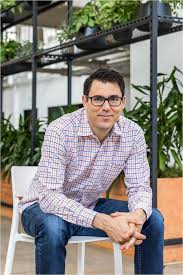
Yeah, it's me again. So, obviously building a software company is hard, but building cars, building factories, supply chains, and an entirely new automotive company is — I'm guessing, I haven't done this myself, but I'm guessing it's much harder. Rivian founder and CEO R.J. Scaringe has spent more than a decade doing exactly that, through enormous expectations, brutal manufacturing challenges, and some very public ups and downs. So, please welcome R.J. Scaringe and TechCrunch's Kirsten Korosec.
Yeah. You were here four years ago, and in that time you've launched a micromobility startup called Also, which you were working on in secret, and then a robotics startup called Mind Robotics that you were also working on in secret. So, what secret project are you working on now?
Oh boy. Right before we walked in, I said, 'So, what are you going to try to get me to say that I'm not supposed to say today?' So, we really started directly here. You know, ultimately there's lots of things we're working on within the business that we haven't shown yet. So, we've just launched it within Rivian. We launched R2. Super excited about the vehicle. There's a bunch of products that come behind that, both on the technology side and then the vehicle side. You know, within Mind, it's incredibly exciting what's happening in robotics and what we're capable of doing today when we think about the progress that's happened on hardware modeling techniques, bringing that together to develop robotics that can actually be deployed at scale. And so we haven't shown any of that yet. That would have been cool to show it today, but soon. And then, as you said, within Also, we've got a bunch of products really around, think of it as small form factor autonomy, that we're quite excited about.
But so what you're saying is you're not working yet. Are you saying that you're not working on another secret project?
No. No additional companies. Just those three.
Okay. You're done for a while.
One of the things that you have talked about a lot is that R2 is like the big project right now, the launch of it, and there's actually demo rides happening outside of here, so you should all take one. You've said in the past that it is an existential product for the company. Really, that what happens with R2 will really be the difference of Rivian really truly scaling.
And I'm wondering, are you encountering different problems with the scale-up of R2 versus R1? Very different era of the company.
Yeah. So R1 was a flagship product we launched, driven with, and you know, this was — we launched the car late 2021. We made a lot of the sourcing decisions and overall production plans for it starting in like the 2018-2019 timeframe, and so the level of maturity within Rivian was much lower. There were a lot of things we didn't even yet know that we needed to know, and we didn't expect COVID to, of course, happen, and then the huge, you know, operational implications of that. So it was just a — there's a lot of challenges associated with that launch. Fast forward to R2, the company is so much more mature. We've really built a lot of process around launching complex projects, managing, you know, supply chains where you have hundreds of suppliers across multiple tiers. And so there were a lot fewer surprises, but there's always, you know, in something like a car where you have, you know, tens of thousands of, you know, discrete components coming together into a single product. If any single one of those is late, you know, that can delay the program, that can delay ramp-up. And so there's always challenges of ramping supply chains, but it's so much more controlled and the organization is so much more mature.
So is there anything right now that you are navigating that is particularly difficult, that is just — you maybe hadn't anticipated? To your point, you know, there's always something that comes up.
I think the biggest challenge for us by far is around supply chain just in general. And I think for anybody here that's building hardware, you can connect to this. The supply chain environment is just not particularly stable. We've got very dynamic geopolitics that are playing out. We have cost structures that have gone up dramatically around the physical world, largely driven by the demand for a lot of those same resources for building data centers. And so if you're building manufacturing plants, there's constraints on resources. And so this is just — this is sort of the nature of building physical products today. I think any company that's doing it is going to encounter these types of challenges. And so we knew that; it's not as if that's a surprise coming into it. We've built a robust organization to handle, you know, supply chains that are more difficult, more dynamic tariff environments, and operating environments that I think are probably the most complex they've been in a long time.
Yeah. It's funny. It's a bit of déjà vu, but a little bit different because there were supply chain problems with COVID. This time around, one of the big issues is around memory chips, and I'm wondering how you're navigating that right now.
I mean, I think everyone who has products that have, you know, any sort of electronics is dealing with this, but there are really two ways. One is you fight like, you know, very, very hard to get the amount of memory in every product down. So minimize the amount of memory required, and that's a tactical exercise. And then the other is building lots of potential supply paths. So multiple different suppliers providing memory, and then at the end you're paying more. So, you know, in the case of a vehicle that has a lot of capability, you know, you're adding many hundreds of dollars in costs with the price of memory going up so much. And that was not something 12 months ago, 18 months ago, you would have predicted.
One of the things though that I've seen with Rivian that's interesting is that you seem to be getting more and more vertically integrated. And I'm wondering if that's one of your strategies here, because you're even going to build the silicon for future products.
Yeah. Yeah. Yeah. I often joke — I think for a lot of entrepreneurs that probably fall into this category — if you had infinite time, infinite resources, we wouldn't have any suppliers. We'd build everything. Our supply chain would be buying, you know, buying earth, buying pieces of land that you then process materials from. And so, of course, we're not buying land and making our own steel or making our own aluminum or making our own copper. So we buy materials from upstream suppliers. So we, you know, we leverage existing supply chains for raw materials, but there are some areas where we do go pretty deep. And so, as you said, silicon is a really key one. In the case of our vehicles, we're really focused on delivering a much higher level of capability for self-driving. And so, later this year, we launch a point-to-point capability where you can type the address into the car, it completely drives itself to its destination. Through the next two years, we're working towards a level four capability where the vehicle can drive itself empty. So that's, you know, critical for robotaxi applications. Imagine a vehicle that could drop your kids at school or, you know, drop you at the airport and drive home. And when you look at the cost to deliver that outside of the development cost, a big driver is the cost of compute, the cost of inference. And so we took the decision — this was now, I guess, four years ago — we took the decision to vertically integrate our in-house inference platform. And you know, it's many hundreds of millions of dollars to do a program like this, but ultimately at the end you have a structural cost advantage where you've taken the inference cost in the vehicle down by, you know, many hundreds of dollars. And so that's an example where we invested a tremendous amount of money to then ultimately deliver this cost advantage later on. But that's true on, you know, motors, gearboxes, power electronics, all the electronics in the vehicle. All the software in the vehicle we do, you know, completely ourselves.
Well, and now robots. So, Mind Robotics, this is a company that you launched in November of last year. You've raised more than a billion dollars, I think, so far. So, good for you on that. I'm sure a lot of founders would love to hear how you did that. But specifically, Mind Robotics, the approach is industrial automation. You plan on making Rivian the first customer. So, how exactly are you doing that? And are you dividing your time between Mind Robotics and running Rivian right now?
Well, I think there's so many things to be excited about from a technology point of view that are happening. We're witnessing multiple inflection points, and we've seen a number of those start to take off. So, with electric vehicles, we're seeing that get to an inflection point where over the next decade we're going to see a really big transformation of the vehicle fleet that's on the road today. We of course have seen that with LLMs in the way we do our work, the way we run our businesses, the way we think about decisions in our own personal lives. And another really big inflection point, which I believe is going to have perhaps the most profound impact on how our society operates, is the role of robotics. And you know, we've been dreaming about robotics, you know, that are capable of doing human-like tasks or human skills for as long as we've told stories. So this has been topics in science fiction for, you know, a hundred years. It's been in movies for, you know, 50 years, and there's many different versions of how robotics play into society. And even today we still reference movies, we reference books when we talk about robotics. What's remarkable is that in just a few years, in the next five to ten years, we'll stop referencing movies and we'll be referencing what happened. We'll be referencing what plays out over the next five to ten years. And so with Mind, the objective was really to think very hard about how do we, as we go through this transition, develop robotics that are capable of doing highly dexterous tasks, capable of human-like reasoning, but develop those robotics so they can be incredibly helpful for humanity. And our focus is on the industrial side of the opportunity. So really thinking about robots that can do manipulation for assembly of objects. That could be anything from a car all the way down to a shoe, and, you know, everything in between. So it's, you know, consumer electronics, that's a dishwasher, that's, you know, that could be furniture. And so there's this enormous opportunity to really rethink our industrial supply chains in the context of robotics that are capable of doing these types of things. And so realizing how big of an opportunity this is — and just to put this to scale, about a third of the world's GDP is industrial labor. And so this is an enormous need. This is particularly profound in developed markets where cost of labor is quite high. So in places like the United States, as we think about bringing different types of manufacturing back into the United States. And so realizing how big of an idea this was, as you said, last year I decided to start another company to focus on this, and we're having an absolute blast. We've built an incredible team. Just announcing today, we brought on Doug Field to really, for me, to partner with in building this organization. I've known Doug for years. I'm really excited about him joining to help build and drive the business. And to your question of like, how am I splitting my time — there's seven days in the week and it gets split, I'd say, you know, sometimes 50/50, sometimes, you know, a little more, a little less. But, you know, it's not like we're only splitting 40 hours. There's a lot of hours in a week to do a lot of things.
Yeah. We've had this conversation before where you were like, well, I take the plane here and then I go to this factory and then I work, and now you've since then added multiple other startups. So, is it fair to say that Doug is going to be sort of more steering the ship? And for those who don't know, this is former Tesla, former Ford, really reshaped their EV strategy, worked on or led the special car project — not-so-secret project — over at Apple. Is he going to be the one really directing Mind?
Well, you know, that's a great question, and I've known Doug for years. And there's people you meet, and I feel like this is, again, something any builder goes through, is you meet someone and you say, 'Boy, I would love to work with that person someday.' And so for years I've often said, 'Boy, I'd love to, you know, work with somebody like Doug.' And as I was thinking about building Mind, as Mind grows, the type of person that I would ideally have as a partner in building the business, I would describe it as I'm looking for someone a lot like Doug Field. And so ultimately, I called Doug and I said, 'Hey Doug, I'm looking for someone like you.' And it was, you know, sort of fun, started the conversation. And him and I then really began digging into how important it is that we really think deeply and very intentionally about how we develop robotics and deploy robotics into our society, into our economy. And we found such alignment in how we thought about this from the overall mission of the business. But even more important, we found really deep alignment just in how we both work and how we build teams. And so I was sort of on this journey of looking for someone like Doug Field and found Doug Field, and so it worked out really well. And he's someone I've, again, as I said, I've wanted to work with for years. So this is — I couldn't be more excited.
Did you call him? I mean, Mind came kind of out of stealth in November of last year. So were you — was he your first call back in November?
When I first set up Mind, the way I structured it is I think every, you know, startup benefits from being very flat in the beginning and not having traditional titles and not having — sort of accepting that the org chart is going to be wildly fluid. And I've said this many times in building Mind, I experienced this with Rivian, experienced this with Also. And so by design, Mind started as a very flat organization, stayed very flat. The company — a few months ago we surpassed 100 people. And so as you start to get to that level of size, you actually need to start designing what the organization looks like. And advice I give all the time, including to myself, is don't get fixated on an org chart. Recognize that, you know, the way the org looks at 150 people is going to be different at 300, it'll change again at a thousand. And so as I was thinking about that, I was also thinking, you know, who is a leader that I can work with and work alongside as we continue to iterate on what the right time-appropriate org chart looks like. And so, you know, my first thought was someone like Doug, and here we are.