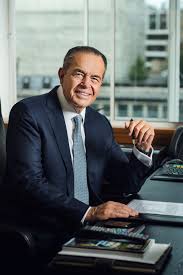
Next up, building a global soccer pyramid, moderated by Sportico's deputy editor, Eben Novy Williams.
All right, good morning everybody. Sir Mohamed, that video is inspiring. I'm ready to sign up if you'll have me at one of the academies. Excited to be on stage with a man who needs no introduction. And Sir Mohamed, I was thinking last night, I've been on stage with a lot of sports team owners. Most of them have a similar story. They were on the outside looking in. They had access to capital. They came to the conclusion that sports was an asset class they wanted to be in and they bought something. You have a very different story and your entry point to soccer looks a little bit different. For folks who don't know, walk us through what got you into soccer in the first place.
Well, to start with, when I was 10 years old, I used to love soccer. My uncle, his name was Mustafa Kamel Mansour, he was a goalkeeper for Egypt and he played in the first World Cup in 1934. And he was my mentor. And when I was 10 years old, I had a car accident in which I was bedridden for about 3 years. I couldn't move. That was 1958. I was 10 years old. For 3 years, you know, I was a sportsman. Me and my brothers very much believed in soccer, football. We were good footballers, but then I was deprived of this. So, this was something I loved all my life, but I was deprived of it. And when the opportunity came to invest, and my son is here, I'm very proud of him. He was a striker for his school. And one of the differences he and I had, once in a lifetime, was when he played here in the European Cup, he was asked to be drafted by one of the teams. He said, 'Dad,' he was 16, 'can I go?' I said, 'No way. You're going to go in business.' And he was a little bit upset for many years. But now we own teams, and this is where our dream has come true. And that's why it's called Right to Dream.
And so, the academy system starts largely as a way to give an opportunity to young soccer players. And then over time, correct me if I'm wrong, that builds into a profitable business by itself because of the economics of selling players, correct?
Correct. So, we acquired Right to Dream back in 2021. This was an academy, for those that don't know, started in sub-Saharan Africa. And it started in 1999. And where it was different, it gave a full scholarship, Eben, to kids to learn education as well as learn sports. And it started in Ghana. Fast forward, today we have 200 professional footballers that are graduates of Right to Dream. We have 12 that have played in the last World Cup. And we're very proud of Right to Dream. And we have, you know, when we bought it, it was like an NGO. We were reinvesting back to teach kids education as well, give them a full scholarship basis, whereby they live and are boarded in school. And when they go out for tryouts, we try out 100,000 kids around the communities or the countries that we operate in, which we choose a class of 100. So, if you compare that, for example, to the percentage of chosen versus the ones that are selected, you can see that these are going to be future leaders in the world. And fast forward, like I said, it was an NGO, non-for-profit. And when we bought it in 2021, there was one football club in Denmark and two academies, one in Ghana, sub-Saharan, and one in Scandinavia, in Denmark. Now, I'm originally from Egypt. I'm a UK citizen, but originally from Egypt. So, when we bought Right to Dream, I said, 'How about Egypt? Why don't you go look there?' They said, 'Mr. Mansour, it's not on our radar screen.' I said, 'But Mo Salah's from Egypt.' So, they went there. They looked. We started an academy in Egypt. We built a team in Egypt. Then the opportunity came for the United States whereby we also started an academy and a team, San Diego Football Club. We have the 30th license of the MLS.
I think of your sports portfolio as kind of like a pyramid that you built from the bottom up, right? The Right to Dream is the bottom thick base and then you have, as you said, the Danish and the Egyptian teams kind of in the middle and then more recently the biggest soccer investment you've made, the MLS team, kind of sits on top of it.
I like the word pyramid because being originally from Egypt, we're always looking at, you know, heritage 7,000 years ago. Our investment strategy and ethos is long-term. What we develop is to have clubs that operate separately in every network that they're in, but they operate with the same style of play. So, if you see kids or teams playing in Denmark, it's the same style of play that they play in Egypt. It's the same style of play that they're playing in San Diego.
And what is that style for folks who are...
It's exciting. It's fast. I want to equate it. It's a very exciting style of play with a lot of passing. We control the game, say 60-65%. First year when we got the license for San Diego Football Club and we started, all the pundits were saying we're going to be number 30. We won the Western Conference that year. We didn't make the final game with Inter Miami with Messi. But it was really, we were, you know, the fan base. San Diego's a lovely city. The fan base, the support we had there just gave us all the confidence that we had made the right decision.
So, I'm curious if you have a... Let's say you have a generational talent coming up through Right to Dream. And there's clubs all over the world that are interested in this star striker. How do you decide whether you sell that player to a big club? Do you keep them in your network, right? Maybe have them play in Denmark or maybe have them play in San Diego. How do you do the calculus of what to do with the talent that comes up at the bottom of the pyramid?
This is where a lot of arguments and discussions are happening between the management of the clubs as well as between the ownership. But I can tell you, when we bought, and talking about business, when we acquired Right to Dream back in 2021, 5 years ago, it's an NGO, non-for-profit. We're going to reinvest everything we make back in the business. But I was thinking it was going to cost a couple of million every year just to support that idea, which I loved because it gives kids opportunities. I mean, talent is everywhere but opportunity is not. So, we wanted to give those kids either an education ability or a sports ability. And then we sold Mohammed Kudus. And then we sold other players and on the average in the last 4 years we've sold players for 200 million euros, which puts Right to Dream in the top 10 clubs around the world that have managed to nurture and improve players. So to answer your question, it's a difficult decision. For example, in San Diego we had an amazing young talent, a left back called Luca Bombino, and he was scouted and then the discussion was do we let him go and eventually he wanted to go and he's in Stoke City here in Europe today. But our dream, and Right to Dream, our dream is to have homegrown players from the United States, from Scandinavia, that will be world-class stars. And that's what we're hoping that Right to Dream will accomplish.
These are good problems to have, obviously, to have players who are in demand.
So I know you're a Man United fan, but I also imagine that you follow global football for specific players, ones who have come through your academy. I imagine you're watching a lot of players that you watched when they were much younger succeeding on fields all over the world.
Yes. So of course, I mean sports, like I say, we watch most games wherever we are and I believe that, you know, it's going to be a key to have stars coming out of our academy. And I believe, like we had a kid called Caleb. He played in the World Cup, Right to Dream graduate, age of 19 from sub-Saharan Africa. The opportunity was created. He went to Denmark. He won the best young player. And then he played in the World Cup, then Coventry acquired him a few months ago. And he's playing now in the team and he joined Right to Dream at the age of nine. And what's different about Right to Dream is to build character, to build those kids. Young boys and girls, by the way. Right to Dream is not only boys. We have girl graduates, like in Egypt, for example. Eben, when we started our Egyptian team, it has won the Premier League for women and was playing in the Africa Champions League and came third. First time ever for Egypt. So, Denmark, the same. They've won the Premier League there, the women's team. So, we're building future generations to come of kids that make us proud.
In the US, women's soccer has gone through a financial revolution, basically, in the last 5 years. I get the sense that in Europe and in Africa, I imagine it's a little bit further behind, but what is your expectation in the near-term future of women's football in those two continents?
It's going to grow, for sure. I mean, we have a young girl... Right to Dream has this academy tournament called Gothia. That's where all the academies in the world go there and Right to Dream has won the Gothia Club Cup seven times in a row. This year, we had a girl from Africa that played in the boys' team as a striker.
And I think she has a fantastic future, as girls, and I believe girl soccer is going to grow in different parts of the world, like it has grown in the United States.
I want to shift to the United States. I want to talk about what you guys are building in San Diego. Your group paid $500 million, the largest fee at the time ever to join Major League Soccer. You told me a few times, I'll quote you, you believe in America. What do you mean by that and what was the thesis behind putting at the top of the pyramid an American club?
Well, you know, I believe in American athleticism, for sure. It's a country with 360 million people. I believe most private equity firms or family businesses or family offices buy into clubs in Europe. We've done it the other way around because, like I said, I believe we're at the tip of the iceberg. I believe soccer is going to grow in America naturally because of the demographics, and we were very fortunate to be in San Diego. A city really that welcomed us when my son and I and members of Man Capital went there to cut the ribbon 3 years ago when we were announced, there were people there just rooting for us, and it was an amazing feeling. When I walk in the city, they come and hug me. It's a city that loves sports. People are very proud of it. And we're very honored and proud to be caretakers for the city and the fans of San Diego. And our thinking, Eben, is long-term. And we're there to make it grow. And, you know, as a startup, of course, you learn along the way, and my life has been building organizations and building, whether it be in business or whatever, and sports is not any different.
Did you look at other cities? San Diego obviously has a large Hispanic community. It lends itself well to soccer. There's a lot of American cities that don't have MLS teams. I'm curious if San Diego was the goal all along or if you bounced around at some other opportunity.