Egypt is in my blood. It's not the first time I've heard you say it. I mean, Egypt isn't just the Four Seasons and the Shereen. I worked in trade, industry, and the private sector.
Honestly, I had a beautiful childhood until 1958. I had an accident. The first hit was a Banksy hit. All my father's property was taken. I spent six months without money. I barely had any money to eat. I learned something in those four years of service at the cat. Opportunities are terrifying. The Mansour Group today has about 60,000 people. Character building and education are amazing, amazing. It builds their personalities and teaches them, in addition to the sports aspect. There were days when I used to go at 5 or 6 in the afternoon, not knowing what would happen tomorrow. We always come back to Egypt. Exactly, it's my country. But what's the one thing you want people to remember the name Mohamed Mansour by?
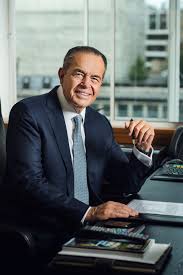
Today I have with me one of the most important businessmen in the history of Egypt. He created an empire in the field of business, not only at the level of Egypt but also at the global level. He did not only succeed in the private sector but also in the public sector and also in the field of charitable work. He was honored by many countries, most recently by the King of Britain, and he received the title of Sir. I am really very happy to be sitting with him today because we all need to listen to and learn from him. Sir Mohamed Mansour, how are you, Dina? How are you doing? Thank God, everything is fine? Everything is great, you're brightening my day, may God bless you. The light is yours, thank you so much. Thank you, ma'am. Now, I always tell them I like to start a podcast by talking about a person's childhood because I feel that this is what shapes a big part of their personality. So, could you tell me a little about your childhood, what you remember from it, your relationship with your mother and father, what you learned from them? Was it a happy childhood? Was it difficult?
Actually, God blessed me that my father and mother, may God have mercy on them, were very kind people, and they were the kind of family anyone would wish for in the world. My father was a man who started his life well and was successful. He was one of the big cotton exporters in Egypt in the fifties, and he had a company called Lotfy Mansour for Cotton Trading and his sons. My mother, may God have mercy on her, was a woman whose life revolved around her children. Her name was Nazli, and my father, may God have mercy on him, was named Lotfy Mansour. I was born in Sharqia, but we moved to Alexandria around 1952 when my father started working in exporting the line from Alexandria, and I graduated from a school called Victoria College in Alexandria. It was one of the most important schools in the Middle East. Kings, princes, and very successful people graduated from it, including, for example, King Hussein, may God have mercy on him. So, my childhood was truly a very beautiful childhood. We lived in an area in Alexandria called San Stefano. I remember every day, my siblings, my cousins, and I would go there in the summer. There was a cinema in San Stefano, and it was a very beautiful cinema. It was a beautiful childhood. In fact, the area of Alexandria was almost called the Pearl of the Middle East. So, it was truly a beautiful childhood until 1958 when I had an accident, a car accident. It was a very serious accident. I was about 10 years old when a car hit me, and I stayed in bed for three years, from 1958 to 1961, unable to move out of bed. You're a child, you want to move and run, but no, I was in Victoria at the time. I used to play football, I'd play football and run around, and I'd win prizes and stuff. So, I mean, I was taking it away from the things I love, which are football and playing. Or maybe it was my first setback in life, but the truth is, that setback probably shaped my personality and started to form what they call a resilient personality. I mean, I don't have that 'I'm impossible' mentality as long as I'm challenged. Throughout my life, I've been a person who tries to improve myself. So, what did I do for those three years? I would read, sit and read, and think, and stuff like that. Then I reached 14 or 15 years old, which was 1963. I went to America, and at that time, President Gamal Abdel Nasser was the president of Egypt. I got a visa, a leave of absence visa, because I had a leg injury and I was having surgery. Then I enrolled at the University of North Carolina. And during that period, the truth is, it was also another part of my life's formation. But I'm going back to my childhood and I want to talk a little about my family. My father, may God have mercy on him, was a very good man. He instilled in us the importance of loyalty to our country and to people, and the value of trying to help them. I always remember every Friday, some simple people would come to our house, and he would go down and meet them, doing whatever he could to help. My mother, may God have mercy on her, was a wonderful woman, the true ideal mother. We were four siblings: Ismail, may God have mercy on him, Youssef, and me. Then Rawya and Yassin came along. We were truly a complete family, a family full of love. This, of course, nurtured my understanding of the importance of family structure. You felt the pressure of being the eldest of your siblings. I'm the third, yes, but they used to call me the 'little big brother.' You know, I always felt like I was the oldest. Yes, Ismail was the oldest, may God have mercy on him. He was four years older than me, then Youssef by three years, and then me—three years after Youssef. Rawya was six years old, and Yassin was twelve years younger. That was my life in Alexandria. Then, the second phase of my life began in America. Traveling abroad wasn't considered normal in Egypt back then; it was a very progressive idea to study abroad. My father, may God have mercy on him, was one of the first Egyptians to graduate from Cambridge University in England in the 1930s. He was a visionary man, always with a long-term perspective. He believed that education would change and that America could improve. He had a friend, a congressman named Harold Cooley, who was chairman of the Agricultural Committee in America. He suggested we go to the University of North Carolina because, as you may recall, we were in the cotton trade and owned cotton gins. Harold Cooley believed that Youssef was the first student to enroll at the university there. Carolina State, and then Ismail went to University in North Carolina, also in Chapel Hill, and I joined them after that, about six months later. So that was the real beginning of a second part of life. I mean, in this second part, suddenly things got a little messed up. Nationalization happened, and the family lost a very large part of its wealth.
How did you experience this period in America?
When I arrived in America, I mean, I arrived in America in November 1963. President Kennedy had passed away a week earlier, also in November 1963. Then I enrolled in university in January 1964. At that time, my father used to send us about $200 every month. Then, at the end of 1964, we were placed under sequestration—not insurance, but rather a form of guardianship. This meant that all of my father's assets were confiscated. He was a very patriotic man, and in truth, he didn't have a single penny abroad. So, one day, he sent us a letter saying, 'I can no longer help you or pay for your education.' So, I was forced to work at a restaurant called Amadeus Ferrali. I worked at this pizza restaurant to pay off some of the debts that had started piling up after my monthly salary stopped. I needed to pay the rent, gas, and other expenses. And in truth, our debt at that time... I mean, I spent six months... I didn't have much money, I barely had enough to eat. So, any penny I earned, even when I was at the restaurant, I'd use to pay off some of my debts. It was a tough time, but it was also one of the periods that shaped my character. I learned the value of work and struggle, and that you should never say, 'I can't do it.' That was always my motivation. Paying off my debts was the most important thing for me, especially for my university studies. I actually joined university when I was 15, very young. Whenever someone told me, 'My son or daughter is very smart, they're going to get in,' and wanted to skip a year, I'd tell them, 'Don't you dare!' Because when I entered university, I was 15, so my mind wasn't very mature. I didn't really study much. So, until around 1966, my grades at university... I was doing well and they were almost going to expel me from university until I went to a physics professor. I pretended to be something I was doing, and I told him, 'If I fail physics, I'll have to be expelled, and my life will be ruined.' He said, 'Look, son, I'll give you a chance. I'll give you an incomplete grade, and that means you'll have to come and sit in the class, in the first class, in the first row. And then, if you don't come one day, I'll give you an F.' So what happened was that this was a turning point in my life. My grades started to improve after that, and then I finished university and returned to Egypt.
And something I find extremely interesting is that in your case, especially, you went to the best different places. I worked in trade and industry and in the private sector, and you actually created an empire, not just in Egypt, but in many different countries, a global one. And then... So you entered the public sector as Minister of Transport. What made you make this move? You're a very successful businessman, what would make you make this move to the public sector?
I was in Paris when I got a call from Dr. Ahmed Nazif. I didn't know him, actually. They told me he said he wanted to see me, so I went to his office. He said, 'We want you, Mohamed, as Minister of Housing.' I told him, 'Dr. Ahmed, I don't know anything about housing at all.' He said, 'Okay, and then what?' Honestly, at that time, it was difficult to refuse, but I told him, 'I only get involved in something I want to succeed in and be worthwhile.' Then they told me, 'Okay, then Minister of Transport.' I accepted because I'm a car guy, you know, so I was only interested in cars. I didn't know that the Ministry of Transport is one of the most difficult ministries in Egypt. It includes the railway sector, the river transport sector, roads and bridges, and ports. It's not just about cars, it's not just about cars. I was a pure Arab, and there were about 280,000 employees. I served for four years, and I did it for that reason: firstly, because of my love for my country. And I said, it was a way of giving back, that I could contribute something. So I did everything I could during those four years, from December 28, 2005, until I resigned on October 27, 2009. So I served for about four years. The reason for my resignation was an accident in Al-Ayyat, a train accident. I felt that I had given everything I could to my country, so I went to Dr. Ahmed Nazif and told him, 'Please inform President Mubarak that I am submitting my resignation so that I can start following up on my work.' I feel I learned something during those four years of service. Of course, I saw Egypt, I saw Egypt, I saw Egypt from within. Of course, I saw the villages, I saw the valleys, I saw all the countries, and I knew... I always used to tell my friends, 'You don't know Egypt.' It's not the Four Seasons and the Charterhouse, it's Cairo and the Gezira Club. On the contrary, this isn't Egypt at all. I mean, this was a period for me, a period I valued. I learned, I got to know my country, I got to know it from the inside out, I loved it even more when I saw the nature of the Egyptians. And it was a really important period in my life. After that, when I resigned, I decided that I, as they say, always like challenges, something new. So I traveled to England and got what they call a Family Office Man Capital. Capital Man Capital, for example, bring a third one, something completely different. Because I was thinking, 'Am I going back now?' I was like, 'How many cars did we sell today?' or 'How many Caterpillar machines?' or something. So I said, 'I want to think about new things.' And by chance, I was preparing for a very intense show. It was 2005. I mean, thank God my memory is good. Before I joined the ministry, I can barely remember my birthday. I'm not going to give you the exact dates, Dina, but what happened was that I started getting into technology. I went to Silicon Valley and found incredible opportunities. Then I felt the difference between the development of America and Europe, so I said I had to have a presence here. So I opened what's called a Venture Capital Firm in San Francisco, called 1984, which helps entrepreneurs who start startups all over the world, especially in the technology sector, specifically in the startup field. We also entered the education sector with a company called Inspired, which is considered one of the largest global companies in the education sector today, like English Speak English International Schools. We also entered the logistics sector; we bought a company in Long Beach, California. If anyone wants to export anything, what's called a full container load, this company is the market leader in the logistics sector. We started this family office back in 2009. Why shouldn't one bring in people? Banks operate and manage people's investments, but at the same time, why shouldn't one choose the members they want to employ, diversifying them a bit from different countries and different backgrounds? So, this was a very important aspect. Man Capital started in London, and thank God, we've established the biggest family office in England.
Today, what about the three things we discussed: operations, business, and the public sector, and Man Capital? Which one did you do best? What role did you play that I loved the most?
Honestly, I don't know what to do. When I enter a field, that's where I invest, that's where I give my all, and that's where I give my love and the group I build. I always try to surround myself with people smarter than me. Yes, that's very important. It's not that I know everything, but that no one can say 'Amen.' Lee Amin, and you'll find that most—I mean, not most, but some administrators in the world like to be in control and believe they're right—so there's no progress. I always try to draw on the ideas and opinions of the young people around me who have progressive ideas. I personally don't know much about technology, but the people around me advise me, and based on their advice, I decide whether to enter this field or that field. Another field I really loved is sports.