I think we're at the tip of the iceberg. I really do. I think soccer is going to grow in America. I think it's a world sport. I think the passion I've seen in San Diego of soccer, the passion I've seen when I've gone to LA Galaxy games, the passion I, you know, I watch every game by the way. You know, I'm obsessed, you know, on Apple. So, the passion I see from the fans, the growth in attendance speaks for itself.
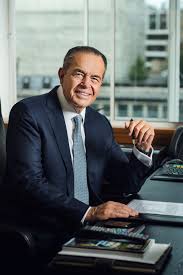
Hello and welcome to this week's episode of SBJ's On Stage. I'm your host Taylor Bloom. Today's episode comes from SBJ's Business of Soccer event in Atlanta, where Sir Mohamed Mansour, chairman of San Diego FC, Man Capital LLP, and the Mansour Group sat down with Coy Wire, sports anchor and correspondent for CNN, for a fireside chat on leadership, ownership, and the future of soccer. Recorded on March 26th, this conversation explores Sir Mohamed's global business journey, his investment philosophy, and why he sees enormous opportunity in the continued rise of soccer in the United States. From entrepreneurship and international growth to building culture inside a new MLS franchise, it's an insightful look at how global leaders are thinking about the future of sports. Let's go on stage.
Hello everyone. I'm so excited to share the story of this man who has one of the most incredible stories that reminds us that it's not what we're going through in life, it's how we go through it up here that determines how we'll come out on the other side. From being bedridden as a young boy for 3 years to beating cancer while in college, from Mo the waiter to Sir Mohamed. A pleasure to be with you, sir. Let's talk about your incredible first year in the MLS. We saw those fascinating highlights. What were some of your personal highlights? What was something that really stood out to you?
Well, I remember it was December 2024. We had the board of governors meeting with Don Garber. And on 12th of December I called our sports director. And I said, "You know, Tyler, how are we doing?" He said, "Well, we have seven players." I said, "What? In 10 weeks we're going to be playing our first game on the 23rd of February of 2025." So, you know, God behold. The first game to me meant everything. At night it was a sleepless night because I'm very passionate about football, soccer as we call it. And that night I was worried. Honestly, I just wanted, you know, a respectable loss because we were playing the MLS Cup winner, LA Galaxy. And when we walked in I said, "Maybe I hope, you know, 3-0, you know, 2-0, something respectable." God behold. Second, first goal, Earnest Traore, second goal, and we won the game. I had another sleepless night because I was so excited that evening, you know, we won it, we did it. And you know, that soccer is everything. The passion of the fans there that came from San Diego, even the passion of the fans from LA itself. But MLS is really, you know, the sport and sport is what makes people.
You invested in teams in Denmark, in Egypt. What made you want to not just have an MLS club, but build an expansion franchise from the ground up?
Well, I've always liked to build things. And I felt when the opportunity came and Don Garber had trust in us, you know, and we had a great partner with the Sycuan tribe local community in San Diego. It's a tribe in San Diego. They say they have a history of 12,000 years. I'm originally Egyptian. We have a history of 7,000. So, I said if you have 19,000 years of history, you can't lose. And you know, then we started in San Diego and I always believed in America. I always believed in American sportsmanship. And I knew that the day would come that the MLS has grown incredibly since Don Garber took over back in 1999. Has grown to be, you know, to date 30 and we were the 30th team. And you know, also we've had that experience because we've had other clubs, you know, in Denmark, we have in Egypt, and now we're coming to San Diego. And of course, using the knowledge of Right to Dream and the style of play of Right to Dream, which is aggressive, resilient, and very courageous.
Yeah, we're going to talk about Right to Dream in just a bit. But just in your first season, San Diego FC, immediate, passionate fan base. You won the Western Conference in the regular season, made it to the semis of the cup playoffs. So, now you're off to a roaring start in season two. How are you able to find, do you think, such quick success there at the club?
Well, because we followed the style of play. I mean, off the field, you know, on the field for example, we got the right team, you know, and Taylor Heaps, you know, as a sports director, you know, and Mikey Varas as the coach, and also the back team and Tom who's with us today, and everybody at San Diego. And we use the style of play of Right to Dream, which is, like I said, ball control, playing from the back, you know, and playing with resilience and courage. And that we knew has worked in other places and we knew it would work in San Diego. Off the field, the passion of the fans, to be honest, I've never seen it anywhere else. Even in Europe. You know, the passion of the fans of having a team and a successful team and how much they put into it is really gratifying and rewarding. And I'm so happy when I go there, you know, a lot of people hug me and say, "Mo, Mr. Mansour, we are so happy, you know, thank you for coming." I mean, this only happens in America. America is always the positive way of getting things done. A little different in Europe.
Now, you mentioned courage, you mentioned resilience. So, that's your life. How did you first fall in love with soccer?
Well, I came from a soccer family. My uncle, who was a mentor to me, played for Egypt back, he played for Glasgow in Scotland as a goalkeeper back in the 1930s when he was studying at the University of Glasgow. And then he played for Egypt in the World Cup. And then he was managing the biggest team in Egypt, which is called El Ahly. So, soccer and sports was in our blood. And I knew that that could be transformed into what we have. And as a result, I was at the age of 10, I went through a very difficult time in my life. I got hit by a car, run over by a car. In which I was deprived of everything I wanted, which is the passion of sport. Because I was a good football player. I was a good runner, swimmer, tennis player. And I was in bed for 3 years. That was 1958. Can you imagine? In Egypt. And when this accident happened, the doctor said we have to amputate the leg. And I would tell my dad and mom who would stay up with me late at night, you know, please, no, no, no, please. You know, I can't. And I lived through it and I stayed for 3 years in bed in Alexandria. And at the beginning, you know, as a child, the kids come and play with you and see you and then I was on my own. So, I read comic books, American comic books, Batman, Superman, and everything. And then I also read a lot and studied. And I would sleep sitting like this for 3 years. I couldn't even sleep on the side. But it made me a stronger person, a resilient person that says, you know, if you have the willpower, you can continue. And it took me maybe to be able to stand because the blood doesn't flow to your brain, it took me months after 3 years to be able to stand on crutches. And that happened and then I came to America and I lived the American way of life. But at the age of 20, I was struck with cancer. And this was back 1968, yeah. So, you can imagine that was the big season. It meant death. But still resilience and good doctors and good attention and here I am today at age of 78.
So, from a young boy age of 10, he had that drive to succeed and that's the name of Sir Mohammed's autobiography. We're just hearing a bit of his fascinating life. The Right to Dream, your innovative academy built in Ghana, Denmark, Egypt, now San Diego. Before we talk about it, I do believe we have a little video to roll to get a taste of Right to Dream.
We are more than a football academy. We're a global movement built upon the belief that everyone has the right to dream. We've been rewriting the rules of talent development for over 20 years. Guided by our core belief that excellence can be found anywhere, we have nurtured the dreams of young talent across West Africa, Egypt, and Scandinavia. And have redefined the meaning of football excellence. Right to Dream is the best academy in Africa, arguably the best academy in the world. Part of a globally recognized football model throughout Ghana, Denmark, and Egypt. We have a track record for developing top-tier talent. But our vision extends far beyond the pitch. We're champions of holistic development, focused on character, purpose, education, and football. Shaping more than just athletes, but leaders and change-makers. We are the future of football. And it's touching down in San Diego. A new era, a new beginning, a new age of football excellence.
Right to Dream, following in the footsteps of Ajax and Benfica, recently named the top soccer academy in the world at the Globe Soccer Awards. How about that? Incredible stuff. How are you able to make Right to Dream work both as a business, but also this pathway to create elite players?
Well, the story starts with my son Ludvig. We have worked in sub-Saharan Africa in mining. And one of the board members of Caterpillar, Dan Dickinson, who's now with us, he mentioned there was this academy in sub-Saharan Africa that was doing great work in education and football. So, when he wanted us to sponsor building them a pitch. So, we ended up building them seven pitches. And then my son called me and said, "Dad, you have to come and see this." And it really fit all the boxes for us because it provides opportunity. There's a lot of talent everywhere, but opportunity doesn't exist. And most of the families, most of the players that are professional players in Right to Dream today, their families have an average income of two dollars a day. So, and this academy gives a scholarship to youngsters at the age of 10 all the way to 16 in education as well as sports. And today fast forward, Right to Dream has 200 professional players that are playing professional football around the world. And we give scholarships for about 30 million dollars to kids to come and study in top universities like UCLA, Stanford, like where you went, Duke, and many others. And of course that is gratifying for me. And once I saw this, it fit the boxes and we said, "Let's do it."
Let's talk more about that concept for Right to Dream. You have this network across four academies, this ability to scout players around the world, but then also now become this player development pathway for San Diego FC specifically.
Correct. So, normally we scout 110,000 boys and girls every year. Of which we choose 100. So, you can imagine the level of these and the aptitude test and the technical tests and everything are so scientific and well done. So, the quality of the players that will be coming out of Right to Dream, I think will be leaders in that field in the coming years. So, when we came to San Diego, when we cut the ribbon with Don Garber and also Cody, you know, our partner and many of our other partners in Sycuan Hills in San Diego, we decided we're going to have a performance center and Right to Dream Academy. And then we started scouting kids around San Diego as well as Tijuana and Mexico area and our first class today is 18 kids and I'm telling you they are amazing, you know, this similar style of play that you will see at San Diego Football Club being played in Denmark, being played in Egypt, which is fast, courageous, and relentless football. So, it's really following the style of play of Right to Dream, knowing we've had a success story globally, and now this is going to be transformed in San Diego and hopefully over the coming years San Diego will grow as a community and we feel that San Diego is a soccer city. So, how the San Diego Football Club was accepted and promoted and encouraged by the fans has been incredible for us.
You talk a lot about you can't do this on your own. You have a great team around you even in your business, 60,000 employees around the world. When it comes to San Diego FC specifically and the ownership group there, you have a bit of a cast of characters. Some star-studded of a three-time All-Star third baseman Manny Machado, you have actor Issa Rae, musician Tems. How do you describe that dynamic as you all work together to support the club?
Diverse. Everybody adds to the club. I'm a listener more than a talker, so I learn from them and we try with this unity and partnership because success of any business, whether it be sports or any business, is the partnerships you have. And we couldn't have had better partnerships like with Cody Martinez and the Sycuan tribe and many others today that each treats San Diego Football Club as theirs and they give to the community and the community gives us back. So, I think it's a very solid partnership. It's a very solid working relationship and that's why we're going to be improving every year. And by the way, like I had in my story, you know, with my accident and everything, every difficult time teaches a person to improve and that's in soccer also. So, if we lose a game, we try to improve and see where we went wrong and how we can improve in the future.
You built a training center in your club there on the Sycuan reservation. What was maybe the main goal or some of your goals when you were looking to build this world-class facility and how now do you see it benefiting San Diego FC?
Well, for sure by Right to Dream, first of all, it's the only academy, I think it's one of the very few academies that provide scholarships to youngsters, education as well as sports. It's good you're going to be building future players and leaders that have character and value. And can you imagine these young kids at the age of 10 having lunch in the same performance center which cost us about 150 million dollars to build and I know Don Garber has seen that and he was very impressed with what he saw. I mean, because we're building for the future and there are going to be stumbling blocks. There are going to be challenges as we go. But for these youngsters to have, you know, their hero or their idol or their best player in the first team sitting and having lunch with them and talking to them and mentoring them, these are the players of the future, I think. And it's a diverse group of youngsters, the first class was 18 kids. We're getting another class that will be probably starting in the summer also. So, this is going to grow and that grows the pipeline. And I want to add, Coy, that you know, as a businessman when we went into Right to Dream at the beginning, it was just I did it as an NGO, a philanthropy, and I was putting a budget every year when we bought it in Ghana and Denmark, you know, of two or five million dollars that were going to support these young boys and girls to play. And then we found that these players have value. And this is a business conference that we have in sports. And the first year when we bought Right to Dream in 2023, we had a football club in Denmark. And then we sold a player called Mohammed Kudus. And then 9 million. Wow. And then another player Sulemana 20 million, another wow. And then it grew last year the income from player sales has been 55 million euros. And this is how and we're going to keep this money to reinvest in other academies and growing. And now I'm starting something in San Diego because I love San Diego and we're going to be building 100 pitches for the grassroots, for the underserved kids in San Diego for them to be able to play. Also train 100 coaches over the coming years and this will be from my budget every year to train 100 coaches so that soccer is ingrained more and more in the community of San Diego.
I love that. I mean, you're taking your own story, your trials and tribulations, and saying, you know what, what I have is not for me to possess, it's to pass on. You're allowing these other kids to dream. And you mentioned Right to Dream boys and girls. You've had success across the globe with women's soccer. What are your thoughts on the current state of the women's game and where do you see it headed?
I think it's going to grow for sure. I mean, women's soccer is going to grow all over the world. With FCN in Denmark had the first in sub-Saharan Africa, for example in Ghana we had the first academy for boys and girls. And then also in Denmark we have an academy for boys and girls. In Egypt we have an academy for boys and girls. And then in Denmark it's won the cup and the league consecutively for women. In Egypt in our first two years that we started our football club there we've won the cup and the league and we won the bronze for the Champions League in Africa. And soon I hope, you know, I know women's soccer has grown incredibly in the United States and it can only grow further. Women's sports generally whether it be soccer or other fields, basketball, you know, volleyball or whatever.
So you went from Mo the waiter in college and eating some of your fraternity brothers' eggs because one of them had a farm, right? This all that you didn't have money for food. And then you become a billionaire. That's a wow as you would say. What lessons have you learned through your business success that now help you as the owner of your soccer clubs?
Well, resilience. Never give up. Mo the waiter. You know, I went through a difficult time because I came from a well-to-do family. You know, my grandfather worked for the king of Egypt. And you know, then there was a revolution in Egypt and an army guy called Nasser came over. He didn't like wealthy people. So, he confiscated all our wealth. So, when I was in America, when I went young, you know, I was getting an income of 200 dollars a month. And then all of a sudden I get a letter from my father. He says, you know, the government has confiscated all our factories, all our money. I cannot send you any money. And I was in a fraternity then. And I said I was 16 or 17 years old in university. And in the corridor I heard the president saying, "Mo, that's me, owes 454 dollars." And it's true. I owed the fraternity because I was a resident of that fraternity. And you know, I felt I said, you know, I'm... So, in the next meeting, I've always been a proud man or a proud person. So, I picked up my hand and I said, they said, "Any new business?" I said, "Yes, I..." and I cried. I was so... I said, you know, my situation back in my home country, you know, I came from a well-to-do family and then all of a sudden my father's under house arrest. I have no money. I'm getting no money, but I'm going to work and pay back what I owe. And I resigned. And fast forward, I resigned. Three fraternity brothers came and lived with me. We lived in a dump, you know, a very bad place. We couldn't afford. And every day I was living on tips, you know, 20 cents, 30 cents in a restaurant that belonged to a guy called Amadeo. He was a linebacker for NC State. And you know, then fast forward when I was taking my sons there to look at universities, I walked into that restaurant where I worked. And I got promoted to be the main waiter. And then when I went in with my son and sat in the booth, a waiter like myself in college came and said, "Can I help you?" I said, "Is Dick here?" So he went and got Dick who used to be a very big guy. And I, you know, intimidating looking. And when he walked over, he had gray hair, you know, was older. I said, "Dick, I worked for you 30 years ago. Mo. I'm Mo." Oh, he said, "Mo." He hugged me. I'm Mo. And he walked to every kid sitting in the booth, "You know that guy? He worked for me. Everything he learned, he became a rich man, he learned from here." And it's true. It's true. I learned the value of money during that period. And Mo, the waiter, learned the value of money, hard work. 2022, I was asked to give the commencement speech for NC State. 22,000 students were there. Wow. And I got up and said, "Mo, everybody has a chance. Everybody has a chance in life. Mo, the waiter, is today Mo, the call it billionaire, millionaire, whatever. But it's Mo, the human being." And it was very touching to me. The university gave me an honorary doctorate degree. And I was so honored and so humbled.
Sir Mohamed, in just your second season as a club owner, what's that dynamic like working with Commissioner Garber and the league offices?
Well, from the first day I saw Don in New York, we went and visited him with our partners and he believed in us. And that means a lot to me. He's a friend. He's somebody that has built a huge, you know, done a lot of great work for the MLS. When he took over, I think it was maybe 10 teams or whatever. Now it's 30. It's grown. It's grown under his leadership, under his guidance, of course with his team and everything. And it's something that should make every American proud and I think we should give Don a big hand for the great work he's done, really.
Constantly tweaking, making changes to make the league better, to make it grow. We have a big one coming up in 2027 where we'll have that summer to spring schedule. What are your thoughts on that?